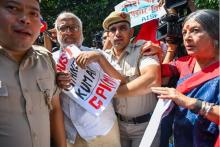
ON May 15, 2026, all of rural India echoed with the voices of agricultural and rural workers demanding reinstatement of MGNREGA and roll back of VB-GRAM (G). Tens of lakhs of workers participated in the strike called by the joint platform of agricultural and rural workers’ unions and the NREGA Sangharsh Morcha. In thousands of villages, MGNREGA workers along with many agricultural and rural workers gathered together outside gram panchayats protesting and demonstrating and submitting a memorandum of their demands to the Panchayat Presidents.
THE scenes unfolding in Beijing were carefully choreographed, yet politics can never be reduced to mere spectacle. When US President Donald Trump travelled to China for his summit meeting with Xi Jinping, Western media, as it often does, fixated on spectacle: lavish banquets, honour guards, theatrical gestures that were designed to flatter the US president. Yet beneath all this ritual lay another reality, harder and more consequential. The United States did not arrive in Beijing from a position of confidence; it came in a state of vulnerability.
GEOPOLITICAL conflicts affect the lives of people who hardly have any role in initiating the conflict. The ruling class of conflicting nations engage in wars and the burden of the disruptions caused in the process is asymmetrically imposed upon common people. The national leaders of Israel and the US decided to attack Iran out of desperation as both could sense a decline of their control over the Middle East. According to official statements it was to salvage the Iranian people from the tyranny of Islamic rule. They didn’t succeed.
The Polit Bureau of the Communist Party of India (Marxist) has issued the following statement on May 16, 2026.
THE Polit Bureau of the Communist Party of India (Marxist) expresses its grave concern over the Madhya Pradesh High Court judgment in the Bhojshala-Kamal Maula Mosque dispute and its wider implications for the secular and democratic foundations of the Indian republic.
The Polit Bureau of the Communist Party of India (Marxist) has issued the following statement on May 15, 2026.
THE Polit Bureau of the CPI(M) strongly condemns the Union government’s decision to hike the prices of petrol, diesel and CNG. The hike of ₹3 per litre in petrol and diesel and ₹2 per kg in CNG will impose more burdens on the working people already reeling under inflation, unemployment, stagnant wages and deepening economic distress.
THE rupee’s exchange rate has now crossed ninety-six to a dollar; and there is still no sign of its downward slide coming to a halt. There is talk of its crossing a hundred in the coming days; it is the worst performing currency in Asia at this moment and among the worst in the entire world.
For over 22 lakh students who appeared for the National Entrance-cum-Eligibility Test - Under Graduate (NEET-UG) on May 3, 2026, across India, the decision by the National Testing Agency (NTA) to cancel the examination came as a traumatic turn. Through years and months of preparation, depriving themselves of entertainment, social life and relationships, the aspirants readily dedicated themselves to fulfilling their dream of becoming doctors.
CPI(M) Polit Bureau member Pinarayi Vijayan has been elected as the leader of the CPI(M) legislature party in Kerala. The decision was made unanimously during the CPI(M) State Committee meeting held over two days in Thiruvananthapuram. The meeting was chaired by Central Committee member K Radhakrishnan. State Secretary M V Govindan announced in a press release that General Secretary M A Baby, and Polit Bureau members Pinarayi Vijayan and A Vijayaraghavan attended the session.
After prolonged infighting and uncertainty that mocked the public mandate, the Congress finally picked V D Satheesan as its leader in the Kerala Assembly. He took oath as the chief minister on May 18, two weeks after the Assembly election results were announced. Leveraging intense pressure from allies including the Muslim League and support from senior leaders, Satheesan secured the chief minister’s chair by outmaneuvering K C Venugopal and Ramesh Chennithala.
THE Union Ministry of Road Transport and Highways announced in end-April new rules governing the use of significantly higher proportions of Ethanol in petrol blends for automobiles than the presently mandated 20 per cent ethanol blended petrol (EBP 20 or E20). This paves the way for introduction of blends such as E28 or E85 as well as E100 or pure ethanol.