The year-long celebration of 90 years of the glorious history of the All India Kisan Sabha (AIKS) started on April 11, 2026 at New Delhi by hoisting the Kisan Sabha Flag. AIKS President Dr Ashok Dhawale unfurled the flag at the AIKS Central Office in an enthusiastic function attended by leaders and activists of different class and mass organisations and the democratic movement. Thousands of village units of the Kisan Sabha across the country commemorated the day by hoisting the AIKS flag.
The Rajya Sabha election to send 5 members from Bihar went in favour of the NDA with Chief Minister Nitish Kumar leading the tally. Despite the support of the five member AIMIM legislative group and one from the BSP, the Mahagathbandhan failed to keep its flock together and three out of six legislators of the Congress party and one of the RJD did not participate in voting, remaining incommunicado till the time the vote ended, thus paving the way for the fifth candidate of the NDA to win.
Many thoughtful people believe that the dominance of a small English-speaking elite in the social and intellectual life of India that has continued long after decolonization has been an important factor in arousing the hostility of a segment of the vernacular proto-elite that has felt excluded and hence has gravitated towards the Bharatiya Janata Party; that the BJP in other words represents inter alia a revolt against the dominance of a small English-speaking elite in the affairs of the country.
A report in the New York Times on April 7, 2026, has revealed in vivid detail how US President Trump and his top advisers were convinced by Israeli Prime Minister Netanyahu to start the current war against Iran. The report, by Jonathan Swan and Maggie Haberman, both Whitehouse reporters is drawn from a book written by the duo “Regime Change: Inside the Imperial Presidency of Donald Trump.” It is based on interviews with top officials who remain anonymous.
On April 12, 2026, theatre practitioners, students and cultural activists across Delhi gathered to mark the 38th National Street Theatre Day, commemorating the legacy of Safdar Hashmi, activist, writer, poet and a pioneer of street theatre in India. Instituted in 1989 during the first Safdar Samaroh, the day has evolved into a powerful assertion of the role of culture in democratic life and public resistance.
[This is Part I of a two-part series. Part II will be published in the next issue]
A couple of years ago, on Vijaya Dashami, the Sarsanghchalak (Chief) of the Rashtriya Swayamsevak Sangh (RSS), Mohan Bhagwat, mentioned a new phrase at the organisation's Headquarters in Nagpur — ‘Cultural Marxist’.
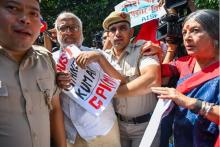
The Centre of Indian Trade Unions (CITU) has unequivocally condemned the brutal repression unleashed by the BJP-led governments of Uttar Pradesh and Haryana on the militant and spontaneous struggles of workers across Noida, Greater Noida, Gurugram, and the entire National Capital Region (NCR). This is not merely an industrial dispute - it is a valiant expression of direct class confrontation, where the state machinery is openly acting to defend corporate interests by suppressing workers’ rights.
Kerala has delivered a verdict that seems to ensure the LDF will secure a historic third consecutive term in power. Despite having the shortest campaign period in recent history, the political heat surpassed even the mid-summer blaze. This is evident from various surveys, assessments, and the reactions of those who visited the polling stations. Drawing from the experience of ten years of growth and development after moving past "darker times," the people asked a simple question: "Why should this government change?"
ON April 7, the US president opened his social media app and typed this about Iran and its 90 million people: "A whole civilisation will die tonight, never to be brought back again. I don't want that to happen, but it probably will." A genocide threat, in plain English. Could that happen without human language? No. The language conveys an inhuman threat. Language is not the true problem in this situation. The language arises from the arrogance of power and the greed for oil. These dress up mass death in a casual social media post. Iran's own language was mature, subtle, and alive.