Technological development and innovation have been the driving force of human civilisation. With change in technologies, the production process, labour process and measurement of human contribution to social product undergoes change. The current phase of digital technology with AI as the emerging general-purpose technology is also going to radically alter the production process.
AT the present stage of the attack on CPSUs, we must clearly understand the economic, political and ideological dimensions behind the public sector policy of the present NDA Government at the centre.
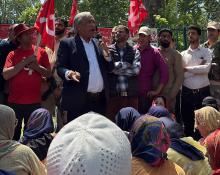
On May Day, the world’s working classes once again stepped into the streets, not merely to commemorate their past struggles and wallow in nostalgia, but to confront the deepening contradictions of the present. From Santiago to Istanbul, from Paris to Manila, the red banners rose against a horizon darkened by war, inflation, and the tightening grip of capital over life. May Day did not unfold as ritual but erupted as necessity.
A convention of flood affected farmers organised by the AIKS state committee at Hisar on April 28 resolved to fight for permanent solutions to the repeatedly occuring floods in various parts of Haryana and other neighbouring states.
The Polit Bureau of the Communist Party of India (Marxist) has issued the following statement on May 4, 2025
The two major features of the assembly election results are the serious setback to the Left Democratic Front (LDF) in Keralam and the victory of the BJP in West Bengal. The DMK-led alliance also suffered a setback in Tamil Nadu, where the TVK led by Vijay emerged as a major force.
Initial Statement issued by the Assam State Committee of the CPI(M)
The BJP-led alliance has returned to power in Assam for a third consecutive term with an overwhelming majority of seats. The fact that the alliance secured nearly 48 per cent of the total votes (BJP alone secured 37.8 percent of votes, contesting in 90 seats out of a total of 126 seats) despite widespread public dissatisfaction with the BJP government has surprised many observers.
The huge travesty that is the Greater Nicobar Project is back in the news cycle because of the visit there by Leader of the Opposition Rahul Gandhi who assailed the Project terming it a scam and a ‘crime against natural and tribal heritage.’ The Union government of course
INTERNATIONAL Labour Day, popularly known as May Day, is observed across the world on May 1. It serves as a powerful reminder of the struggles and sacrifices of the working class, particularly the workers of Chicago who laid down their lives in 1886 while fighting for their rights and a dignified future. In Jammu and Kashmir, this legacy of resistance finds a poignant reflection in the history of the shawl weavers.
In the forested plateau of Santhal Pargana in Jharkhand, a vast and violent transformation is underway. Beneath the hills and agricultural lands of this region lie some of eastern India’s most valuable coal reserves. Over the past two decades, mining of these reserves has begun through the development of three adjacent blocks in the Pachwara coal belt, located in the Rajmahal coalfield and spread across the Pakur–Dumka region. These blocks are called Pachwara North, Pachwara Central, and Pachwara South. But this is not just a story of industrial progress.