Peoples Democracy newsletter

Peoples Democracy newsletter categories.

The Week in Parliament

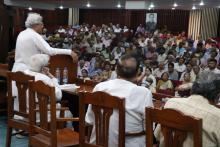
IN the Rajya Sabha, John Brittas spoke on the Appropriation No.4 and No.5 Bills. He said, “I am very glad that we are debating two bills, and not certain divisive issues like temples or mosques or even a movie or a movie star's costume. I am glad that we are deciding and discussing pertinent matters which are of concern to the people of this country. I am glad that the Supreme Court after an inordinate delay of six years has taken up pleas on demonetisation to adjudicate. And the government is now scurrying for cover and has taken the alibi that this is only a matter of academic interest.

The New Cold War Deepens in Africa Using Jihadism and Terrorism as the Excuse

IN late November, Boko Haram insurgents attacked a post at the Chad-Nigerian border, killing ten soldiers of Chad’s military. This attack is part of a broader jihadi push in the Lake Chad Basin, which comprises Cameroon, Chad, Niger, and Nigeria. Founded in 2002, Boko Haram (‘Western civilisation is forbidden’) fought the Nigerian military for control over the country’s north so that its preachers could establish a dar al-Islam in the region.

Tripura: anashiksha Divas Observed With Great Enthusiasm

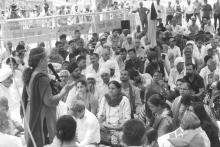
ON December 27, 2022, the 78th Janashiksha Divas was observed throughout the state with great enthusiasm under the leadership of Tripura Rajya Upajati Gana Mukti Parishad (GMP, in short) and the CPI(M). Large number of tribal and non-tribal people participated in the observance programme at various places across the state. During this programme, Party flag was hoisted along with hoisting the GMP flag, followed by paying homage to the great leaders, who spearheaded the ‘people’s literacy movement’ in the state, in the 40s and 50s.

Polit Bureau Communiqué

The Polit Bureau of the Communist Party of India (Marxist) met in New Delhi on December 27-28. It has issued the following statement on December 28.ECONOMY: The Polit Bureau expressed its concern at the deepening recessionary conditions in the Indian economy. Notwithstanding all propaganda and claims made by the government of economic recovery, investments in augmenting India’s productive capacities are not growing.Industrial output contracted by a sharp 4 per cent in October, the second time in 3 months.

Chhattisgarh: Coal Loot: This is the Crony Capitalism

COAL mining in Chhattisgarh is a living example of how corporates are looting natural resources and flourishing under crony capitalism. Parsa Kete Mines are located in Hasdeo Aranya area on the border of Surguja-Korba district, which has been allotted to the government of Rajasthan through Rajasthan State Power Generation Corporation Limited. The Rajasthan government has handed over the coal mining work to Adani through an MDO.

Emerging Conflicts in Capital’s Control on Labour

CONTROL on the labour process has been the key to capital relations. It is important because the origin and reproduction of capital relations depends on the alienation of labour from the process of production. One of the important means to exercise control by capital over labour is to separate the mental and physical labour through a hierarchical structure. It is meant for a division of labour which is curated to distinguish people who would be thinking and those who would be mindlessly executing instructions given by planners within the factory.

Imperialism and the Agrarian Crisis

THE hegemony of imperialism is invariably associated with an agrarian crisis in countries of the global south; in fact agrarian crisis is just the other side of the ascendancy of imperialism. This is evident from the case of Indian agriculture. The colonial period saw a more or less perpetual agrarian crisis, whose starkest manifestation was in the form of recurring famines. Colonial rule in India began with the East India Company acquiring the revenue-collecting rights over Bengal from the Mughal Emperor Shah Alam in 1765.

AP: M Basavapunnaiah Memorial Lecture

ON the occasion of the 108th birth anniversary of Marxist theoretician and Party leader, Makineni Basavapunnaiah, the Makineni Basavapunnaiah Vignana Kendram organised a memorial lecture on the theme, “Central Government’s Attacks on State’s Rights”. MB Rajesh, minister for local self government and excise, government of Kerala, delivered the lecture on December 26.Speaking on the occasion, Rajesh said Makineni Basavapunnaiah, popularly called as MB, played a very important role in the formation of the Communist movement in India.

Pages

Subscribe to RSS - Peoples Democracy newsletter