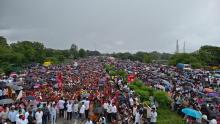
The struggle of Haryana’s rural sanitation workers in May 2026 stands out as one of the most significant working-class movements in the state in recent years. Around 10,500 rural sanitation workers have been employed across Haryana since 2007, with one worker serving approximately every thousand residents in rural areas. Most of these workers belong to the Valmiki community, and more than 20 per cent are women. Their labor ensures basic sanitation services in hundreds of villages across the state.
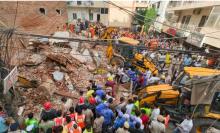
RECENTLY, large-scale demolitions of residential settlements have been underway in cities like Faridabad and Gurgaon in Haryana, bordering the national capital, Delhi. These actions are being carried out through the Municipal Corporation administration and the Country Town Planning Department, under the leadership of the ruling BJP party. The colonies, inhabited for 60-70 years, are being demolished, leaving lakhs of people homeless and pushing them into poverty.
The following statement has been issued by AIKS on June 24, 2026:
The All India Kisan Sabha (AIKS) extends its support to the nationwide protest actions being organised on 1 July 2026 by the Joint Platform of Rural Workers’ Organisations against the proposed replacement of MGNREGA by the VB-GRAMG Scheme and in defence of the Right to Work for rural households.
ECONOMICS and finance tend to manifest in the political process. However, what we are witnessing right now is an extraordinary level of convergence in the contemporary landscape. A deeper exploration reveals that this is more than a mere coincidence.
WHEN industrial capitalism was developing in Britain in the late eighteenth and early nineteenth century, the new machine-made goods had displaced many artisan producers, giving rise to the Luddite movement against the introduction of machines. With increased unemployment, there was an increase in the relative magnitude of poverty, as Eric Hobsbawm had argued in a debate with another historian R.M. Hartwell. But then things improved later on in the course of the nineteenth century.
IN recent years, a concerted political effort has been made to establish June 20 as ‘West Bengal Day’ and to project Syama Prasad Mookerjee as the founder of West Bengal. Political appropriation of history is not new, but any historical event must be understood in its full context. Therefore, examining the validity of the narrative surrounding June 20 is essential.
THERE is a myth that ostriches bury their heads in the sand when threatened. The United States is like the mythical ostrich in its response to the current Ebola outbreak. The hantavirus outbreak aboard a cruise ship was like a dress rehearsal. It showed the consequences of dismantling global pandemic preparedness. That rehearsal is over. The far more dangerous Ebola act has begun, and the curtain has risen in Central Africa.
Let us look into the prices of crude oil in the international market, the prices borne by consumers in India, the policies behind them, the claims made by the rulers who formulated these policies, and what is actually happening in practice. Prior to 2002, a system called the Administrative Price Control Mechanism was established and functioning in India. It operated under the control of the Ministry of Petroleum. Its main objective was to regulate crude oil prices so that the burdens of fluctuations in the international market were not passed on to the people.
As night deepens, the city falls silent. Yet, in that very silence, there are nights when the roar of bulldozers plunges history into a darkness deeper than the night itself.
The Polit Bureau of the Communist Party of India (Marxist) has issued the following statement on June 12, 2026
The Communist Party of India (Marxist) welcomes the Delhi High Court judgement quashing the FIR registered by the Economic Offences Wing of the Delhi Police and the subsequent Enforcement Directorate case against Newsclick and its Editor-in-Chief, Prabir Purkayastha. The verdict is a stern warning against the misuse of government agencies for political vendetta.