P Krishnaprasad
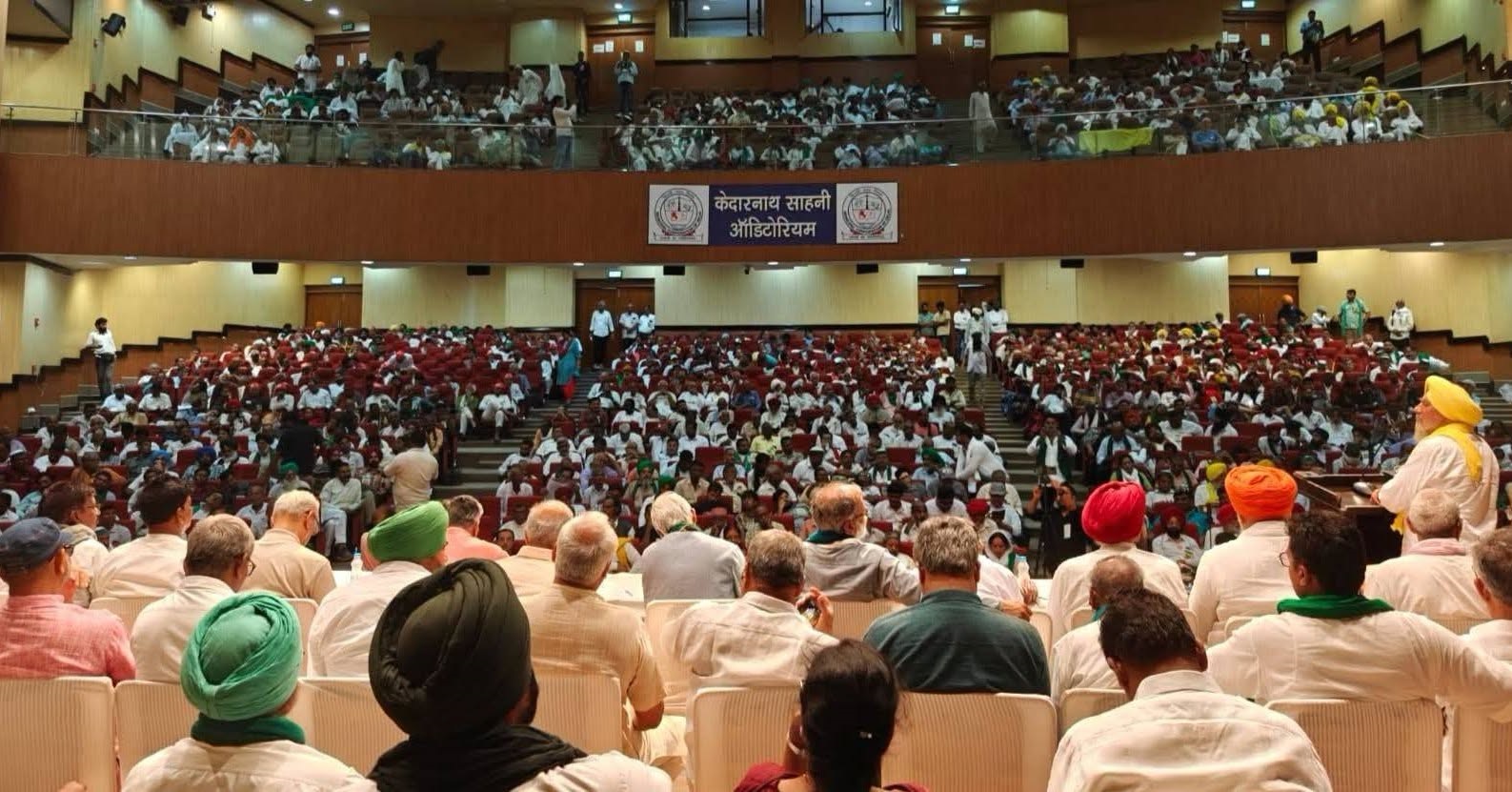
The All-India Convention of the Samyukta Kisan Morcha (SKM) – the largest umbrella platform of kisan organisations representing all the states and union territories of India—was successfully held on July 28, 2026, in New Delhi. Over 1200 delegates from states across the country attended and adopted a Declaration, which called for a decisive mass struggle based on worker-peasant unity against the chronic agrarian crisis of more than three decades.
ACTION CALLS AND PROCEEDINGS
For the immediate future, the convention resolved to mobilise in strength for the nationwide mass actions on August 10, 2026, to mark the anniversary of Quit India Day. The Convention also decided to launch massive struggles in New Delhi and 100 other spots across India starting from November 26, 2026, on seven principal demands. The details of the struggle will be declared in due course. The historic convention gave a clarion call to rally the people against the BJP-RSS-led corporate-communal class rule.
An 11-member presidium comprising Ashok Dhawale (AIKS), Yudhvir Singh (BKU Tikait), Umesh Singh (AIKM), Satyawan (AIKKMS), Rajan Kshirsagar (AIKS Ajay Bhawan), Satnam Singh Ajnala (JKS), Rangaiah (AIUKS), Arjun Prasad (KKU), Sunilam (KSS), Ashok Baitha (AIKMKS) and Ramesh Mahapatra (SKS) conducted the proceedings.
P Krishnaprasad presented the draft declaration. Leaders of the SKM member organisations—Vijoo Krishnan, Rakesh Tikait, Joginder Singh Ugrahan, R Venkaiah, Purushottam Sharma, Shankar Ghosh, Raminder Singh Patiala, Manjit Singh Dhaner, Gurmit Singh Mehma, Satnam Singh Ajnala, Jangbir Singh Chauhan, Suresh Kauth, Balwinder Singh Aulakh, and Harvinder Nabha—addressed the delegates. Ashok Dhawale made the concluding remarks. CJP leaders Ashutosh Ranka and Deepak Baliyan were felicitated in the convention.
VICTORIOUS STRUGGLE, NEW CHALLENGES
The SKM was formed in the context of the historic farmers' struggle at the Delhi borders which began on November 26, 2020, and witnessed 380 days of a massive Mahapadav - day and night peaceful sit-in at several Delhi borders blocking national highways - and the loss of 736 martyrs. The main demands included immediate repeal of the three pro-corporate, anti-farmer and anti-people Farm Laws, legally guaranteed MSP@C2+50% with procurement for all crops, comprehensive loan waiver, and a halt to the privatisation of electricity. It was the largest mass struggle since independence and achieved the repeal of the three Farm Laws on November 19, 2021. The struggle was suspended on December 11, 2021, after a written assurance on the other demands from the Union Government dated December 9, 2021. However, none of these assurances were implemented during the last five years.
On the contrary, the Modi regime has imposed many anti-farmer, anti-worker policies in the last five years. These include the most regressive anti-worker four Labour Codes, repeal of the MGNREGA of 2005 and replacing it with the bogus Gram-G Act, accelerated privatisation of power through the Electricity Amendment Bill and smart meters, and the new Seed Bill. The latest onslaught is the duopoly of Adani and Leap India in the FCI silos, where 77.5 per cent of the grains will be controlled by them, along with the curtailment of free grains through amendments to the National Food Security Act (NFSA). Although not a single rupee of the farmers debt was waived in the 12 years of the Modi regime, corporate loans worth over Rs 16 lakh crores have been written off!
On top of all this, the Prime Minister is succumbing to US imperialist pressure to sign the India-US Free Trade Deal and other FTAs with the UK, EU, New Zealand etc. This is a grave assault not only on millions of peasants and workers, but also on lakhs of Micro, Small and Medium Enterprises (MSMEs). The FTAs are the blueprint for the economic re-colonisation of India. As far as agriculture is concerned, FTAs are going to import cheap agricultural products, erode agricultural viability, capture food processing markets, and change cropping patterns to damage food self-reliance.
CONSISTENT EFFORTS TO RESIST PRO-CORPORATE POLICIES
On January 16, 2026, at the call of the SKM, farmers across the country took a pledge in villages to unleash consistent mass struggles until all the demands assured in writing on December 9, 2021, were achieved. The successful General Strike on February 12, 2026, called by the Platform of Central Trade Unions (CTU) and supported by the SKM was a major joint effort by workers and peasants to resist these policy onslaughts. On March 9, 2026, a Worker-Farmer Parliament was conducted at Jantar Mantar in Delhi. April 1, 2026, was observed as a nationwide "Black Day" to protest the official implementation of the four Labour Codes by the Union Government.
The recent period witnessed massive protests largely by contract workers and unorganised sector workers, especially in different industrial regions of North India. These workers are basically landless and poor peasants displaced from their villages. These upsurges, mostly spontaneous, created great enthusiasm among workers across the country. The great victory of the students’ struggle in June-July 2026 against high-level corruption and paper leaks, which forced the Modi regime to accept the demand for the resignation of Education Minister Dharmendra Pradhan, is another milestone achievement in trying to restore the democratic rights of the people over the crass authoritarianism exhibited under Narendra Modi and Amit Shah.
The SKM All India Convention was convened in the context of all the above developments. It adopted seven principal demands, some supplementary demands, decided to add local demands, and it also formulated a six-point plan of future action.
SEVEN PRINCIPAL DEMANDS
1. No India-US Free Trade Agreements. Repeal all Free Trade Agreements.
2. Enact Law for MSP@C2+50% with guaranteed procurement for all crops.
3. Comprehensive loan waiver to end rural indebtedness and peasant and daily worker suicides. Provide Rs 25 lakh compensation to each peasant suicide family.
4. Scrapping of four Labour Codes and minimum wage of Rs 42,000 to all workers.
5. Restoration of MGNREGA, ensure 200 days of work and Rs 700 as wage.
6. Withdraw Electricity Bill 2025, Seed Bill 2025, and NFSA Amendment Bill.
7. No Forceful Land Acquisition, no pro Corporate Land Pooling, Protect Land rights based on LARR Act 2013, FRA 2006 of tribals and non-tribal forest dwellers and PESA 1996 on self-governance and tribal self-rule.
PLAN OF SIX-POINT FUTURE ACTIONS
1. SKM member organisations to hold State Conventions in the next two months to prepare for a long haul of Independent as well as coordinated struggles.
2. Observe August 10, as Massive Protest Day in memory of the 84th anniversary of the Quit India Day, with various forms of actions such as Jail Bharo, Rail Roko, Road Roko, at 1000 spots across the country. This action is called by SKM against anti-national FTAs and on other demands. Several organizations and platforms have decided to support and coordinate with SKM.
3. August 17, 2026: SKM Delegations to submit the Charter of Demands to the PM, L-OP, CMs, L-OPs of Assemblies, MPs and MLAs, demanding favourable action on the principal demands.
4. Commence independent and coordinated campaigns such as Mass Padayatras, Vehicle Jathas, Tractor Marches culminating in Public Meetings, Mahapanchayats and State Rallies by all the member organisations.
5. SKM Village Mahapanchayats on October 3, Lakhimpur Kheri Martyrs Day to be observed across India.
6. Kisan March and multiple day mass action starting November 26, 2026, at 100 spots including the National Capital. The details of the mass actions will be declared later.


