FOLLOWING the vigorous and victorious July student struggle at Jantar Mantar in Delhi, the movement by Adivasi students in Maharashtra in August 2026 once again brought issues of education and employment, especially of the socially oppressed, to the forefront. Given the intensity of the 17-day long agitation, the state government was forced to bow down.
The crisis faced by left-wing movements in India during the neoliberal era has already been reflected at several levels. Communal forces were able to divert the difficulties people faced under this economic framework into a politics of anger against others and reap rich dividends in this regard. The collapse experienced in West Bengal and Tripura after long periods of continuous rule also happened under such circumstances. Continuing this trend, the CPI(M) suffered a major setback in the recent assembly elections in Kerala.
MODI’s narrative about him administering homeopathic medicine is largely a self-inflicted assault. Far from being a successful strategy it is proving to be a self-goal – a case of unmitigated frustration. To brand all those who have views contrary to the regime and Hindutva as “dimagi naxals” leads to only one inescapable conclusion: that all those who support Modi and his ideas are “gair-dimagi andh bhakts”.
THE passage of the West Bengal Universities and Colleges (Administration and Regulation) (Amendment) Bill, 2026, in the state Assembly on September 10, marks a critical turning point in the governance of higher education in West Bengal.
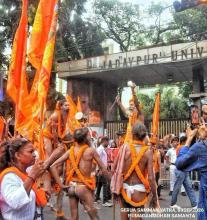
The ‘Gerua Samman Yatra’ from Golpark to Jadavpur’s 8B bus stand on September 9, brought the politics of communal mobilisation directly to the perimeter of Jadavpur University. Led by Chief Minister Suvendu Adhikari, the procession featured large contingents of BJP cadres, saffron-clad sadhus and Naga sanyasis. While nominally organised under the banner of defending the “dignity” of saffron, the rally marched with saffron banners, provocative posturing and slogans of ‘Jai Shri Ram’.
VERY recently the eloquent reticence of the Chief Election Commissioner of India, Gyanesh Kumar, has given way to an extremely brief observation. He has opined that notwithstanding the ‘little inconvenience’ of some citizens, the Special Intensive Revision (SIR) carried out across the country was necessary to clean up the Electoral Rolls for conducting a ‘fair election’. This could be regarded as the greatest understatement of the century.
All India Democratic Women's Association (AIDWA) National General Secretary Kaninika Ghosh called upon women to organise struggles to protect their rights and freedoms, stressing that the fight for women's rights must transcend caste and religious divisions.
UTTAR PRADESH is once again in the headlines and has become a serious subject of debate among politicians, intellectuals, journalists and YouTubers. The discussion, however, is not about development, the runaway rise in prices, the growing number of unemployed people, the rising crime rate, increasing violence against women, or the need to control crimes against Dalits because none of this seems to be happening. On the contrary, something or the other happens here every day that leaves people distressed and alarmed.