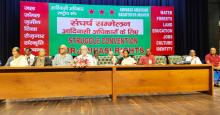
Around 600 participants from 23 states gathered in Delhi on 11–12 December for the National Convention on Health Rights, organised by Jan Swasthya Abhiyan (JSA). The convention commemorated 25 years of JSA’s sustained engagement with health policy, public health systems, and the defence of people’s health rights. JSA is a national platform comprising 22 networks and several hundred organisations and groups working across India.
THE sensational developments over the last week brought the question of crimes against women to the forefront with a dramatic effect. The exceptional case of the Unnao rape victim, a mere 15-year-old who was lured by Kuldeep Singh Sengar, the local MLA of Unnao, has burst into public discourse. The air was thick with disbelief over the Delhi High Court's decision to suspend the life sentence of the convicted Sengar in the 2017 rape case and grant him bail. Naturally, this obnoxious development set off waves of outrage nationally.
The Supreme Court (SC) has put in abeyance its own decision on the Aravalli range of November 20, 2025, in the wake of widespread anger expressed by farmers, women, rural labourers, tribals, environmentalist groups and other concerned citizens. Fire of contention in this case arose from the Supreme Court’s acceptance of a new definition submitted by the Ministry of Forest and Environment according to which, hills less than 100 metres from the relief will not qualify to be hills and thereby lose protection from the mining.
Amid continued Opposition protests over the passage of the VB-G RAM G Bill to replace the Mahatma Gandhi National Rural Employment Guarantee Act (MGNREGA), both Houses of Parliament were adjourned sine die. The Winter Session of Parliament concluded on Friday after 19 days. Taking part in the debate on the VB-G RAM G Bill in the Rajya Sabha, Bikash Ranjan Bhattacharyya described the Bill as unconstitutional. While speaking on the Bill, it reminds me of a poem by Sukumar Ray.
THE Government of India's Ministry of Agriculture and Farmers Welfare's aggressive attempt to reform a sector essential to India's food sovereignty is the Draft Seeds Bill 2025, made available on November 12 for public comment until December 11. The Godi Media has framed the draft bill as a necessary modernisation. The seed industry, represented by bodies like the Federation of Seed Industry of India, has lavished praise, calling it a timely step toward facilitating business and investment.
Extreme inequality in terms of income, wealth, gender and regions has become the hallmark of neoliberalism. Fewer than 60,000 multi-millionaires who are the top 0.001 per cent wealthiest of the world possess three times the wealth of half of humanity. Their share has grown over the years. The top 10 per cent of the world earn more than what the bottom 90 percent of the population earns and the poorest 50 per cent earns only 10 per cent of global income.
CPI(M) Polit Bureau has issued the following statement on December 20, 2025.
THE Polit Bureau of the Communist Party of India (Marxist) expresses its deep concern over the recent developments in Bangladesh. It urges the interim government of Bangladesh to act immediately against attacks on media outlets and minorities, and to protect the rights of the people. The two most revered cultural institutions Chhayanot and Udichi have come under dastardly attack.
"MODI Government, while talking of Vikasit Bharat, is blocking all opportunities for the growth of people. As part of its assault on people’s rights, REGA act has been changed with many amendments. MNREGA name has been changed to VB G RAM G. But this is not just a change in name, but in content also. The changes made have not been to better it. But MNREGA, which was helping rural workers to an extent, has been effectively buried" declared U Vasuki, CPI(M) Politburo member while speaking at a well-attended rally at Bangalore.
The magnificent victory of the 16-month long mass movement against forcibly setting up of an ethanol factory has found a proud place among some of the few successful agitations that took on the ‘double engine’ corporate-communal government head on.