Jan Akrosh Jatha Mobilizes Apple Farmers Across Jammu and Kashmir
The Communist Party of India (Marxist) Jammu and Kashmir conducted its ‘Jan Akrosh Jatha’ from March 9 to March 24, 2026, simultaneously launching the campaign across the Kashmir and Jammu divisions to mobilize public opinion against what it termed the “anti-people” policies of the Central government. The campaign culminated in a major rally in New Delhi on March 24.
The Jatha was launched on March 9 by Mohd. Abass Rather, State Secretary, CPI(M) J&K, in Kulgam (Kashmir), while Hari Singh, Regional Secretary, flagged off the Jammu leg from Miran Sahib in R.S. Pura. Under the unifying slogan “Save Apple, Save Kashmir,” he stated that the primary objective was to highlight the hardships faced by farmers, workers, and youth. Key demands included a waiver of Kisan Credit Card (KCC) loans, protection of MGNREGA, regularization of daily wagers and scheme workers (Anganwadi, ASHA), and the withdrawal of the recent electricity tariff hike.
Due to prevailing circumstances, the Jatha in Kashmir operated through a series of delegation visits and indoor public meetings rather than a full padyatra. From March 14 to 18, state leaders led the campaign across various districts. In Behibagh, State Committee member and President of the Apple Farmers’ Federation J&K Zahoor Ahmad demanded the cancellation of the India-US trade deal. In Kund, State Committee member Mohd. Yaqoob criticized rising LPG prices, while in Pombay Nillow, Mohd. Afzal Parray condemned the renaming of MGNREGA as “VB-GRAMG,” alleging it undermined the original act’s spirit.
The Kashmir leg culminated in Shopian, where the final indoor meeting was met with severe police interference. Leaders, including State Secretary Mohd. Abass Rather, alleged they were manhandled and that police resorted to a lathicharge on a peaceful gathering. Rather condemned the incident, stating: “Cracking down on small, peaceful gatherings… is a blatant violation of democratic rights… Suppressing such voices will not address the real issues faced by farmers, workers, and citizens; it only deepens alienation and frustration.” Central Committee Member M.Y. Tarigami echoed the condemnation, requesting the Lieutenant Governor’s office to investigate the matter.
The Jammu leg featured sustained public mobilization through rallies and padyatras. On March 9, a 12-kilometer padyatra from Indira Nagar to R.S. Pura highlighted severe farmer distress caused by recent devastating floods. Regional Secretary Hari Singh criticized the implementation of the Four Labour Codes, warning they would undermine hard-earned workers’ rights, including the eight-hour workday. The campaign continued with rallies in Jammu city on March 14, followed by extensive outreach in Reasi on March 15, where a rally and public meetings were held across the Bhambla to Pouni route. Local party committees organized parallel meetings in Ramban, Kishtwar, Doda, and Samba. The final event in the Jammu division took place on March 18 in Kathua, where hundreds of farmers and workers gathered at Kalibari Chowk. A procession led by Hari Singh, Kishore Kumar, and Jagdish Sharma culminated at Shaheed Bhagat Singh Chowk, calling for a united struggle against the Central government’s policies.
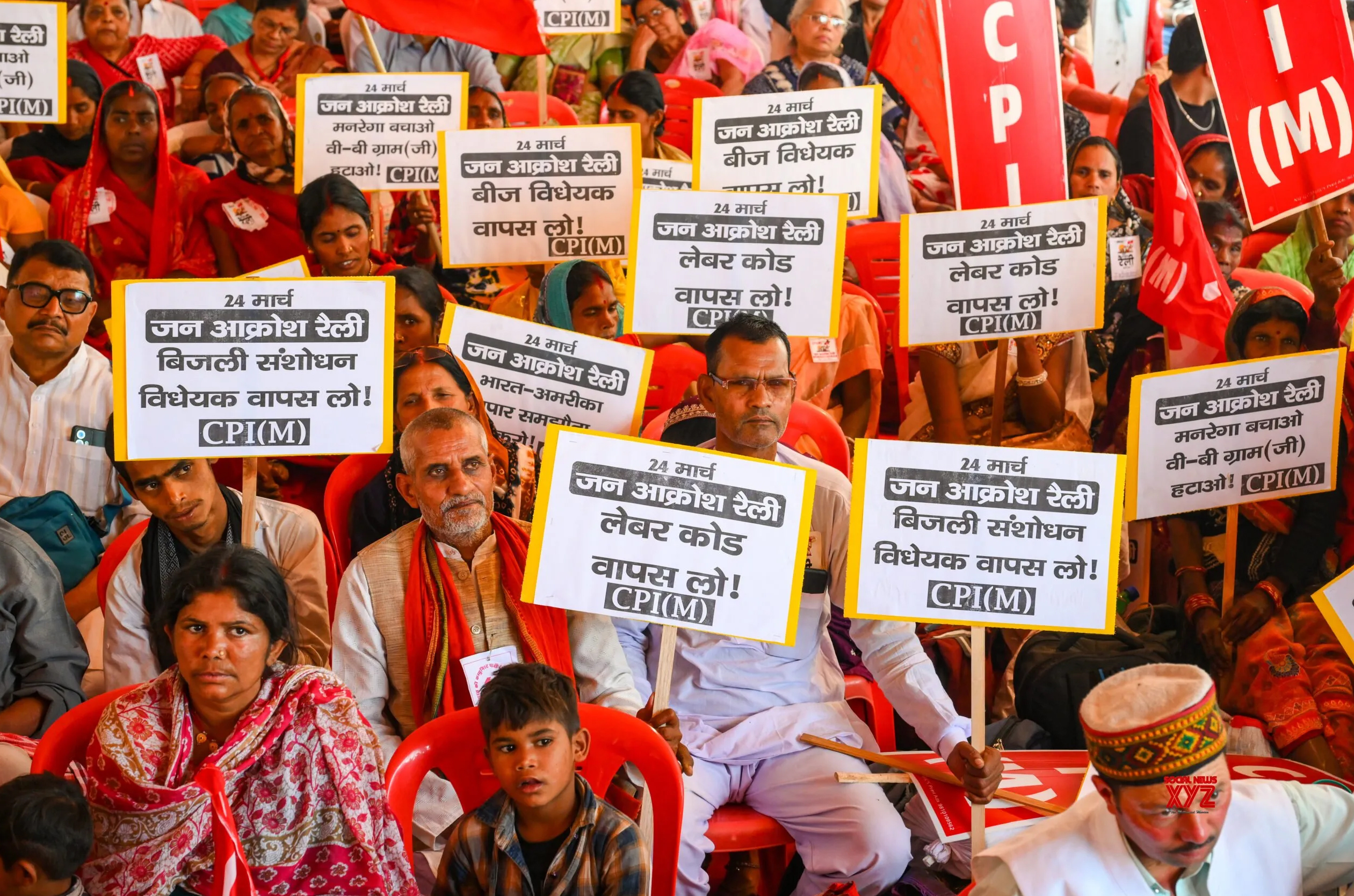
The campaign concluded on March 24 with ‘Jan Akrosh Rally’ at Ramlila Maidan, New Delhi. Hundreds of party workers and senior leaders from both divisions of Jammu and Kashmir participated, carrying party flags and raising revolutionary slogans. The ‘Jan Akrosh Jatha’ served as a platform for party to consolidate agrarian and labor unrest into a political movement.
Uttarakhand Jan Aakrosh Jatha
On International Women’s Day, 8 March 2026, Polit Bureau member Vijoo Krishnan addressed a gathering at Gandhi Park, Dehradun, after offering floral tributes at Mahatma Gandhi’s statue. A large number of scheme workers and AIDWA members participated. The Jan Aakrosh Jatha then proceeded in a procession to the martyrs’ memorial at the Dehradun Collectorate, where he paid tribute to the heroes of the Uttarakhand state movement and formally launched the statewide campaign.
The Uttarakhand Jan Aakrosh Jatha covered 2,000 km, holding public meetings in ten of the state’s thirteen districts, with major halts on 8 March in Dehradun, Doiwala, and Haridwar; 9 March in Shaktifarm; 10 March in Almora; 11 March in Tharali and Karnaprayag; 12 March in Rudraprayag and Srinagar; 13 March in Pauri and Kirtinagar; and 14 March in Tehri. Organized by the CPI(M) Uttarakhand State Committee, the campaign aimed to raise public awareness and build unity against the anti-people policies of the central and state governments. The Jatha concluded on 15 March at Sabhawala before joining the national rally in Delhi on 24 March.
In Almora, AIDWA leader Sunita Pandey criticized the government for focusing narrowly on tourism, temple beautification, and yoga centres under the “Devbhoomi” rubric. The Ankita Bhandari murder case was highlighted as exposing crimes flourishing within the tourism industry and the broader oppression of women. Citing the AIDWA investigation, she alleged that a bulldozer was used to erase evidence, questioning the identity of the “VIP” shielding the truth and the suspicious role of ruling-party functionaries and MLAs, asserting that convicting only three individuals does not constitute complete justice. Expressing concern over migration, she noted that the army-once the largest employer for Uttarakhand’s youth-has been compromised by new policies, and she condemned the budget for prioritizing the Hindutva agenda and religious tourism over women’s interests and basic needs.
In Rudraprayag, All India Kisan Sabha leader Pushpendra Tyagi emphasized that collective effort is essential for meaningful change, observing that despite difficult hill conditions, the participation of women and locals signals a desire for transformation. Recalling the sacrifices of Bhagat Singh, Rajguru, and Sukhdev, he noted the massive rally in Delhi on 24 March as part of the centenary commemoration of their martyrdom in 2031. He cited Kerala’s progress on education and health, contrasting it with attempts elsewhere to close government schools.
In Srinagar, SFI state president Nitin Maletha detailed the damaging effects of the National Education Policy, arguing that students from remote Himalayan areas are unable to prepare for the CUET exam, while continuous fee hikes further burden families. He noted that H.N.B. Garhwal Central University now admits fewer local students than before NEP, allowing lumpen elements to exploit native-hill identity politics on campus, leaving Uttarakhand students feeling cheated and out-of-state students vulnerable to exploitation. He added that many schools have closed under NEP, with cluster-based mergers having a far more severe impact in hilly areas due to transportation difficulties.
In Tharali, All India Kisan Sabha general secretary Vijoo Krishnan strongly criticized central government policies over the preceding eleven years, dismissing slogans like “Achhe Din” as mere rhetoric. He claimed that five lakh farmers have committed suicide, and due to lack of employment, hill youth have been forced into menial jobs in South Indian cities. He called the Agniveer scheme a contract system that jeopardizes the future of youth, and on women’s safety, he cited the Ankita Bhandari, Hathras, and Bilkis Bano cases to question government functioning.
In Tehri, CPI(M) Central Committee member Rajendra Singh Negi addressed local issues, stating that disaster-affected people are not receiving proper compensation. He demanded six lakh rupees for families of the deceased based on 2013 Kedarnath norms, along with proper assessment of property loss. He criticized the Smart City project in Dehradun as mere signage without basic facilities, and opposed eviction notices for communities settled on forest land for generations, demanding implementation of the 2006 Forest Act to grant ownership rights.
On the final day at Sabhawala, state secretary Rajendra Purohit opposed changes to labour laws and the Electricity Amendment Act, stating that forty-four labour laws have been replaced with four Labour Codes that threaten the eight-hour workday. He described electricity privatization and prepaid smart meters as steps benefiting corporate houses, and citing trade agreements with the United States, he warned of a deepening crisis for Indian agriculture and dairy production. Concluding, leaders appealed for a massive turnout at the Delhi rally on 24 March, warning the government to change its anti-people policies or leave power.
Gujrat Jan Aakrosh Jatha
A state-level “Jan Akrosh Jatha” was held in Gujarat from March 10 to 15, 2026, to protest corporate-government policies. Flagged off in Ahmedabad on March 10 by CPI(M) leaders Central Secretariat Member Muralidharan and CC member and State Secretary Hitendra Bhatt, the initial 18-km route involved 30–35 participants. The day included garlanding Bhagat Singh’s statue at Khokhra Circle, multiple street-corner meetings, pamphlet distribution, a street play titled Yaaro ke yaar, Desh ke gaddar exposing the corporate-political nexus, and a public meeting in Saraspur attended by 100 people, addressed by Muralidharan, Hitendra Bhatt, and Dahyabhai Gajera, and conducted by Satish Parmar.
On March 11, the Jatha travelled 230 km to Rajkot, where a 26-km rally drew 76 participants. Support came from ASHA workers, Anganwadi workers, and LIC union members, culminating in a public meeting at Kothariya. The next day, in Bhavnagar district, the Jatha passed through Palitana and Sihor before reaching Bhavnagar, where diamond workers, LIC employees, and frontline workers welcomed them. A procession to Ghogha Gate was followed by a public meeting and cultural programs addressed by Hitendra Bhatt, Arun Mehta, Dahyabhai Gajera, Harshad Popat (LIC Union leader), and Ashok Sompura. Cultural performances were held at two locations.
On March 13, the Jatha reached Vadodara. At a meeting in Munj, Polit Bureau member Mariam Dhawale sharply criticized the “Modani Model” of corporate-political collusion. Tributes were paid to Sardar Patel in Padra, and despite intense heat, a large meeting was held in Bhoj village, with street plays continuing. Spontaneous support emerged in Aati village, where over 125 attended.
On March 14, in Kheda and Aravalli districts, the Jatha received a traditional welcome in Bayad with drums. Rallies and public meetings in Bayad and Modasa saw strong local participation, with attendees pledging support for the upcoming “Chalo Delhi Rally.” The Jatha also honored a comrade who had resisted an attack on the party office.
The final day, March 15, covered Sabarkantha district with welcome stops at multiple locations before a concluding gathering at Himatnagar. A street play was again performed, and leaders addressed the crowd, expressing gratitude.
A core team remained throughout, with district leaders joining locally. Across all five days, the Jatha combined rallies, street plays, public meetings, and extensive pamphlet distribution, successfully carrying the party’s message to new areas. The mobilization strengthened party cadre, fostered emerging young leadership, and set the stage for expanded struggles against the “double engine” government.
Jharkhand Jan Akrosh Jatha Reaches 1 Million
In preparation for the workers’ mobilization at Ramlila Maidan on March 24, the CPI(M) organized two central Jan Akrosh Jathas (campaign contingents) across Jharkhand. Led by senior All India leaders-Brinda Karat, Sudip Dutta, and State Secretary Prakash Viplav-the jatha sought to convey the Delhi rally’s message to the masses.
The first jatha began in South Chotanagpur, a region steeped in revolutionary history. It commenced at the memorial of Veer Budhu Bhagat in Silagai, Ranchi, who led the Kol and Larka rebellions against British imperialism in 1831-32. Flagged off by State Committee member Veena Linda, this jatha traversed 647 kilometers across 23 blocks in Ranchi, Lohardaga, and Gumla, holding over 100 meetings.
The second jatha started from the Sidho-Kanho memorial in Dumka, the heart of the Santhal Hul. It conducted mass outreach in more than 100 villages across Dumka and Pakur. During this leg, public hearings with villagers affected by coal mining revealed severe hardships caused by displacement, pollution, and water crises.
Both jathas converged in Bundu, a historic center of the Munda rebellion and past peasant struggles led by Rajendra Singh Munda. This marked by a massive procession and a public meeting chaired by Secretariat member Suresh Munda. Senior party leader Brinda Karat outlined the demands of the March 24 rally, joined by other state and district leaders.
In districts not covered by the central jathas, district-level jathas were organized in areas such as Dhanbad, Bokaro, and East Singhbhum, alongside Gram Sabha meetings in Chatra. To support the outreach, the state center published 50,000 handbills and the districts distributed over 100,000 leaflets.
Notably, the campaign was executed effectively despite major festivals like Ramzan, Sarhul, and Navratri. Organizers expect over 2,000 farmers, workers, and youth from Jharkhand to attend the Delhi rally.


