 10-Day Jatha in Himachal
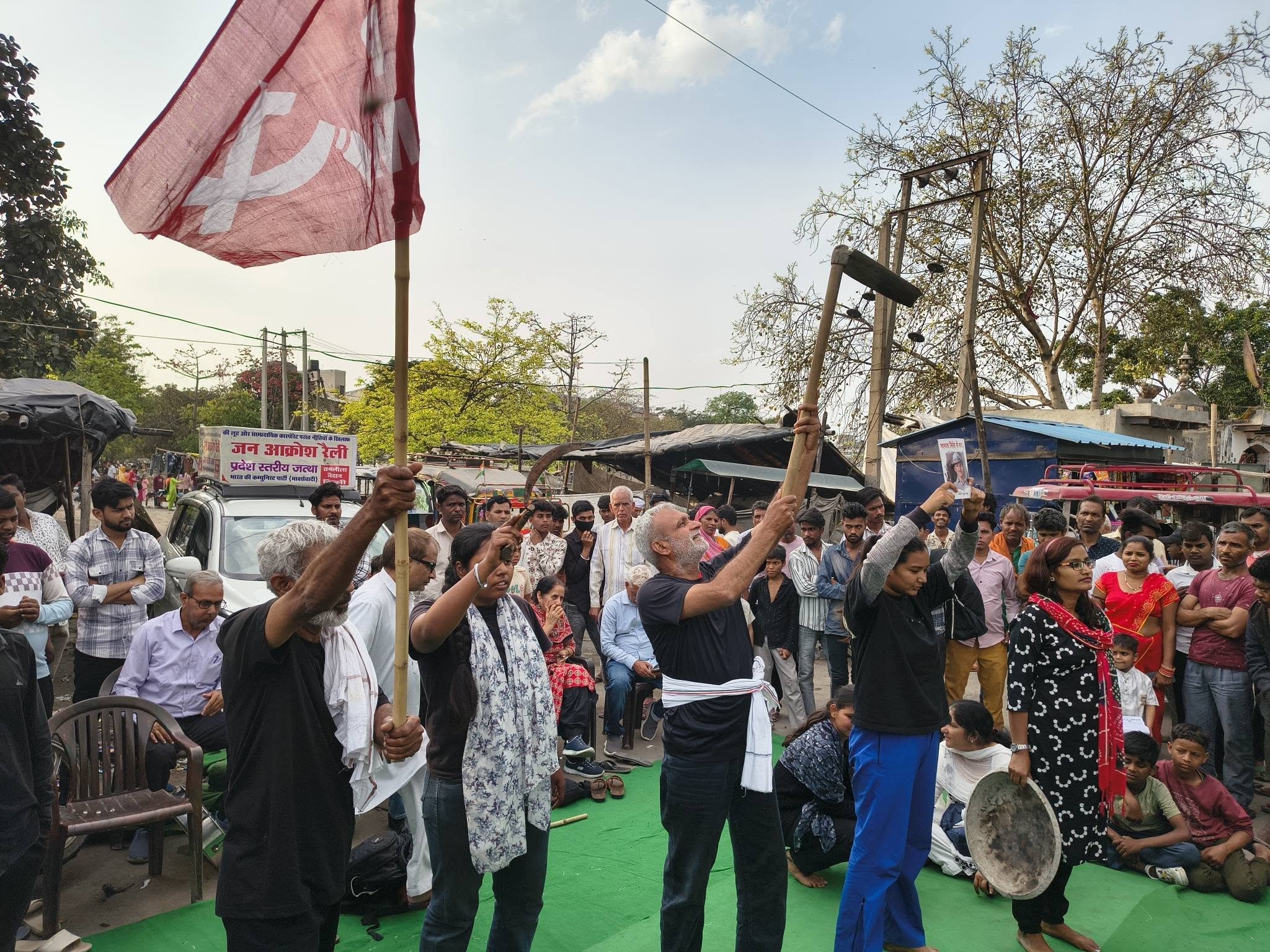
The 10-day ‘Jan Aakrosh Jatha’ launched on 9 March in Himachal Pradesh emerged as a platform of grassroots mobilisation, political communication, and collective resistance; beginning from Sirmaur, it traversed more than 3000 kms in diverse regions covering 18 locations across 11 districts (Kinnaur, Kullu, Mandi, Kangra, Solan, Hamirpur, Una, Chamba, Bilaspur, and Shimla) and reaching both remote villages and urban areas alike with a core objective to unite workers, farmers, and marginalised groups to consolidate public opinion against central government anti-people policies.
Throughout the journey, the Jatha became a participatory dialogue through meetings, rallies, and street plays, even in remote areas. Led by a cultural team under Dr. Praveen Jaret and Janwadi Mahila Samiti state president Ranjana Jaret, these performances effectively communicated critiques of government policies and highlighted the erosion of labour, agrarian, and social rights.
The mobilisation’s slogans clearly reflected its direction-demanding repeal of the four labour codes, restoration of MGNREGA, withdrawal of the Electricity Amendment Bill 2025, and opposing smart meters, highlighting concerns over economic security and public services. They also called for scrapping the Free-Trade Agreement (FTA), citing wider economic anxieties and its potential to expose Himachal Pradesh’s apple industry to unfair foreign competition, threatening local growers’ livelihoods. Energy reforms, including smart meters and electricity privatisation, were opposed as increasing the financial burden on citizens, alongside concerns over rising inflation, fuel, and cooking gas prices.
The Jatha mobilised people around key local issues, including displacement and compensation for Pong and Bhakra dam outsees, land-for-land demands in disaster-affected areas, the state’s rightful share in hydro royalty, allocation of at least five bighas of land to farmers, and implementation of MSP for milk.
The demand for restoring Revenue Deficit Grant (RDG) was particularly significant in the context of Himachal Pradesh’s unique developmental challenges. As a mountainous state with limited revenue-generation capacity and high infrastructural costs, Himachal depends heavily on central financial support. RDG plays a critical role in sustaining essential public services such as education, healthcare, pensions, and welfare schemes. Its reduction or withdrawal directly impacts governance capacity and development outcomes, making it a central issue of concern for the state’s population.
Women’s participation-especially in interior Himalayan regions-emerged as a defining feature of the Jatha. Women actively voiced concerns related to employment, land rights, MGNREGA, and social security.
CPI(M) Himachal Pradesh State Secretary Sanjay Chauhan, former MLA and State Secretariat member Rakesh Singha, and central committee member Dr. Vikram Singh, addressed gatherings across the route, lending direction and continuity to the campaign.
Despite adverse weather, especially in Dharamshala, participation remained high, signalling widespread dissatisfaction. The Jatha concluded with a resolve to intensify the struggle and mobilise for the March 24 Delhi rally, emerging as a strong platform for awareness, democratic engagement, and organised resistance. Funded through mass community contributions, the jatha movement became a truly people-led campaign rooted in solidarity, and shared resolve.
Jatha in Rajasthan Gains Ground
Amid powerful slogans such as “Why should the people of India bear the burden of a Gulf war imposed by the United States?” and “Why are Adivasis being dispossessed of their water, forests, land, and livelihoods?”, the second Jan Jatha of the Communist Party of India (Marxist) was flagged off from the Udaipur division on 12 March with massive public support. The mobilisation also raised the call to “March to Delhi on 24 March” against anti-people, pro-corporate policies.
The statewide campaign opposes key central policies, including the dilution of MGNREGA, imposition of smart meters and electricity privatisation, the Seed Act pushing farmers toward multinational dependence, and pro-employer labour codes. The Jathas will continue across the state until the March 24 rally at Ramlila Maidan, New Delhi, aiming to raise awareness and amplify people’s issues. This phase began in the tribal Udaipur division, led by CPI(M) senior leader Brinda Karat, State Secretary Kishan Pareek, State Secretariat member Dulichand Meena, and District Secretary Rajesh Singhi.
Addressing the gathering, senior CPI(M) leader Brinda Karat alleged that the BJP’s “double-engine government” has transferred Adivasi rights over water, forests, and land to corporate houses like Adani and Ambani, while weakening MGNREGA-their key livelihood source. Criticising pro-corporate priorities, she asserted that CPI(M) remains committed to raising and fighting for people’s issues.
She noted the sharp rise in billionaires over the past 12 years, questioning its link to real development, and cited her visits to Gogunda villages to highlight the lack of basic services-water, electricity, roads, schools, healthcare, and jobs-arguing that development claims are hollow as inequality widens.
Karat also criticised the dilution of the Forest Rights Act, pointing out that despite provisions like Section 3(2) allowing infrastructure in forest areas, permissions are often denied, questioning whether Adivasis are treated as equal citizens. The programme included a protest at Sayra tehsil, where officials were gheraoed over delays in forest rights pattas and other local demands.
State Secretary Kishan Pareek called for intensified struggle against what he described as corrupt and anti-people policies of the government. He stated that the BJP government is ignoring the interests of farmers and workers while pushing new laws. The ongoing Jathas across Rajasthan have seen active participation from farmers, labourers, students, and youth, and people were urged to join the massive rally in Delhi on 24 March.
Speakers also alleged that the BJP-RSS “double-engine government” is dispossessing Adivasis-the original inhabitants of the country-from their lands, while transferring natural resources to corporate entities. The weakening of MGNREGA has particularly impacted tribal communities dependent on it, while restrictions on forest produce have further affected their livelihoods. CPI(M) leaders emphasised their long-standing struggle for tribal rights, including movements for forest land pattas from the streets to Parliament.
Criticism was also directed at emerging political parties claiming to represent Adivasis but allegedly failing to address their concerns and instead engaging in corruption similar to mainstream parties. Leaders stressed the need for a united movement under progressive leadership. Local leaders highlighted that tribal communities are being denied even basic forest access, lack educational and employment opportunities, and must travel long distances for drinking water. Public meetings were held in several villages along the route, including Kovia, Bagga, Bokhada, Bagad, and Kamba.
UP – Expanding into the Heartland
In Uttar Pradesh, CPI(M) General Secretary M.A. Baby participated in the Jan Aakrosh Jatha programme as part of preparations for the 24 March rally in Delhi. Addressing a public meeting on 15 March at Gandhi Park in Chakia Bazaar, Chandauli district, he called upon farmers and workers to join the rally in large numbers.
He criticised Prime Minister Narendra Modi’s unfulfilled promise of doubling farmers’ incomes, stating that instead, farmer suicides have increased due to anti-farmer policies. Drawing a comparison, he highlighted Kerala-governed by the Left-as a model where extreme poverty has been eradicated over the past decade.
Referring to achievements in education, he noted that Kerala has achieved near-universal school attendance and has made education free up to the undergraduate level, while many poor children in Uttar Pradesh still lack access to schooling. He called upon workers, rural poor, and agricultural labourers to unite against the four labour codes, defend MGNREGA, and oppose the Seed Bill and free trade agreements by participating in the 24 March mobilisation.
Addressing farmers, labourers, and women, he expressed confidence that the strength of Left forces would grow in Uttar Pradesh and that a pro-poor government could emerge in the future. He criticised what he termed “bulldozer politics,” alleging that it disproportionately targets the poor, and asserted that organised resistance would challenge such actions.
He also recalled that MGNREGA was implemented due to pressure from Left parties during the UPA government but is now being weakened under the current regime. The new framework, he argued, shifts financial burdens onto states and undermines the guarantee of work for rural populations. He further criticised cuts in subsidies and rising electricity costs for farmers and workers.
M.A. Baby concluded by calling for unity among farmers and labourers to struggle against what he described as a pro-corporate government. Other leaders, including Central Committee member Hiralal Yadav, State Kisan Sabha President Baburam Yadav, State Committee members Shambhunath Singh, and Lalamani Vishwakarma, also addressed the gathering, reinforcing the call for mass mobilisation.
Jan Sangharsh Jatha: Bihar Mobilises
A statewide “Jan Sangharsh Jatha” (People’s Struggle March) was launched in Bihar from March 6 to mobilize support for the March 24 “Delhi Chalo” campaign. The movement targets what it describes as anti-people policies of the Government of India, including an unequal trade agreement with the United States, pro-employer labour codes, the Seed Bill favouring multinational corporations, and proposed electricity law amendments that could harm farmers and consumers. It also opposes opening domestic markets to foreign agricultural products, demands remunerative prices as per the Swaminathan Commission, and raises concerns over the erosion of India’s economic and political sovereignty.
To mobilize large participation from Bihar, jathas were organized in seven directions under national and state leadership. One jatha moved through East and West Champaran to Siwan and Gopalganj, addressed by Polit Bureau member Mariam Dhawale, State Secretary Lalan Chaudhary, and Secretariat members P.N. Rao and Shashikant Rai. Another, beginning March 10 from Patna, covered Nalanda, Gaya, Nawada, and Jehanabad, with major meetings in Masaurhi and Rajgir, led by Central Committee member A.R. Sindhu and other leaders; in the Shahabad region, (Sasaram, Arrah, Bhabhua, Buxar), leadership included Central Committee member Vikram Singh and others.
From March 11, a jatha led by former Central Committee member and Kisan Sabha national leader Badal Saroj covered Hajipur, Chhapra, and Manjhi, drawing large public participation in both formal and open gatherings. A major jatha led by olit Bureau member Ashok Dhawale, State Secretary Lalan Chaudhary moved from Madhubani through Darbhanga, Samastipur, Begusarai, and Khagaria to Saharsa, witnessing strong participation in regions known for land struggles, with key meetings in Saur Bazaar and Kopa. Samastipur saw particularly extensive mobilization, with continuous outreach since March 6 and a major protest planned at the District Collectorate on March 19. Begusarai also recorded strong participation, including among transport workers.
Another jatha, led by Polit Bureau member Vijjo Krishnan and Central Committee member Awadhesh Kumar, ran from Araria (March 15) to Bhagalpur (March 17), with significant participation, especially by women. Key meetings were held in Supaul, Madhepura (including the tribal village Rajni), and Deepnagar in Bhagalpur-an area associated with past land rights struggles. In Supaul, a major gathering was held in the village of late farmer leader Balram Singh Yadav. The campaign also noted continued participation by families of martyrs such as Rajesh Hansda. A further jatha led by State Secretariat member Sanjay Kumar is covering Lakhisarai and Jamui from March 17 to 20.
Over nearly 10 days, the campaign has reached remote areas, strengthened organizational mobilization, and energized party ranks. Floral tributes were paid to martyrs of land struggles across districts, alongside a renewed resolve to intensify resistance against what participants describe as a corporate-driven, imperialist-aligned, and authoritarian regime. The Party expresses confidence that Bihar will mobilize thousands to ensure the success of the March 24 “Delhi Chalo” call.


