Sufal Mahto
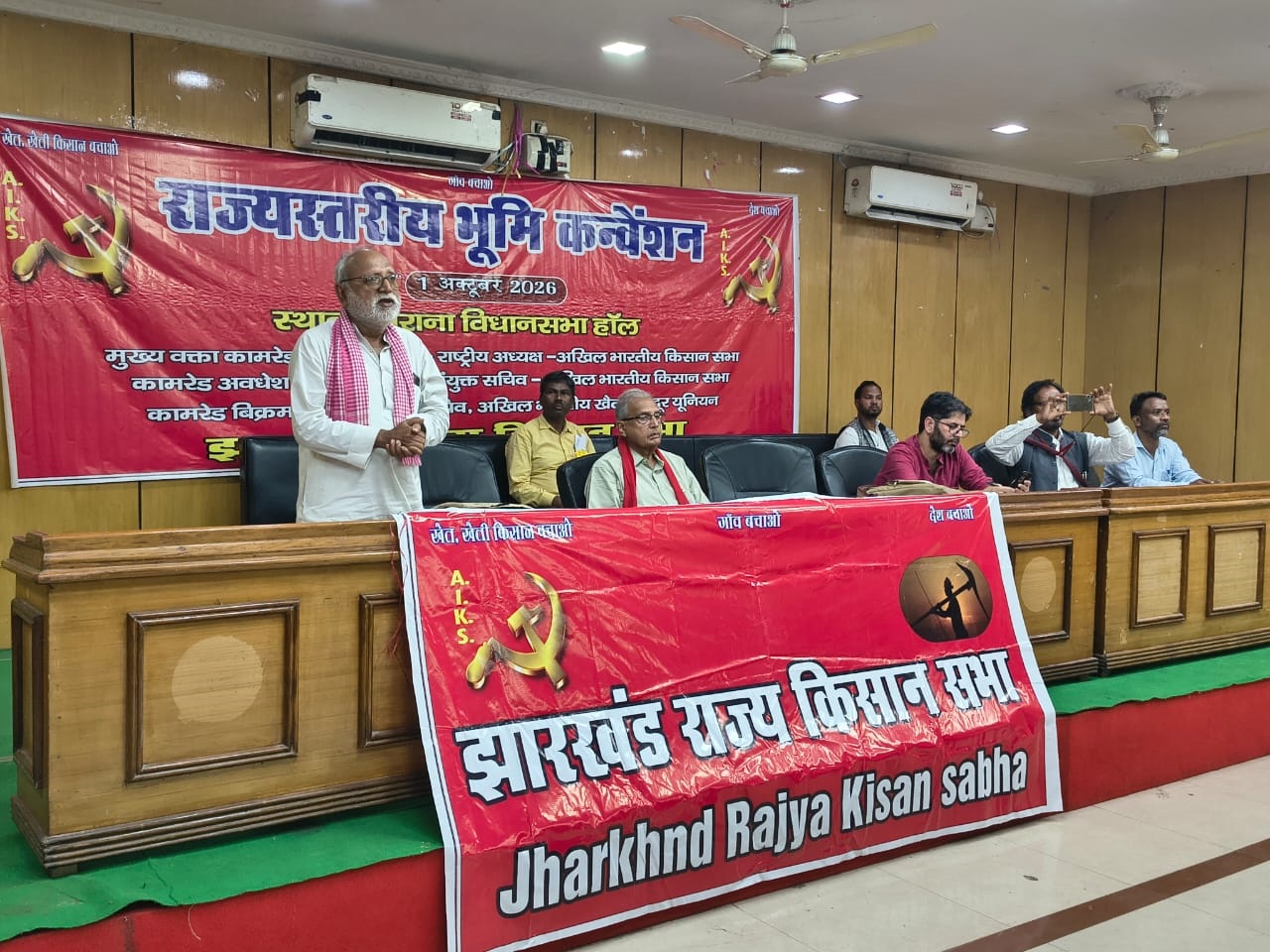
THE AIKS-organised Jharkhand Land Rights Convention was held on October 1, 2026 at the Assembly Hall in Ranchi, under the chairmanship of Asim Sarkar, state president of the Kisan Sabha. Addressing the convention, Ashok Dhawale, national president of the All India Kisan Sabha (AIKS), said that this convention, organised on the birth anniversary of A K Gopalan and the anniversary of the Chinese Revolution, marked the beginning of a decisive movement against the plunder of land above the ground and minerals beneath it in Jharkhand.
MAJOR ASSAULT BY BJP-LED MODI REGIME — PLUNDER OF LAND
Dhawale said that the plunder of water, forests, land and minerals was continuing across Jharkhand and the country through blatant violations of the Forest Rights Act (FRA), the PESA Act and the Land Acquisition Act (LARR) of 2013. Exposing the pro-corporate, communal and neo-fascist character of the BJP-led central government, he discussed in detail its anti-worker, anti-farmer, anti-agricultural worker, anti-student, anti-youth, anti-women, anti-Dalit and anti-Adivasi policies. He stated that nearly five lakh farmers, agricultural workers and daily-wage workers had been driven to suicide across the country as a result of its policies.
He explained that Adivasis were being dispossessed of their water, forests and land in states with substantial Adivasi population such as Jharkhand, Chhattisgarh, Madhya Pradesh, Odisha, Assam, Maharashtra, creating an acute crisis of displacement. Discussing the growing resistance of workers, peasants and Adivasis against corporate plunder, he pointed out that the historic Kisan Long Marches in Maharashtra and the militant struggles organised in recent years had forced the BJP government there to yield to popular demands.
In his address, he recalled the numerous Adivasi uprisings in Jharkhand against the dispossession of Adivasis from their land and exploitation by landlords and moneylenders. He paid tribute to the 1784 uprising led by Tilka Manjhi, the Santhal rebellion of 1855 led by Sidho-Kanho and Chand-Bhairav, and the martyrdom of Birsa Munda in 1900. He explained that the Chhota Nagpur Tenancy Act and the Santhal Parganas Tenancy Act had been enacted under the pressure of these movements. Today, however, all these protective laws were being weakened, and Adivasis were once again being dispossessed of their land.
Concluding his address, he said that instead of protecting votes and voters, Chief Election Commissioner Gyanesh Kumar was overseeing the removal of 13 crore voters’ names under the pretext of the disastrous Special Intensive Revision (SIR). The entire country was sick of this blatant exercise serving the BJP’s interests. He demanded the immediate dismissal of the chief election commissioner and the immediate abrogation of the SIR exercise.
Addressing the conference, Awadhesh Kumar, national joint secretary of the AIKS, said that the 12 years of Modi’s rule had witnessed the most severe attacks on food-producing farmers in Jharkhand, Bihar, and across the country. The plunder of land was part of the same policy, and a major struggle was needed to defeat it.
Vikram Singh, national joint secretary of the AIAWU, said that the united struggle of the Kisan Sabha and the Agricultural Workers’ Union would be intensified against the plunder of forests and minerals in Jharkhand.
MAIN RESOLUTION
Presenting the main resolution at the conference, Sufal Mahto, general secretary of the Jharkhand State Kisan Sabha, stated that agricultural land accounted for only 25 per cent of the state’s total land area, with most of the remaining area comprising forest land and plateaus. Nearly 40 per cent of the country’s mineral wealth was located in Jharkhand, attracting the attention of corporates like Gautam Adani and Mukesh Ambani.
Violating the Forest Rights Act, the PESA Act and the LARR Act, legislations enacted to protect peasant rights and Adivasi rights, the central and state governments were indiscriminately handing over land to large corporations. As a result, more than one crore Adivasi farmers in the state were now victims of displacement.
Land was being grabbed on a massive scale in the name of road and railway construction, smart cities, dams, elephant corridors and mineral extraction. The resolution pointed out that forests accounted for approximately 29 per cent of the state’s land area and that Adivasis had traditionally enjoyed rights over these forests. Their livelihoods, homes, culture and distinct identity were deeply connected to them. These foundations of Adivasi life were now being systematically destroyed.
Jharkhand had received a total of 14 lakh acres of land under the Bhoodan movement, but only 5.5 lakh acres had been distributed among the landless. In June 2019, the BJP-led state government had created a land bank by taking control of 21 lakh acres of land. The Hemant Soren government, too, had not scrapped this land bank.
Discussing the ongoing struggles over land-related issues across the state and the achievements secured through these movements, Sufal Mahto called for intensifying independent and united statewide mass resistance against land grab and displacement.
The conference was addressed by Praful Linda and Sukhnath Lohra, leaders of the AARM.
The conference concluded with the announcement of a phased movement: a land rights campaign would be conducted until November 15; the Kisan Sabha flag would be hoisted in every village on November 15, 2026, the birth anniversary of Birsa Munda; and a statewide land rights rally would be organised in Ranchi in March 2027.
FUTURE PROGRAMME OF ACTION
1. Launch a sustained and determined struggle against the forcible acquisition of land in the name of government and private projects;
2. Develop movements around the plunder of agricultural land for road and railway construction, building projects, factories, mineral extraction and other purposes;
3. Launch a movement to ensure strict compliance with the Chhota Nagpur Tenancy (CNT) Act, the Santhal Parganas Tenancy (SPT) Act and the LARR Act in all land acquisition matters;
4. Unite people displaced in the past and being displaced now and intensify their struggles;
5. Build a team of lawyers for legal battles on behalf of farmers affected by land acquisition;
6. Conduct surveys over land acquisition issues and compile accurate data for the Kisan Sabha;
7. Unite struggles against land acquisition into a coordinated and organised movement;
8. Intensify the struggle to secure forest rights by ensuring the implementation of the FRA.


