S Noor Mohammad
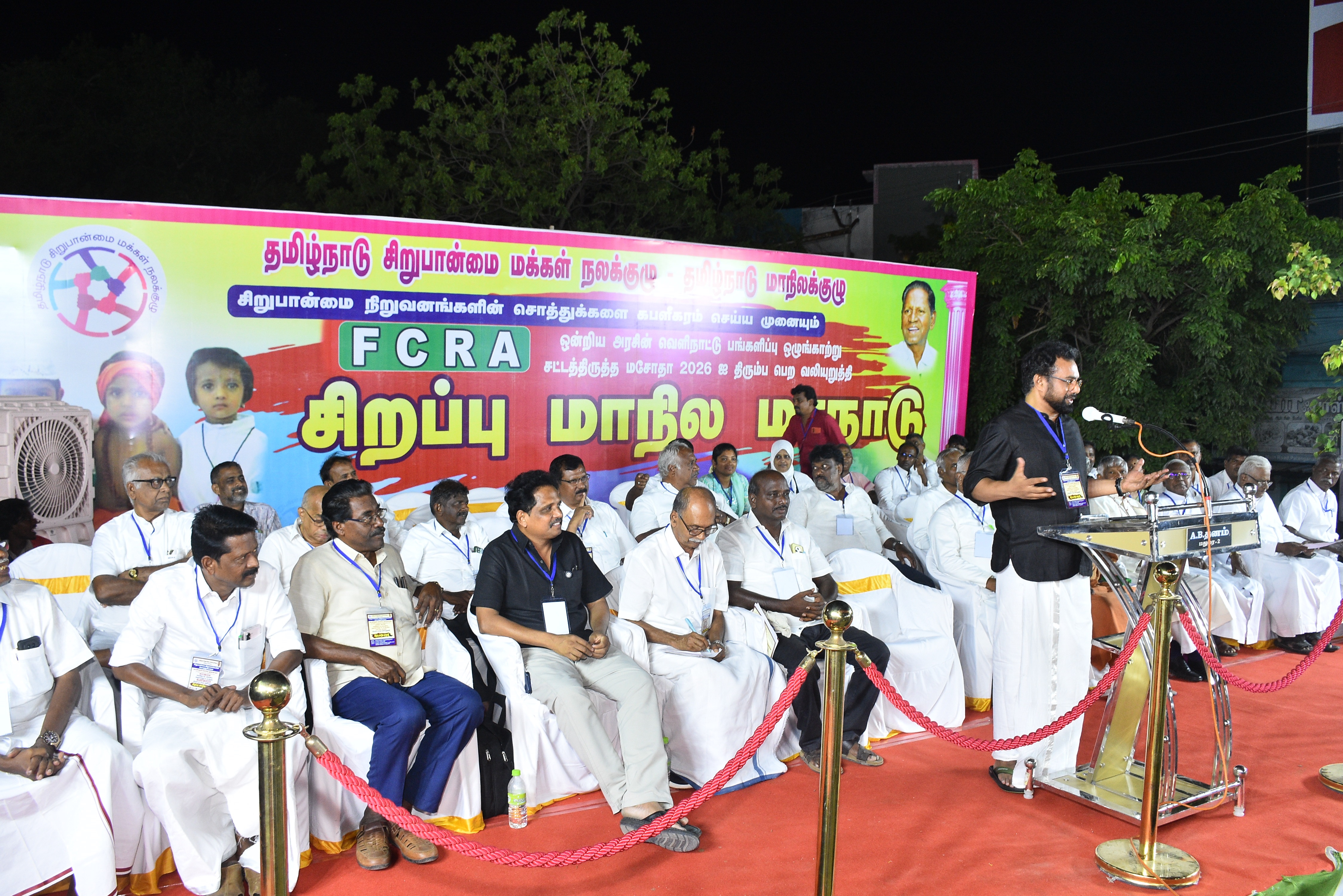
A MASSIVE wave of public resistance surged through Madurai as thousands of people gathered at the Palanganatham roundabout on July 3 for a historic state-level special conference organised by the Tamilnadu Minority People’s Welfare Forum. The mammoth rally sent a thunderous warning to the union government, demanding the immediate withdrawal of the Foreign Contribution Regulation Act (FCRA) Amendment Bill 2026, which critics describe as a calculated attempt to weaponise bureaucratic machinery to strangulate minority-run charitable institutions and destabilise the secular fabric of the nation.
The conference, presided over by the Forum’s General Secretary P Senthil Kumar and inaugurated by President S Noor Mohamed, brought together prominent political leaders, social activists, and religious dignitaries from Christian, Muslim, and Hindu communities, showcasing an exemplary display of inter-faith solidarity against majoritarian overreach.
A DIRECT SUBVERSION OF DEMOCRATIC PROCESSES
The contested legislative amendments, introduced by the BJP-led union government in Parliament last March, were initially stalled and kept in abeyance following a fierce, coordinated resistance from opposition benches, spearheaded by the Communist Party of India (Marxist) and other secular forces. However, the subsequent notification of highly restrictive rules on June 22, 2026, reignited nationwide outrage.
Addressing the massive gathering, CPI(M) State secretariat member and Madurai Member of Parliament Su. Venkatesan exposed the underhanded tactics employed by the union government during the budget session.
"On March 25, when the union government introduced this malicious piece of legislation, they deliberately timed it to catch the opposition off-guard, assuming that Left and secular MPs would be fully occupied with intense election campaigns in Tamil Nadu and Kerala," Su. Venkatesan stated. "But our MPs rushed back to Delhi overnight, confronted the treasury benches, and blocked their attempts to quietly ram the bill through without debate. While they may try to abuse their parliamentary majority, no authoritarian regime can withstand the collective democratic will of 140 crore citizens."
Venkatesan emphasised that the growth and socio-economic development of regions like Madurai are deeply intertwined with the educational, medical, and social institutions established by minority communities over the last century. He noted that the vast majority of India’s freedom fighters emerged from these very institutions. By systematically targeting them, the union government is not merely attacking a community but trying to erase the historic pillars of Indian civil society.
INSTITUTIONAL SEIZURE AND THE DESTRUCTION OF CHARITY
The conference shed light on the highly dangerous, retroactive clauses hidden within the FCRA Amendment Bill 2026. A resolution proposed by the Forum's State Vice President M Ramakrishnan detailed how the new framework empowers the union government with absolute executive discretion to suspend, terminate, or disallow any organisation’s FCRA license at will.
Under the draconian guidelines, if an organisation's five-year renewal is delayed or rejected on arbitrary grounds, its registration is automatically cancelled. Following cancellation, a government-appointed 'Designated Authority' is empowered to unilaterally seize and take over the entire institution's assets, properties, and bank accounts, subsequently transferring them into the government’s general public account.
Crucially, state governments have been completely stripped of any consultative or intervention powers in this process. The law operates on absolute retrospective authority; even if an institution built an infrastructure worth tens of crores using domestic funds over several decades, a minor foreign contribution—even as low as one per cent of its total historical funding—creates a legal loophole for the union government to confiscate the entire property.
JUNE RULES: GEOGRAPHICALLY ISOLATING HUMANITY
CPI(M) Central Committee Member and Rajya Sabha MP John Brittas delivered a scathing critique of the newly updated rules notified on June 22, which legally restrict philanthropic organisations from operating across state lines. Under these provisions, any entity utilising foreign funds must strictly confine its services to a single, pre-registered state or Union Territory.
Brittas shared firsthand accounts from his recent interactions with charitable organisations in Delhi, highlighting the cruel, absurd reality of these geographic restrictions:
"I spoke to sisters from the Sisters of Charity who run a leprosy asylum in Delhi. The capital city is geographically tightly bordered by Uttar Pradesh and Haryana. They asked me a heartbreaking question: 'Sir, if a helpless leprosy patient walks in from Noida or Gurgaon—just a five-minute drive away—are we legally required to turn them away? If we treat them, the bureaucrats will cancel our license for violating state boundaries.' This is the depth of inhumanity embedded in these new rules."
This artificial balkanisation of charity means that during catastrophic natural disasters—such as cyclones, floods, or earthquakes—well-equipped charitable organisations will be legally barred from crossing state borders to provide emergency relief, medical aid, or rehabilitation to victims in neighbouring states.
THE RSS DOUBLE STANDARD AND HATE POLITICS
The conference sharply called out the stark hypocrisy of the union government’s regulatory gaze, contrasting the aggressive clampdown on transparent, registered charities with the absolute opacity enjoyed by right-wing majoritarian groups. Over the past decade alone, more than 24,000 FCRA licenses of genuine NGOs have been cancelled, decimating millions of voluntary jobs and cutting off vital lifelines for the poor.
John Brittas pointed out that the Rashtriya Swayamsevak Sangh (RSS) remains an unregistered body, entirely shielded from the rigorous financial scrutiny imposed on minority public trusts, despite receiving thousands of crores in unaccounted foreign remittances annually.
Drawing structural parallels between modern India and dark historical eras, Brittas invoked the words of Albert Einstein regarding the rise of fascism in Nazi Germany, reminding the audience that the tragic collapse of Weimar democracy occurred because the academia, judiciary, and civil society caved in out of fear instead of fighting Hitler collectively at the very first step.
Brittas also heavily criticised the union government's foreign policy shifts, noting that India has compromised its long-standing global reputation for standing with oppressed populations. He drew a sharp contrast between past leadership and the present:
"When Iraq was unilaterally attacked by the United States, the Atal Bihari Vajpayee government, with the unanimous backing of the opposition, passed a resolute parliamentary resolution condemning the aggression. But today, when tens of thousands of innocent children are systematically butchered in Gaza, the current regime remains a silent spectator. They lack the courage to even offer condolences upon the killing of international leaders, completely surrendering India’s historical independent foreign policy to Western imperialist blocs."
A UNIFIED CALL FOR STATE-WIDE AGITATIONS
The conference concluded with a powerful consensus that the attack on FCRA is not an isolated regulatory issue, nor is it a concern restricted to Muslims or Christians alone. It is a fundamental assault on the Indian Constitution, aimed at dividing the working masses to divert attention from governance failures. From the systematic division of ethnic communities in Manipur to the weaponisation of localised police forces in Madhya Pradesh to harass nuns and tribal women under false pretences, the majoritarian ecosystem thrives entirely on manufactured hate.
Distinguished leaders representing various social and cultural spheres extended their solidarity at the event, including Madurai Mayor (in-charge) T Nagarajan, Kumbakonam Thrivadikkudil Swamiji, CEIRT President Lawrence Pius, Dindigul Bishop Thomas Paulsamy, and Madurai Diocese Vicar General John Britto Packiaraj. Legal activists Adv. Henri Tiphagne, Fernandas Rathinaraja, and Jaisingh Prince Prabhakar, alongside Alhaj S A Liyagat Ali of the Jamaat Federation, also spoke, emphasising that the legal arena alone cannot win this battle without sustained grassroots mobilisation.
Amid roaring applause from the thousands in attendance, the Tamilnadu Minority People’s Welfare Forum passed a definitive resolution announcing a massive, coordinated statewide protest on July 28, 2026. The Madurai declaration has set the stage for a prolonged, unyielding public struggle to reclaim the democratic, secular, and pluralistic values of the nation. The vote of thanks was delivered by District Secretary N Ganesa Moorthy.


