Sanjay Chauhan
Himachal Pradesh is witnessing a rise in workers’, peasants’, women’s, and people’s struggles across sectors and regions. From hydro project-affected farmers in Luhri and dairy producers in Datnagar to NHPC workers, sanitation workers, ambulance employees, Anganwadi and Mid-Day Meal workers, and women-led healthcare protests in Shimla, social unrest is spreading across the state. These are not isolated agitations but interconnected struggles arising from economic distress, contractualisation, privatisation, weakening labour protections, delayed compensation, unemployment, and shrinking state responsibility.
Under neo-liberal policies, the growing alliance between corporate and state power has intensified pressure on labour rights, agriculture, healthcare, cooperative systems, and rural livelihoods. Both BJP and Congress governments have largely continued policies based on outsourcing, privatisation, and reduced public accountability, increasing insecurity among workers, peasants, women, and poor households.
In Himachal Pradesh, where land, forests, water, healthcare, labour rights, and dairy livelihoods are central to survival, people are increasingly forced into collective resistance to defend livelihoods, public services, and democratic rights. These struggles reflect not only administrative failures but a broader class-based resistance against corporate-state policies and neo-liberal restructuring.
Struggle of Hydro Project-Affected Farmers
A major agitation was launched in the Luhri Hydro Project area under the leadership of Himachal Kisan Sabha and the Luhri Hydro Project Affected Committee against Satluj Jal Vidyut Nigam Limited (SJVNL) and the local administration. Farmers raised issues related to delayed crop-loss compensation, cracks in houses caused by blasting, pending lump-sum compensation for 120 affected families in place of promised jobs, damaged roads, dust pollution, and drinking water shortages caused by project activities.
The struggle intensified as farmers halted project work, forcing the administration and SJVNL officials into negotiations. A late-night meeting held on 24 April 2026 resulted in a 14-point agreement under which SJVN assured payment of compensation by June 2026 and completion of pending surveys in remaining panchayats. The agitation was suspended but not withdrawn, and affected families warned of stronger protests if promises were not implemented. The movement exposed the continued neglect of rehabilitation responsibilities in large hydroelectric projects and highlighted the growing resistance of rural communities against corporate exploitation and ecological destruction.
Dairy Farmers’ Movement
The dairy farmers’ movement around the Datnagar Milk Plant has become one of the most sustained rural struggles in Himachal Pradesh. Led by Dudh Utpadak Sangh and Himachal Kisan Sabha, farmers have protested against delayed payments, low procurement rates, faulty milk testing, inadequate veterinary services, and poor-quality cattle feed.
Although official milk procurement rates were increased, most producers still receive only ₹30–40 per litre, with payments often delayed by months, pushing rural households into debt. Lack of functioning milk analysers in many societies has also led to manipulation in quality testing and financial losses for farmers.
Sustained protests in 2024, 2025, and 2026 forced partial victories, including release of arrears and restoration of procurement. The “Datnagar Chalo” protest of April 2026, involving large participation of women, raised demands for direct payments, ERP implementation, staff recruitment, improved breeding support, and a bran processing unit. The movement has now grown into a wider struggle against privatisation, cooperative failures, and the crisis facing dairy-based rural livelihoods in hill areas.
NHPC Workers’ Struggle
Workers at the NHPC Baira Siul Project under the banner of the Baira Siul Project Workers Union (CITU) launched a prolonged agitation against arbitrary termination and anti-worker policies. The immediate issue was the illegal termination of worker Duni Chand at the age of 58 despite the legal retirement age being 60 years.
The case became symbolic of wider insecurity faced by workers under increasing contractualisation and management pressure. Workers organised dharnas, gate meetings, and continuous protests for more than twelve days despite heavy rain and repeated attempts by management to diffuse the agitation through verbal assurances. The union rejected these assurances and announced further phases of struggle including chakka jam, work stoppage, and legal action in Labour Court.
May Day 2026 was observed at the project site itself, linking the local struggle with the broader international history of workers’ movements. The agitation exposed how even public sector undertakings are increasingly violating labour laws and adopting anti-worker practices under neo-liberal restructuring.
Victory of Sanitation Workers in Shimla
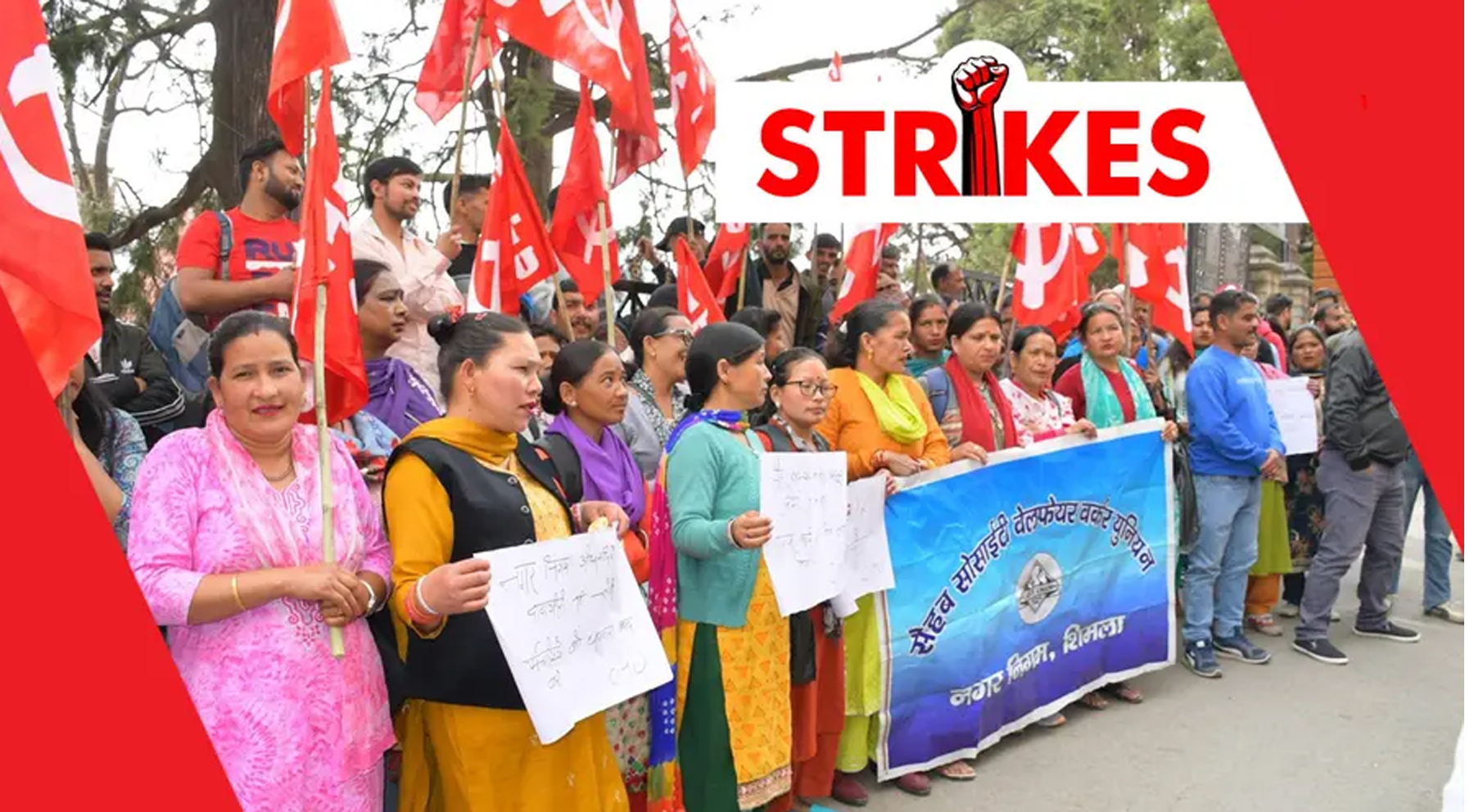
The struggle of sanitation workers employed under the SEHB Society (Shimla Environment, Heritage and Beautification Society) in Shimla emerged as one of the most significant labour movements in recent times. The dispute began when the Municipal Corporation withdrew the workers’ 10 percent annual wage increment and benefits such as special leave.
More than 900 sanitation workers are responsible for maintaining cleanliness in Shimla city, yet they remain among the lowest-paid and most neglected sections despite working in difficult and unsafe conditions. Workers raised issues such as excessive workload, denial of overtime, non-compliance with EPF rules, temporary employment, and increasing contractualisation. Women workers strongly highlighted rising inflation, household expenses, debt burdens, lack of maternity leave, and threats of dismissal during illness or pregnancy. This made it clear that the movement was not limited to wage demands alone but was also a broader struggle for dignified working conditions, social security, and recognition of women’s labour.
After a seven-day strike in May 2026 led by the SEHB Society Workers Union affiliated with CITU, the Municipal Corporation was forced to negotiate. Under the written agreement, the 10 percent wage increment was restored, benefits related to special leave and pay scales were reinstated, and dismissed workers were reinstated. The struggle emerged as a major victory of workers’ unity.
Ambulance Workers’ Agitation
The agitation by 108 and 102 ambulance workers became a major healthcare sector labour struggle. Organised under the Himachal Pradesh 108 & 102 Ambulance Employees’ Union (CITU), workers protested against Medswan Foundation and NHM over 12-hour shifts, denial of overtime, illegal EPF deductions, and non-implementation of court orders. Workers alleged that both employee and employer EPF shares were deducted from their salaries and that previous service benefits were ignored after the transition from GVK EMRI to Medswan.
A 132-hour strike and continuous sit-in outside the Secretariat during April 2026 forced authorities to assure a tripartite meeting. Though the strike was temporarily withdrawn, workers warned of intensified agitation if promises were not implemented. The movement became a major struggle for enforcement of labour rights and court orders.
AIDWA-Led Healthcare Movement Against Privatisation
A major women-led healthcare movement emerged in Shimla against shifting the Gynaecology OPD from Kamla Nehru Hospital (KNH) to IGMC. Led by AIDWA along with Jan Swasthya Abhiyan (JSA) and Shimla Nagarik Sabha, protesters argued that the move weakened integrated mother-child healthcare and was linked to efforts to weaken KNH for construction projects. The movement also opposed rising medical test charges and the decline of free healthcare services. A 24-hour sit-in at KNH and a large protest at IGMC on 30 April 2026 demanded restoration of OPD, IVF, and robotic surgery services within KNH and rollback of increased charges. The agitation has increasingly evolved into a broader struggle against privatisation and weakening of public healthcare.
Mid-Day Meal and Anganwadi Workers’ Agitation
Mid-Day Meal (MDM) and Anganwadi workers, who form the backbone of nutrition, education, and welfare systems, have intensified their struggle in Himachal Pradesh against low honorariums, delayed wages, insecure working conditions, and absence of social security.
Recent protests in Shimla highlighted issues such as unpaid salaries, excessive workload, lack of insurance, poor working resources, delayed incentives, and denial of labour rights. Statewide agitations have now been announced, including an Anganwadi workers’ protest on 8 June 2026 and a Mid-Day Meal workers’ statewide strike on 22 June 2026.
Nearly 21,000 Mid-Day Meal workers survive on only ₹5,000 per month and payments are frequently delayed. Workers are also denied paid leave and forced to perform additional duties without compensation. Unions have demanded implementation of High Court orders on 12-month wages, timely payment of honorariums, social security, accident insurance, compensation for deaths during duty, regularisation, gratuity, improved service benefits, and recognition as government employees.
Workers have also opposed privatisation of ICDS services, warning that it would weaken public welfare systems and intensify exploitation of women workers. The movement reflects a broader demand for dignity, recognition, labour rights, and protection of public welfare services.
Growing Class Unity in People’s Movements
Across these struggles, a common reality is emerging. Despite laws protecting labour rights, compensation, and social security, neoliberal policies, privatization, contractualization, and the shrinking welfare role of the state are steadily weakening them. In institutions such as SJVNL, NHPC, Milkfed, Medswan, and outsourced municipal systems, anti-worker policies, delays, lack of transparency, and corporate interests are increasingly dominant under both BJP and Congress governments.
Some gains have come only through sustained protests, strikes, and organized class unity. Women have played leading roles in sanitation workers’, dairy farmers’, healthcare, Anganwadi, and Mid-Day Meal workers’ struggles. These movements have expanded beyond wage demands into broader struggles for dignity, labour rights, social security, and democratic rights.
In Himachal Pradesh, struggles around wages, healthcare, land, forests, water, livelihoods, and democratic rights are increasingly converging into wider people’s movements against neoliberal policies and corporate exploitation. The key challenge now is to deepen ideological and political consciousness and transform scattered struggles into broad, permanent mass organizations linked with wider social and political transformation.


