Aniyan P V
The wave of spontaneous working class upsurge has engulfed Noida (Uttar Pradesh) since April 9, 2026. This wave, which began from Barauni (Bihar) at the end of January, has since then advanced rapidly from one industrial centre to another, Panipat, Surat, Manesar to name a few (In the last 3 months there have been such class actions in more than 60 locations). The stagnant real wages, increasing costs of living amidst the LPG crisis (created by Modi government's strategic surrender), large scale false propaganda by the government on labour codes and consistent campaign by the trade union movement created conditions for this upsurge. Undoubtedly, it's the systemic crisis of capitalism which has resulted in this spontaneity under the leadership of the contractual industrial workers.
As has been the case with every single node in this wave, it was the shared experiences which formed the main propelling factor behind the class action. The struggles in Richa Global and Motherson companies in Noida are linked to similar actions for wage increase in their units in Haryana. The wage hike which the Haryana government brought after April 9 also has ignited the demand for a similar wage revision in Uttar Pradesh. In UP, not only has the minimum wage not been revised for the past 12 years, even the DA increase has turned out to be marginal (2% hike compared to 7% every year before 2014). In Haryana, the minimum wage revision was pending for more than 11 years and the latest marginal increase also was made through an executive order. Further, it is much short of the recommendations of the Minimum Wages Advisory Committee (₹23,196) submitted in December 2025.
The wages at the dawn of this strike for unskilled workers in Uttar Pradesh and Haryana were ₹11,314/- and ₹11,257/- respectively. The workers were expected to live on below-par subsistence wages across Delhi NCR where the cost of living has increased manifold in the last decade. Given their rental expenses at ₹4,000/-, high living expenses in Noida and the latest LPG crisis which have taken away at least ₹500/- every week, their basic survival was under question. Besides this they were not given any overtime wages, statutory bonus and many times their duty hours used to be 12 hours instead of 8. The palatial factory buildings of Noida symbolise this inhumane surplus generation. While these are the wages of contract workers in the formal manufacturing sector, needless to add that there is a huge overhang of the unorganised sector workers whose salaries are a pittance. In every factory, workers have raised the demand for wage revision and have joined the strike. The unfortunate incidents of violence have happened because the HR departments of these companies did not yield to any of these demands, aggravating the impatience of the workers.
Reaction from the double engine BJP governments of Uttar Pradesh and Haryana
The governments of UP and Haryana have been forced to raise the minimum wages through executive orders by which the unskilled workers would now get ₹15,221/- and ₹13,690/- respectively in Haryana and Uttar Pradesh. This is much less compared to the struggling workers’ demands of a hike to between ₹20,000/- and ₹26,000/-.
The Uttar Pradesh government played a diabolic game of keeping the district CITU leaders under house arrest so that this movement doesn’t acquire an organised and peaceful form, and simultaneously tried to muzzle this spontaneous dissent by using the police. Police have unleashed a brutal crackdown on the workers. The UP Police on April 13-14 picked up many innocent bystanders, including children returning from tuitions and buying groceries in the market, along with construction workers eating lunch, and men and women shopping for medicine and clothes. Eyewitness accounts state that around 350 juveniles and approximately 800 adults have been detained at Kasna. Many people were also arrested at their workplaces between April 15-17, while workers were entering or punching in at their workplace, at the behest of the HR officials of the companies. The UP Police till April 19, even after 5 days of arrest haven’t informed their families on the grounds of arrest nor produced them before any court. Police have sealed the CITU offices in sector 8 Noida as well as Bhangel. The CITU district leadership have been willfully targeted with Com Gangeshwar Dutt Sharma, district secretary, being put under house arrest on April 9. Com Ramswarath and Com Mukesh, the district General Secretary and President, were also kept under house arrest at frequent intervals. Of late, the UP government is busy hatching conspiracy theories one after another while turning a blind eye to the grim reality of the status of its workers.
CITU-CPI(M) Delegations Visit
The CITU delegation led by Com Elamaram Kareem (General Secretary), Com Sudip Dutta (President) and Com AR Sindhu (Secretary) along with state and district leadership met the officials (JCP and one of the Tehsildars) in the DM office and placed the demands of the workers on April 15. Com Kareem placed it on record that the Noida happenings remain a labour issue and the government shouldn’t try to give it a law and order twist to crack down on the struggle.
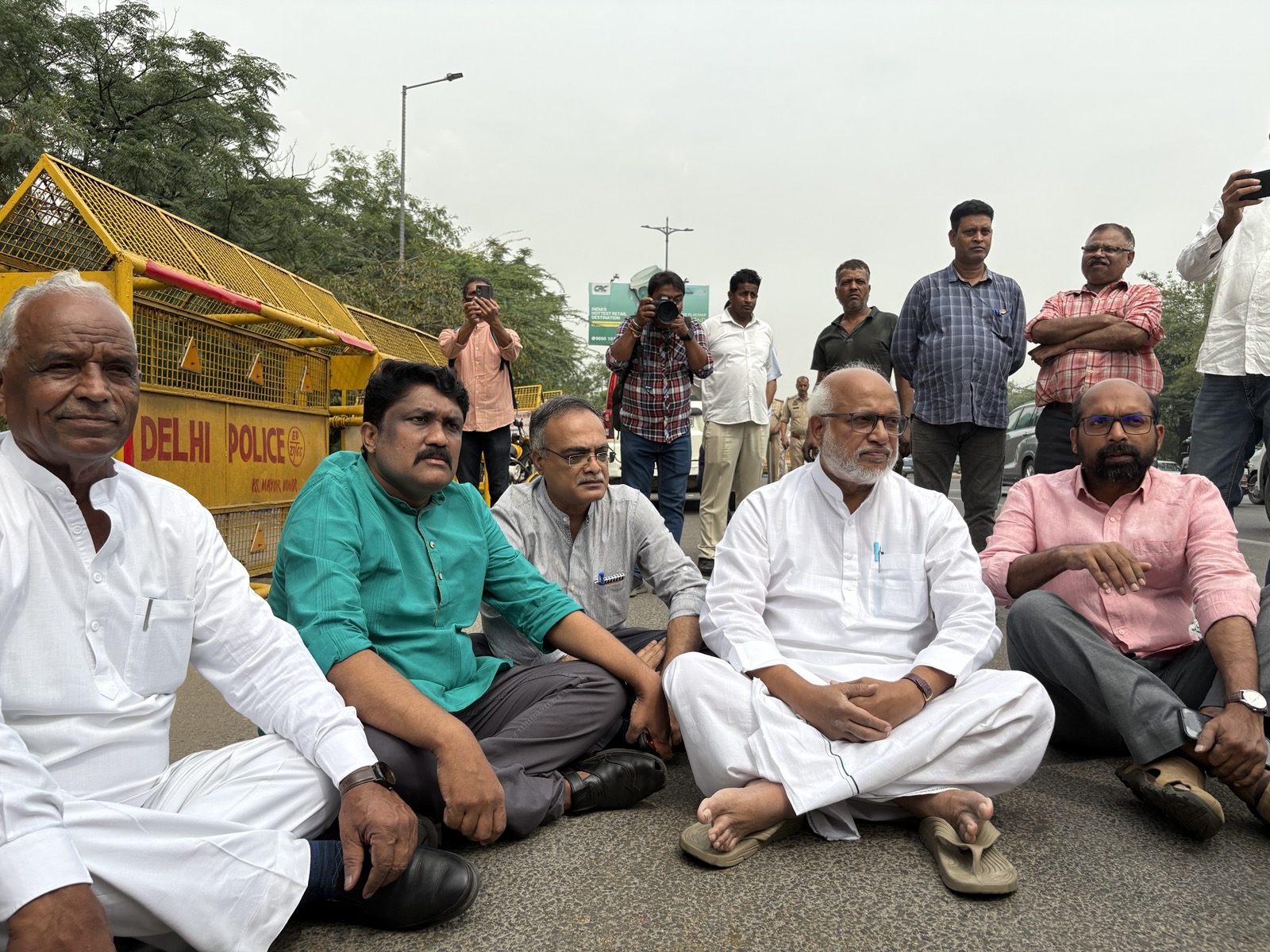
The CPI(M) delegation led by General Secretary, Com MA Baby, and comprising members of the parliament Comrades Amra Ram, John Brittas, V Sivadasan and A A Raheem along with the Delhi state secretary Com Anurag Saxena was first blocked by the UP Police at Chillah Border, enroute to visit the families of the affected workers and the DM. It was only after the leaders sat on the roadside in protest, that the police allowed them to move forward. They were taken to the camp office of the police. In the meantime, the police arrested Comrades Aniyan P V, Virendar Gaur (General Secretary and President of the state CITU) and Rajeev Kunwar (Delhi State secretariat member of the CPI(M)) and others those who had reached the DM office directly to be part of the delegation. Following this unnecessary police action, the delegation led by Com Baby sat on a dharna in front of the Camp office of the DM, Noida. After further talks, the administration agreed to release all the detainees. It was also assured that they will release all those innocent workers in batches. After the visit, Com Baby also wrote to the Prime Minister about the happenings in Noida. He demanded a uniform minimum wage of Rs 26,000/- across Delhi NCR and subsidised LPG cylinders to be distributed among workers. He also urged repeal of the four labour codes notified in November 2025.
Future Course
The future course of this battle in the Hindi heartland depends on the next move of the Central as well as the state governments towards the implementation of the now notified labour codes. A cursory look at the issues of minimum wage and working hours, which came to limelight through these struggles, shows that the government has to step back on both these counts. The government claims that all workers will now receive a minimum wage though the labour codes. However, it speaks of a 'Floor Level Wage' also alongside. According to the Floor Level Wage, the daily wage stands at ₹178—which is merely one-fourth of the current minimum wage in Delhi for a helper (₹710) and far less than the now revised Haryana (₹585/-) and Uttar Pradesh (₹527/-) wages. While the general demand is that, given the rising cost of living, the daily wage required for a family of four to survive should at least be ₹1,000, the government seeks to push workers toward a starvation wage. The second issue is the approval for 12-hour workdays—without any overtime pay. The employers have been allowed to push workers to work up to 12 hours a day, four days a week. The implication is clear, the work pressure on laborers will intensify, yet they will not receive the standard double rate for overtime work. The government has introduced a new rule regarding 'spread-over time,' under which employers are permitted to keep workers inside the factory premises for up to 12 hours, even if the actual working duration is only 8 hours. On issues such as statutory bonus, equal remuneration and work place issues of women workers as well, the new labour codes give relaxations for the employers. Each of these issues will face the wrath of the working class in the coming days and ultimately the new labour codes will meet the plight of the farm laws.
The workers who have come in contact with CITU in Noida during the struggles are more than convinced about the inadequate minimum wages, extended duty hours and their rights being snatched by the government under the garb of the labour codes. The numerous on-ground reports demonstrate the remarkable level of consciousness of workers who have been toiling under extremely exploitative conditions. It's this consciousness which forms the core of the working class resistance.
The coming days will see the strength, potential and class anger within this spontaneous movement being transformed into an organised counter-offensive against the capitalists and their political agents. The demand for uniform minimum wages across the NCR (a region of planned and integrated extraction of surplus value extraction with elaborated value chains for the capital) has been raised by CITU for the last decade and half, and in this struggle it has become the demand of the entire class. The agenda for the working class is clear and concrete - repeal of the labour codes, which seek to legalise neo-slavery, and defence of the rights of workers (including strict implementation of the revised minimum wages, while continuing to fight for higher wages)!


