Prachi Hatiwlekar
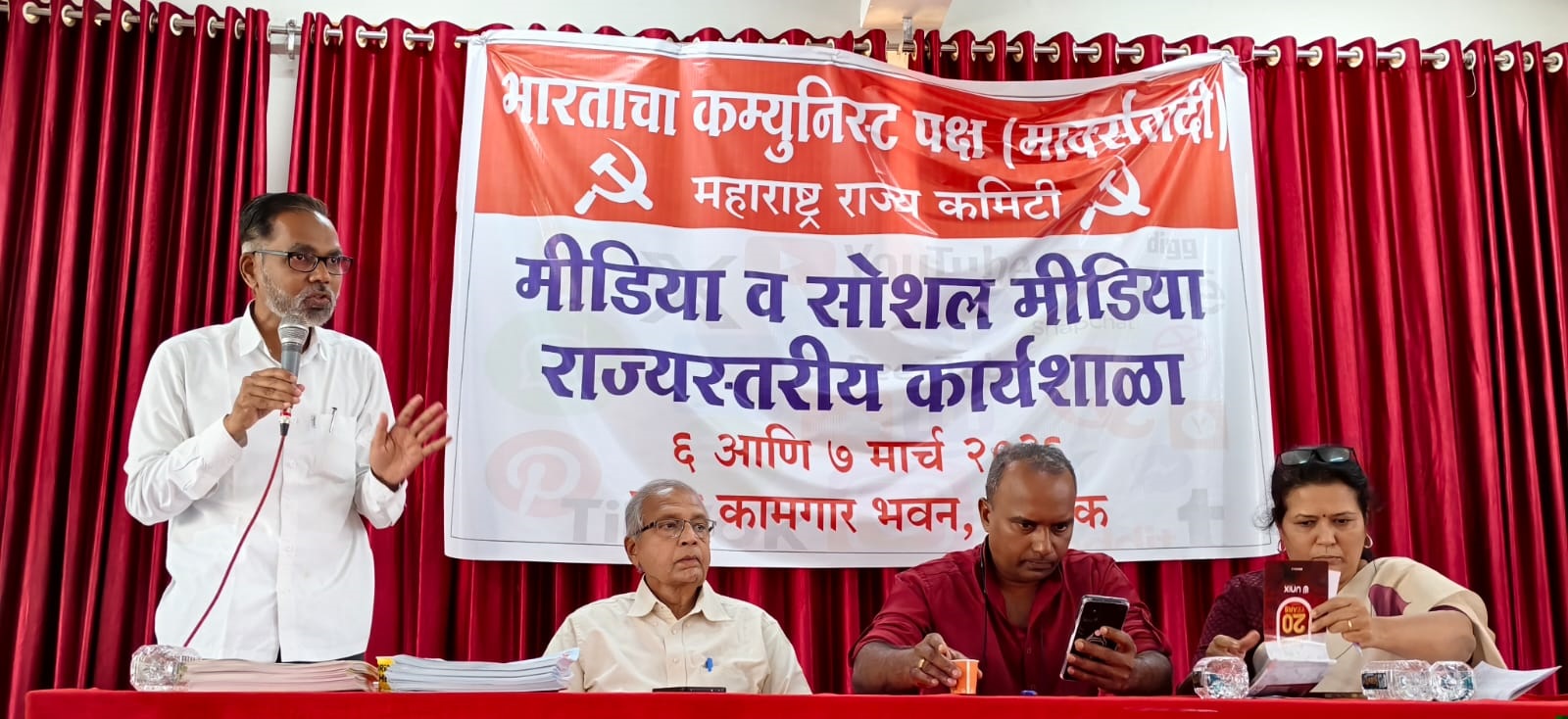
A two-day workshop on social media - an accessible, dominant, and cost-effective medium for communication and for disseminating the Party's policies and programmes to the widest possible audience - was held on March 6 and 7, 2026, at the CITU office in Nashik. It was attended by over 160 activists, predominantly youth, from 23 districts.
The workshop started with flag-hoisting by CPI(M) Polit Bureau member Dr Ashok Dhawale. In his introductory remarks, the Party's State Secretary Dr Ajit Nawale highlighted the significance of social media and outlined the Party's expectations from the team.
The first session, presided over by Shivaji Magdum, was conducted by Sonali Lochan, a member of the Party's central social media team. She said that, as newspapers are not too popular in the younger generation, we must focus more on attractive posters, memes, etc. It is essential to create some posts on a daily basis. While it is expected that these posts be created promptly, they should not be produced in a hasty or haphazard manner. Since we cannot afford paid promotions, the responsibility of continuously circulating the Party's posts to the public rests upon each one of us. Mainstream media outlets also keep a close watch on these platforms. Therefore, if an issue gets viral on social media, the mainstream media is compelled to take its cognisance. The best example of this was the AIKS-led Nashik to Mumbai Long March of 2018, and also the subsequent three Long Marches in 2026. She concluded with the significant remark that social media is not the ultimate "solution" to our problems, but just a medium to strengthen our struggles that are waged on the streets.
The second session, which was presided over by Rohidas Jadhav, was an interactive one conducted by Prathamesh Patil, founder-editor of the ‘Indie Journal’, on "Social Media - Methodology and Concepts". He emphasized that we must create our own content rather than just reacting to others’ propaganda posts. The political party that handles these platforms effectively, ultimately succeeds. We must ensure that we remain active and present in the arena. It is incumbent upon us to take the initiative in promoting and projecting our own leaders. We must maintain a constant dialogue with journalists. If we provide them with ready-made news reports—complete with selected, good quality photographs, they often publish the news as it is. Furthermore, we must always keep our response ready to address and counter any misinformation or malicious propaganda being circulated against our Party. He also stated that we must project the image of both our Party and its leaders effectively.
The third session, presided over by Maroti Khandare was "The Use of Media in Elections", conducted by journalist Roshan Deshmukh, who had managed the campaign for the Maha Vikas Aghadi (MVA) candidate in the Akole (ST) constituency in Ahilyanagar district. He noted that nowadays, we hardly get time for a door-to-door election campaign, as the election date is declared only a few days in advance. Hence, the public image of both our Party and the candidate must be consciously built on social media platforms well before the elections are even declared. Along with highlighting their strengths, one must also anticipate potential false allegations against them and have ready-made responses prepared. Further, comprehensive information about our rivals and how we want to portray their public image must be fully prepared in advance. He explained, in great detail, yet in a highly entertaining style, the specific precautions that must be taken during the actual campaign, given that every official social media post is subject to scrutiny by the election authorities.
The fourth session, on the second day of the workshop, presided over by Lata Gaikwad, was conducted by renowned Director of Photography Shubhra Datta, who addressed the subject, "Techniques and Skills in Photography and Videography." She provided hands-on training to the participants, covering everything from the basics of holding a camera to the actual creation of promotional posters and social media reels. She also offered a rather unconventional piece of advice: that alongside technical proficiency, physical flexibility and an unwavering focus on one's objective are absolutely essential for success in this field.
In the subsequent fifth session, which was moderated by Prachi Hatiwlekar and Prasad Subramaniam, representatives from all districts shared their feedback regarding the workshop and expressed their expectations from the Party. They also outlined the current scope of social media activities within their respective districts and detailed their plans for the future. This discussion will be very useful for the Party state leadership in formulating its future strategy. In the same session, journalist Navnath More explained the importance and the use of AI technology and how it has made things very simple.
During the concluding sixth session, Ajit Nawale announced the party's upcoming eight-point agenda and declared a six-member preliminary core committee. Prasad Subramaniam will be the convenor of this committee. He also announced the launch of the Party's new channel, ‘Jansanvaad’ and appealed to all to help to reach it to the widest possible audience.
CPI(M) State Secretariat member Dr D L Karad expressed his happiness that the workshop was being hosted at the CITU office in Nashik. He emphasized that social media possesses the potential to bring about a change in political power. He identified two primary dimensions in this sphere: one that addresses material concerns and the other that appeals to emotional issues. He asserted that both these aspects must be handled with care and sensitivity.
The concluding speech was by Dr Ashok Dhawale. He emphasized that while social media is undoubtedly extremely important, there is no substitute for class or mass struggles waged on the streets. The movement must be expanded by addressing issues of vital concern to the public, the party's organisational structure must be strengthened and, concurrently, our engagement in the social media must be significantly enhanced. He offered a valuable piece of advice: while working on social media platforms, one must never lose sight of the anger and the struggle against injustice, atrocities, inequality, and exploitation, the core inspiration that originally drove us to join this Party.
Following each session, Dr Ajit Nawale presented a summary of the proceedings in an effective manner. The Social Media Team - and particularly its convenor Prasad Subramaniam, put in great efforts to ensure the success of this workshop. The CPI(M) Nashik District committee made good arrangements for this workshop. The Nashik District CITU, the Nashik district AIKS, and the CPI(M) Kolhapur District Committee contributed one meal each for the delegates. The workshop concluded with a vote of thanks, accompanied by resounding slogans. After returning to their respective districts, the activists immediately launched a campaign to mark the Centenary Year of the historic Chavdar Tank Water Satyagraha at Mahad; through this initiative, they offered a fitting testament to the success of this workshop.


