NASA’s Artemis-II Mission: Moon Race 2.0 begins
Raghu
THE US National Aeronautics &Space Administration (NASA) launched its much awaited Artemis-II crewed mission, after several minor hiccups and postponements, on 1 April 2026 from the Kennedy Space Centre in Florida. The Orion spacecraft, launched by NASA’s revamped Space Launch System (SLS) rocket, carried 4 astronauts including one from the Canadian Space Agency on a 10-day mission around the Moon and back, as a precursor for a subsequent moon landing in 2028 and, in the longer run, establishment of a permanent space station on the lunar surface and possible onward missions to Mars. The Artemis programme is an international collaborative effort led by seven initial partners and joined by many countries including India. A key role is played by the European Space Agency which provides the rocket boosters which propel and power the Orion spacecraft beyond Earth’s gravity, during orbits around the Earth and Moon as required to set the trajectory, and similarly on the return journey.
The Mission marks the first time humans have returned to outer space beyond low-earth orbit, such as to the International Space Station, since the Apollo 17 moon landing by US astronauts in 1972. At that time, NASA had jettisoned its crewed lunar expeditions facing budget cuts against the backdrop of declining public interest in lunar expeditions, with audiences dropping sharply even for live telecasts of astronauts walking on the Moon reflecting an attitude of “been there, done that,” as well as dwindling political backing and a lack of the powerful motivation earlier provided by the space race with the Soviet Union which was considered won and done.
There is some sense of déjà vu now, since once again a space race, this time with China, appears to be propelling the US crewed space programmes aiming at prolonged presence on the Moon and potentially using that as a base for missions to Mars. China’s space programme is galloping ahead and targeting a crewed landing on the Moon in 2030. There can be no doubt this is accelerating the Artemis programme compared to the more leisurely pace, that too with fits and starts, of the earlier development phase of the SLS rocket and Orion capsule since 2016.
Just before the Artemis-II launch, the head of NASA, its Administrator and hand-picked Trump favourite Jared Isaacman, announced a revamp of the Artemis programme with new architecture and timelines. It was felt that the long interval between Artemis-I in 2022 and the present Artemis-II in 2026 has been too long, and such prolonged intervals do not enable efficient modifications and corrective actions, and an accelerated and more purposive architecture was required. A new Artemis-III mission was therefore added, before the planned crewed lunar landing in 2028. The new mission slated for 2027 would take a crew launched by SLS to low-earth orbit, where Orion would dock with the new lunar landing module, built by either SpaceX or Blue Origin depending on competitive evaluation, so as to test all systems before the moon landing in 2028 as per current schedule. The crewed moon landing would be achieved by Orion docking with the landing craft separately brought to lunar orbit probably by SpaceX’s Starship. After this several rather than a single or few additional crewed missions to the lunar surface would be undertaken during 2028-2030 to set up the envisaged permanent lunar station.
An additional budget of $1 billion has been provided for the revamped Artemis programme. However, this does not translate into money being thrown into the US space effort, since it is accompanied by a sharp cut in the overall funding for NASA, as discussed later.
The Mission
Artemis-II is chiefly a test flight to try out the rocket and the spacecraft, which incidentally are being used in a crewed mission for the first time. Whereas Artemis-I in November 2022 had tested the systems without crew, the present mission tries out the Orion space craft for sustaining human space flight, testing space flight operations and maneuvers by crew, and conducting a dress rehearsal for future crewed missions. So the main objectives of the mission do not involve major scientific experiments or mission goals.
The major aspects of the Artemis-II mission are a launch to orbit around Earth, a propulsion boost to take Orion beyond Earth’s gravity towards the Moon till ‘capture’ by the Moon’s gravity, a figure-8 trajectory around the Moon and back to Earth including a prolonged period on the far side of the Moon which is never seen from our planet, and back to Earth, executing the high-heat and high-risk re-entry through the atmosphere, finally splashing down in the Atlantic ocean on April 9.
While much has been made of the “record” set by Artemis-II and its crew for the longest ever distance any human has travelled away from Earth, this is really an incidental outcome of the trajectory planned. Apollo-13 held the previous record of traveling just short of 400,000km from Earth, whereas Artemis-II saw the crew traveling 404,410 km. At its closest point, Orion was 6,507 km from the Moon’s surface.
Other significant records in Artemis-II were the first woman astronaut, Mission Specialist Christina Koch, to travel around the Moon and the first black man, Pilot Victor Glover, to travel beyond low-earth orbit.
Far side of the Moon
Beyond records, the highlight of the mission has undoubtedly been the 40 minutes spent by the crew and the Orion spacecraft on the far side of the Moon, often mistakenly called the ‘dark side’ of the Moon. Due to the rotational speeds and orbital trajectories and periods of the Earth and Moon, only one side of the Moon always faces the Earth while the far side always remains unseen from here. However, this does not mean that the far side is dark. Indeed, the far side receives as much sunlight as the near or Earth-facing side of the Moon. Therefore, astronauts aboard Orion were able to gain an unprecedented view of the far side of the Moon for 40 minutes and more including some viewing time of parts of the lunar surface beyond the horizon. Of course, during this time, Orion lost all radio or other contact with Earth since all communication paths were cut off by the Moon obstructing ‘line of sight’ to Earth.
Again, it is not as if no humans have ever seen the far side of the Moon. In fact, all crew Members aboard lunar expeditions such as in the Apollo missions, whether only orbital or landing on the Moon, have seen parts of the far side of the Moon. However, focus of all those missions was on the potential or actual landing sites on the near side, and orbital trajectories were designed with this goal in mind. So those astronauts actually saw the far side of the Moon from closer altitudes than in Artemis-II which, however, also meant that they saw only parts of the lunar surface. The Orion spacecraft in the Artemis-II mission was over 4000 km from the Moon, so astronauts were able to see the whole lunar disc, which was also illuminated for part of the time.
The astronauts observed a vast region pitted by craters caused by impact of meteorites or space rocks, but with less of the characteristic large dark patches visible from Earth on the near side, believed to be the result of volcanic activity. At non-illuminated times, they also saw flashes of light caused by such impacts. They also observed brown, green and orange patches. All these and other observations may yield interesting insights.
The excitement of the crew was palpable from their emotional live reporting after emerging from the far side. Numerous high-resolution photographs from both hand-held and spacecraft-mounted cameras have also been transmitted back to Earth. Some spectacular visuals and photographs, one of an ‘Earthset’ or setting of the Earth behind the lunar horizon (Fig 1) analogous to a sunset, and one of a solar eclipse behind the Earth (Fig.2), were described by the Canadian astronaut as ‘mind-bending.’
A significant technological achievement was the use of the new Orion Optical Artemis-II Optical Communication System or O20 laser-based data communication system which enables data transmission at 260 megabits per second enabling high resolution data and 4k video transmission at much higher rates that radio transmission.
Oddities and novelties in Orion
The virtually round-the-clock live telecast from Orion and reportage also brought to life some of the oddities and specifics of space flight in general and the Orion spacecraft in particular.
Needless to say, there have been many changes in spacecraft design and construction since those now seemingly ancient Apollo days. There is more space to move around, although the priority of functionality over comfort or aesthetics continues to prevail. So wires and cables are still all over the place. There are only two relatively small windows in Orion, so astronauts had to watch the amazing spectacles on display in pairs, and the windows got dirty quickly, prompting queries to mission control for protocols on how to clean them! Sleeping arrangements continue to be tricky, since there are no fixed beds and, in zero gravity, there is no up or down, so with each astronaut had to work out their own method and location. One chose to sleep in her sleeping bag hanging ‘upside down’ like a bat, that is, with her feet towards the top of the spacecraft, another in a corner near the communication consoles, and yet another just floating mid-air! All reported getting adequate and comfortable sleep!
Then there was the toilet issue which had notoriously caused problems from the outset of the flight. Orion is the first spacecraft with a separate, closed and dedicated toilet, although the International Space Station (ISS) of course has one since astronauts stay on board for many months continuously. NASA has designed a Universal Waste Management System (USMS) with versions for the ISS and for the Artemis programme. Urine is recycled into potable water consumed by astronauts. Fecal matter is stored in special pouches which are dumped into space on re-entry where they burn up. Efforts are underway to filter out potable water from this matter too as would be essential for longer trips such as to mars. On Artemis-II, the urine froze inside the system thus clogging it for subsequent use. The problem was solved after two days, but the liquid had to be vented out into space in a procedure that was shown live, liquid droplets floating off into space for who knows how long, possibly containing bacteria into outer space!
New US attitude towards Space Science
A surreal moment during Artemis-II was a live call from US President Donald Trump to the crew aboard Orion. In his usual manner, Trump claimed that he had rescued NASA from being closed down, generously funded NASA and so on, and also praised a well-known Canadian ice hockey player and Canadian Prime Minister Carney having earlier attacked and derided Canada and demanded that it become a State of the US! These resulted in awkward silence from the crew requiring rescue by mission control checking audio transmission!
But nothing can hide the fact that the overall NASA budget has been slashed by as much as 23-25% with the science programmes undergoing a 47% reduction in grants, threatening Mars sample returns and more than 40 science missions, while privileging prestige projects such as Artemis which project US dominance in space, as prioritized by President Trump’s new executive Space Policy announced recently. There has been substantial resistance from scientists, think tanks and even the US Congress which reversed cuts announced in his first term, fearing cut backs and job losses in many constituencies around the US. Trump and his hand-picked NASA Administrator are focusing on the space race with China, cost cutting in NASA and commercial ventures in space. The latter may also threaten the Artemis programme which, at least on paper, emphasizes international collaboration in space for the common public good for all of humanity, whereas commercial activities in space such as for identification and utilization of resources will most likely lead to profit-making and narrow corporate interests. US priorities may well push this new space race in problematic directions.
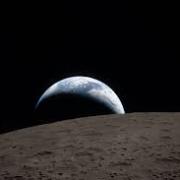
Fig 1: Earthset
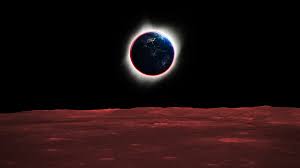
Fig 2: Solar Eclipse from the Moon


