Madhu Garg
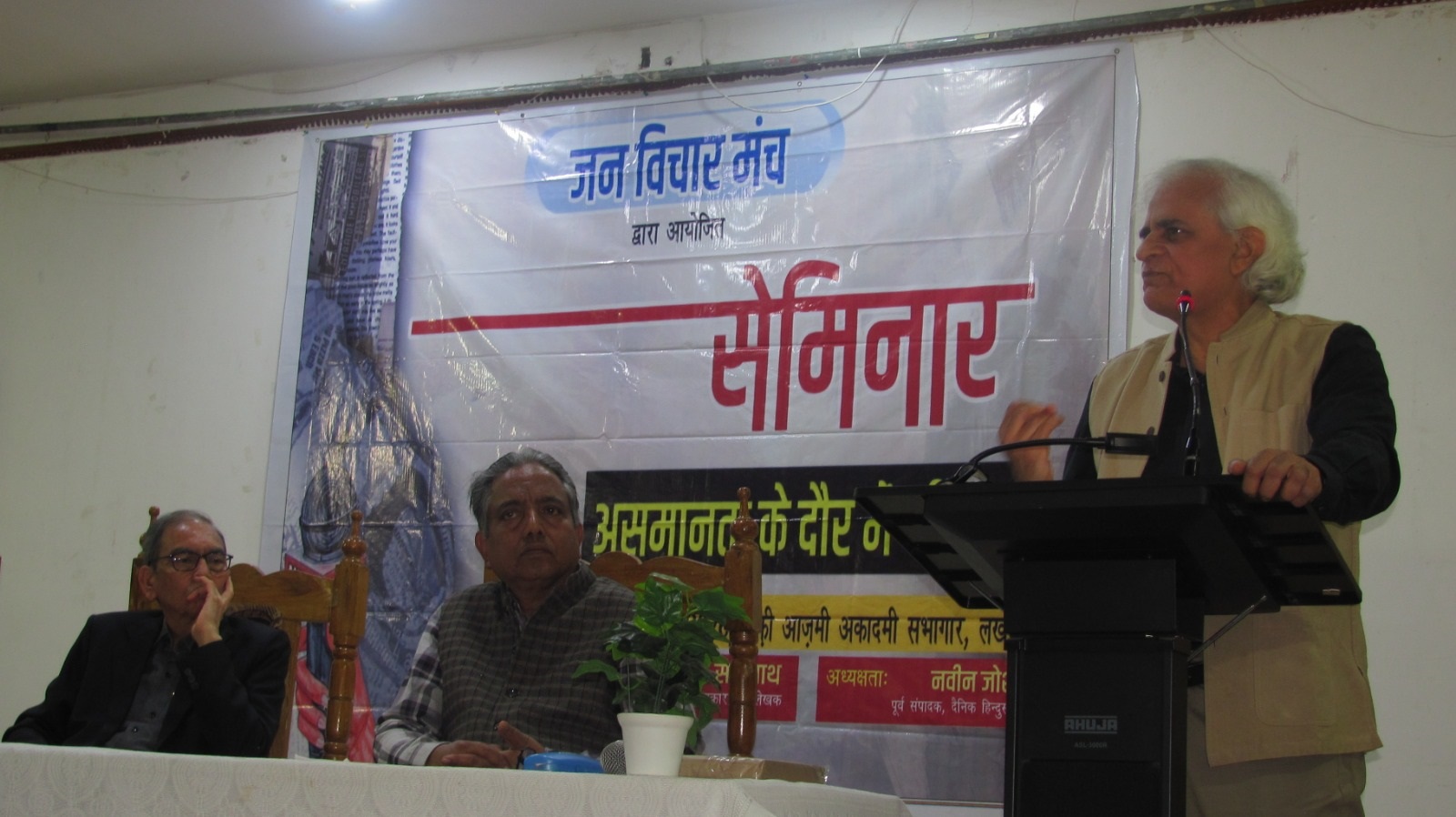
On 14 February, at a seminar organised by Jan Vichar Manch, Lucknow, the packed audience at the Kaifi Azmi Auditorium listened intently for nearly two hours to renowned journalist and writer P. Sainath. Prof. Nadeem Hasnain, the founder of Jan Vichar Manch, introduced Sainath and spoke about his books, especially ‘Everyone Loves a Good Drought’, which has a Hindi translation titled ‘Teesri Fasal’. Pratul Joshi conducted the program.
Summarising Sainath’s lecture into a few points is challenging. However, here are some key highlights:
He began his remarks with Anant Ambani’s wedding. In 2024, Rs 5,000 crore was spent on the wedding, which was attended by the Prime Minister, Governors, Chief Ministers, film stars, bureaucrats, and business owners. Meanwhile, in the Vidarbha region of Maharashtra, the daughters of three lakh farmer families could not get married due to financial struggles. Sainath stated that spending on Ambani’s wedding was more of a business investment, amounting to only 0.27 per cent of his wealth, which he easily recovered within one year. In such a high-profile wedding attended by politicians and senior officials, it is natural that corporate interests regarding forests, minerals, or public institutions would be prioritised.
While news of Ambani’s wedding filled media headlines for months, the plight of Vidarbha’s farmers went largely unmentioned. A survey indicated that a significant reason for farmers' suicides was their inability to marry off their daughters. No media outlet criticised the extravagance of the wedding or the farmers’ suicides.
Today, we are experiencing a severe phase of inequality – economic, social, judicial, linguistic, and gender-based. The notion that “everyone is equal before the law” is merely a theoretical statement. Arnab Goswami obtained bail within 24 hours for a serious case, while Kerala journalist Siddique Kappan spent two and a half years in jail for covering the Hathras case. When he became ill during COVID, he remained chained to a hospital bed in Mathura. In Lakhimpur Kheri, a minister’s son, Teni, killed nine people, including five farmers, with his car and is now out on bail. Umar Khalid has been imprisoned for five years without trial, despite Supreme Court judges asserting that “bail is the rule and jail is the exception.” Today, even a police constable seems more powerful than the Supreme Court.
Since 1991, economic inequality has been steadily rising in this country. In 1990, there were no billionaires. By 2024, there were 211 billionaires whose wealth accounts for 26 per cent of the country’s GDP. Their total wealth is 62 times the farmers’ budget. Regarding caste inequality, Sainath pointed out that 90 per cent of billionaires belong to upper castes. During the COVID pandemic, when 90% of the population faced distress, 24 new billionaires emerged, particularly from the pharma and healthcare sectors. According to Forbes magazine, India ranks third in the number of billionaires yet sits at 134th in the Human Development Index. This suggests that 1 per cent of the population controls 22.6 per cent of the nation's income. Even during British rule, the wealth gap was not as large as it is today. The freedom movement against British rule was also a fight against such inequality.
An ADR report states that among 543 MPs in Parliament, 30 per cent were crorepatis in 2004; 58 per cent in 2009; 88 per cent in 2014; and 93 per cent in 2024. Among them, 42 per cent are crorepatis with assets exceeding Rs 10 crore and yet they claim to represent the country’s poor. The report also shows that the success rate in winning elections for wealthy candidates is 19.6 per cent, while for candidates without money, it is just 0.7 per cent.
The government has restricted funding for opposition parties, as anyone who provides funds risks imprisonment. The Electoral Bonds scheme has also been exposed.
It is often said that anyone can become an Ambani through hard work, but who works harder than the working women of this country? Citing an ILO report, Sainath noted that working women globally perform a total of 12.5 billion hours of unpaid work daily, valued at $10.8 trillion. On the contrary, Elon Musk is projected to earn $1 trillion soon. This reflects gender inequality, which Oxfam identifies as discrimination at three levels: caste, class, and gender. To earn wealth comparable to Ambani’s, one would need to work for over 5,090 years.
Speaking about corporate control over media, Sainath mentioned that the media industry was valued at Rs 1.4 trillion in 2023 and is expected to grow to Rs 2.7 trillion by 2025. This surge happened after Ambani’s Jio merged with Disney Hotstar, leading to a 32 per cent increase in value from a single trade deal.
Corporates are also intervening in government programs for women. Reflecting on recent assembly elections in Bihar, where women were promised Rs 10,000, he questioned the source of this money. Funds are being diverted from women’s programs like Anganwadi, Mid-Day Meal, and Balwadi. Akshaya Patra has entered the Mid-Day Meal scheme, claiming to provide satvik food to 2.4 million children. In Odisha, Vedanta Group is running Anganwadis, while Adani operates Anganwadis in Navi Mumbai. This shows that after extracting trillions, small amounts are being handed out, and the government is shirking its responsibilities.
Sainath described the farmers’ movement as the largest movement globally in the last 30 years, which demanded justice over 52 weeks. It openly challenged profit-driven corporates, yet it was largely absent from media coverage. Even during the pandemic, farmers remained camped at the borders of Delhi, enduring heat, cold, and rain, resulting in the martyrdom of 720 farmers.
On the issue of the media misleading the public about Trump’s tariffs, he used the example of Maharashtra. Cotton farmers managed to secure an MSP of Rs 8,125 per quintal through their efforts, but after Trump imposed tariffs, the government retracted the excise duty on cotton, causing prices to plummet. Soybean farmers are also facing serious ruin. Tariffs on leather could shut down small tanneries in Tamil Nadu, many owned by Dalits. The media, echoing the government, misleads the public on tariffs.
Today, journalism is fading and being replaced by media. Journalism aims to represent the people's voice, while media exists for profit. Today’s journalists often act as stenographers, merely typing what they are told by their masters. Securing government ads has become the primary goal. Almost all newspapers and channels are under corporate control, with Ambani owning a majority of television channels.
Ambedkar and Gandhi were remarkable journalists, each publishing three newspapers. Bhagat Singh is remembered as a revolutionary and martyr, but he was also a significant journalist who wrote in Hindi, Urdu, Punjabi, and English, voicing the concerns of the people; he even studied Persian while in jail. At just 23, he achieved so much, while, as Sainath jokingly remarked, he began his journalism career at the same age.
In conclusion, Sainath emphasised that we cannot expect change in favour of the poor under this capitalist system, regardless of which government is in power. We need to organise with the public to demand that the right to work, the right to education, and the right to food be recognised as fundamental rights in the Constitution. We must question what happened to the promise made within ten years of independence regarding compulsory education for all.
Presiding over the seminar, Naveen Joshi, former editor of Hindustan and a senior journalist, remarked that today the press operates like a factory, newspapers are treated as products, and readers are viewed as consumers. Newspapers cater to the economic status and interests of their readers. There is little space left for villages and the issues faced by ordinary citizens.
Sainath and Naveen Joshi addressed questions from the audience with great attention. It was a deeply significant discussion.


