Archana Prasad
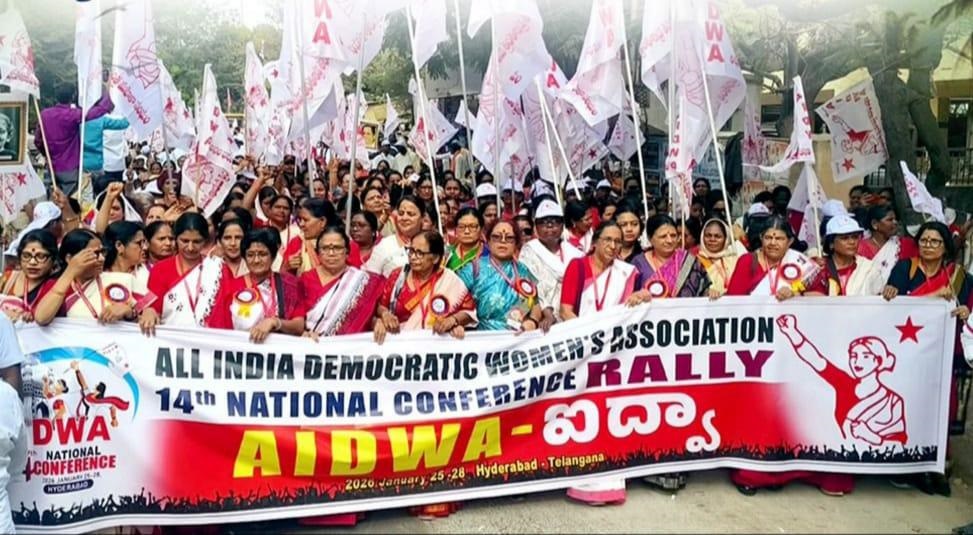
The 14th National Conference of the All India Democratic Women’s Association (AIDWA) was held in Sarojini Balanandan Nagar and Chandrakala Pandey Hall, RTC Kalyan Mandapam, Hyderabad, from January 25-28, 2026. This was the first AIDWA National Conference held in Telangana. It was attended by 809 women delegates and observers from 25 states.
INAUGURAL SESSION
The Conference began with the flag hoisting by National President P K Sreemathi amidst enthusiastic slogans of ‘AIDWA Zindabad’ and ‘Inquilab Zindabad and homage at the Martyrs Column.
Renowned actor and screenwriter Rohini Molleti inaugurated the conference. with P K Sreemathi presiding. The condolence resolution paid homage to the the leaders and activists of the women’s and other democratic movements who passed away since the last conference. Tributes were paid to deceased cultural personalities, intellectuals and the victims of communal and post-poll violence. Eminent educationist and chairperson of the Reception Committee Prof Shantha Sinha welcomed the delegates.
Rohini Molleti saluted the struggles of AIDWA activists and said that ‘struggles were the only path to equality’. She highlighted that a woman’s struggle must begin from the home and continue in all spheres of public life where she faced discrimination. Addressing the audience in English, Telugu, Tamil and Malayalam, she highlighted the role of artists, writers and performers in taking progressive ideas and struggles to the people.
The keynote address by AIDWA patron and ex-MP Brinda Karat emphasised the AIDWA’s role in leading the fight for democratic rights against political repression, violence against women, and social and economic injustice. She stressed the need to intensify solidarity with anti-imperialist struggles in Palestine and Venezuela and expressed shame over the Modi government’s subordination to US imperialism. The need to build up a massive campaign against attacks on women’s right to work and loot of MFIs was also pointed out. P K Sreemathi delivered the concluding speech.
SYMBOLS OF RESISTANCE
AIDWA honoured four women as symbols of resistance at the inaugural session - Rani from Dharmapuri district, Tamil Nadu, for her ongoing fight against the molester of her daughter, Bibi Ruksar from Araria, Bihar, for her struggle for survival after she was forced to return to her paternal home because she bore a girl child, Razia Banu from Bikaner, Rajasthan, who fought the oppression of microfinance companies with the help of AIDWA and now organise other indebted women, and Divya Arul, an accomplished mountaineer from Puducherry who successfully climbed Mount Elbrus, the highest peak in Europe, and Mount Kun, one of the most challenging Himalayan peaks. The conference also honoured Miha, the first woman national level basketball player from Telangana.
MASSIVE PUBLIC MEETING
Aa massive public meeting was held on January 25 at the RTC grounds. It was attended by more than 13,000 women from many districts. AIDWA Telangana state secretary Mallu Laxmi welcomed the participants and state president Aruna Jyothi proposed the vote of thanks. The main speakers were National President P K Sreemathi, General Secretary Mariam Dhawale, Patron Brinda Karat, Vice President Subhashini Ali, Treasurer S Punyavathi and Former MLA Julkani Ranga Reddy. All speakers highlighted the need to oust the RSS-BJP regime and combat the corporate-Hindutva nexus.
REPORT ON INTERNATIONAL AND NATIONAL DEVELOPMENTS
The delegate session elected a Presidium with P K Sreemathi (President), Monalisa Sinha (West Bengal), Aruna Jyothi (Telangana), Sunita Shingda (Maharashtra), G Pramila (Tamil Nadu), and Usha Saroha (Haryana). General Secretary Mariam Dhawale placed the 58-page Draft Report.
The international section highlighted the growing vulnerability of women globally, even 30 years after the Beijing Declaration. According to the UN, 55 per cent of member countries did not have any protective laws for women and around 8 per cent of the world’s female population lived in increased poverty. Women’s unpaid and domestic work had increased to about 2.3 hours per day by 2023. The section condemned the attack on Venezuela and the forced abduction of President Nicholas Maduro. It noted the impact of the genocide on women and children and condemned the imperialist designs in Palestine. The growing anti-imperialist protests and the participation of women against conservative and right-wing forces are a ray of hope in this situation.
Nationally, the report highlighted the impact of communal Manuwadi politics and pro-corporate policies on the life of women, on how this degrades the ability of state governments to undertake women’s welfare measures. The attacks on votin rights and the government’s influence on the Judiciary and Election Commission also illustrate neo-fascist characteristics. Persistent agrarian and economic distress have created an unemployment crisis and rising malnutrition and hunger. The report noted the increasing communal attacks on minorities, rising violence against women, particularly from the minority, dalit and adivasi communities.
The discussion on the report highlighted multiple state-level experiences -price rise, lack of access to affordable food, education and healthcare, the corporate takeover of land, repeal of MNREGA and enactment of VB-G RAM G Act. Delegates noted that economic crisis and lack of jobs was driving women into indebtedness and exploitation by MFIs. The anti-women politics of the ruling BJP was seen in its attempt to shield the accused in cases of rape, assault and harassment.
REPORT ON WORK AND ORGANISATION
General Secretary Mariam Dhawale placed the 56-page report on work and organisation and highlighted the sustained work and diverse campaigns over the last three years.
Around 8,000 AIDWA members from across the country attended the massive “Chalo Delhi” rally on October 5, 2023, against the BJP government’s anti-people policies. Under the banner of “Let’s protect women, the country, and women’s rights” jathas, jeep yatras, and marches were also held in local areas. On August 17, 2023, several victims of the anti-women government policies and AIDWA national leaders spoke at a national convention titled “BJP-RSS Hatao, Mahila Bachao, Desh Bachao” in New Delhi. A nationwide campaign against the Modi government was carried out and the AIDWA booklet, ‘Modi Sarkar, Anti-Women Sarkar’ was sold in thousands all over the country.
A nationwide signature campaign was carried out in support of the wrestlers who were sexually harassed by BJP leader Brij Bhushan Sharan Singh. Countrywide protests were held against the violence in Manipur and the death and displacement of several thousand people. Meetings, dharnas and protests at government offices and public places demanded action to stop the violence. On August 14, a historic "Reclaim the Night" protest saw students, youth, and women on the streets raising the slogan, "We want Justice, We deserve Justice, Fight for Justice" against the horrifying rape and murder of a doctor in R G Kar Hospital in Kolkata.
Nationwide Social Justice Jathas in villages/talukas/districts started on April 14, 2024, the birth anniversary of Dr B R Ambedkar, against the communal poison spread by the BJP-RSS.
The National Public Hearing on Increasing Women’s Indebtedness and MFI loot was held on August 23-24, 2025, in New Delhi with an eminent jury of Justice Madan Lokur, Prabhat Patnaik, Thomas Franco, Pamela Philipose and Kirti Singh. The Hearing followed AIDWA’s all-India survey of over 9,000 women in 21 states and nearly 100 districts on the loot and violence by MFIs.
Sustained campaigns were conducted against communalism, for universal public distribution systems, for proper implementation of MGNREGA, and getting justice for victims of assault and violence. As a result, AIDWA membership has grown in many states, consistently crossing 1 crore in the last few years.
The General Secretary focused on the need to have a strong team at the central office as the backbone and to provide inputs to states for their campaigns. The main task was to build a capable team with collective functioning and individual responsibility. The need to improve coordination with and between states, to strengthen the unit committees and to expand the organisation in rural areas.
COMMISSION PAPERS AND RESOLUTIONS
Fruitful discussions were held on seven commission papers - 1) Women and imperialism today (by Malini Bhattacharya); 2) Deepening effect of Manuwadi ideology on laws relating to women (by Kirti Singh); 3) Caste, gender inequality and class struggle: New challenges in the time of Hindutva (by Subhashini Ali); 4) Overworked and underpaid: Women ‘informal’ workers in 21st century India (by Archana Prasad); 5) Urbanisation and the smart city mission (by Madhu Garg and Sandhya Shaily); 6) Sports and women (by Jagmati Sangwan), and 7) Women in the digital world and increasing cybercrimes (by P Satheedevi).
The conference passed 18 resolutions – 1) Against imperialist genocide and in solidarity with Palestine; 2) Against the US imperialist attack on Venezuela; 3) Against flawed SIR; 4) Against communalism and its impact on women; 5) Against saffronisation, commercialisation, and centralisation of higher education; 6) Against saffronisation of school textbooks and syllabus; 7) For repeal of anti-women labour codes, the proposed national labour policy 2025 and support to the 12 February national strike; 8) Ensuring right to safe and affordable credit for women; 9) Against attacks on right to work and VB-G RAM G Act; 10) Highlighting the Kerala LDF government’s achievements in women’s welfare and social justice; 11) Calling for climate justice and resistance to environmental degradation; 12) Against assault on adivasi rights; 13) Ensuring equality, dignity, and justice for Dalit women; 14) Opposing school mergers and closures; 15) On right to health care for all; 16) Against price rise and for universal PDS; 17) Against cash for votes at time of elections; 18) Against drug cartels.
PUBLICATIONS, CULTURAL PROGRAMMES AND EXHIBITIONS
Seven publications were released during the conference: 1) Women’s Rising Indebtedness and the MFI Loot: Report of the Nationwide Survey & National Public Hearing; 2) Susheela Gopalan, written by Geena Kumari; 3) Transforming Women’s Lives and the Left Alternative - the Kerala Story, by AIDWA Kerala state committee; 4) English translation of the report of the First State Conference of the Andhra Mahila Sangha by AIDWA Andhra Pradesh state committee; 5) Telugu translation of the CEC pamphlet by Subhashini Ali for the Social Reform Jatha; 6) Compilation of S Punyavathi’s Telugu articles; and 7) A booklet on women in the Telangana Armed Struggle (from P Sundarayya’s book) by AIDWA Andhra Pradesh & Telangana state committee. These works highlight the perspective, history and campaigns of AIDWA.
Two exhibitions were put up during the conference, a photo exhibition that was inaugurated by General Secretary Mariam Dhawale on January 24 at the Sundarayya Vignyan Kendram and an art exhibition at Sarojini Balanandan Nagar, RTC Kalyan Mandapam, opened by R Bindu, Kerala Minister of Higher Education, on January 25. A play on Ambedkar was performed by a famous cultural troupe on January 26. Praveen and Ranjana Jaret and team delivered a joyous musical performance on January 27.
CREDENTIAL COMMITTEE REPORT
For the first time the credential committee forms were filled online, and quite successfully. Credential Committee Convenor Prachi Hatiwlekar presented the report. In all 809 women from 25 states attended the conference as delegates and observers. They belonged to diverse backgrounds, a significant proportion were dalits. More than a third of were below the age of 50, the oldest was 75 and the youngest 26. More than one third reported inter-faith and inter-religious marriages. 50 per cent had own choice marriages. 129 had been jailed during struggles, with Hemavati from Tamilnadu serving the longest period of about 5 years in jail.
GREETINGS SESSION
Leaders of the National Federation of Indian Women, All India Progressive Women’s Association, All India Mahila Sanskritik Sangathan greeted the conference. Greetings from fraternal organisations were expressed by Sudip Dutta (President, CITU), Vijoo Krishnan (General Secretary, AIKS), A Vijayaraghavan (President, AIAWU), Himaghnaraj Bhattacharya (General Secretary, DYFI), Shilpa (Vice President, SFI) and A R Sindhu (Secretary, AIWWCC).
THE NEW TEAM
A Central Executive Committee of 109 members was elected. 17 members were relieved, 20 new members inducted. A 36-member National Secretariat was also elected with P K Sreemathi as President. Mariam Dhawale was relieved as General Secretary as she had completed three terms. Kaninika Ghosh was elected General Secretary and Tapasi Praharaj Treasurer. S Punyavathi, the former Treasurer, was relieved at her own request.
There are 18 elected Vice Presidents: Subhashini Ali, Mariam Dhawale, S Punyavathi, U Vasuki, Sudha Sundararaman, Jahanara Khan, K K Shailaja, Sathi Devi, Susan Kody, P K Zainaba, Kirti Singh, Rampari, Debolina Hembram, Jagmati Sangwan, Madhu Garg, Brinda Debbarma, G Pramila, K S Saleekha. The 10 newly elected Secretaries are: Krishna Rakshit, C S Sujatha, N Sukanya, Asha Sharma, Prachi Hatiwlekar, T N Seema, Mallu Laxmi, Monalisa Sinha, A Radhika and Swapna Dutta. The 5 elected assistant secretaries are: T Devi, Savita, Archana Prasad, Maitreyee Mishra and V Savithri.
Malini Bhattacharya and Rama Das were elected Patrons in addition to the existing patrons Brinda Karat, Banani Biswas and Rekha Goswami.
CLOSING SESSION
The outgoing General Secretary and Treasurer were felicitated. Amidst thunderous applause, outgoing general secretary Mariam Dhawale delivered an inspiring speech, thanking all who had made her three tenures successful and emphasising teamwork. She pledged that she would continue working for the organisation.
The new General Secretary, Kaninika Ghosh, called to make the general strike of February 12 a massive success and to build a massive campaign to restore MNREGA and oppose the exploitation of MFIs.
In her closing presidential address P K Sreemathi thanked the Telangana AIDWA and volunteers and exhorted the delegates to build a strong movement to counter the corporate-communal nexus. The Conference ended with the rendering of ‘We Shall Overcome’ in multiple languages.


