Sudhanva Deshpande
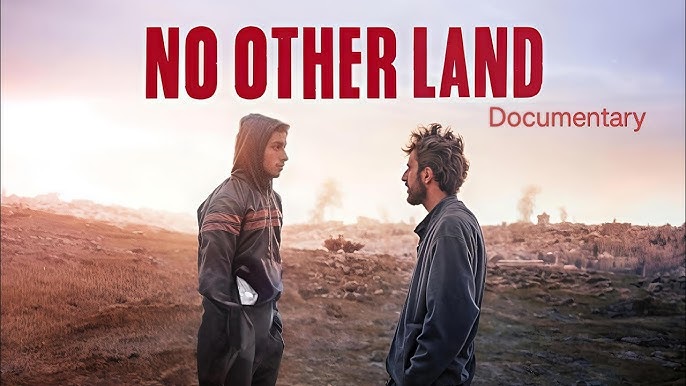
Nothing could be plainer to see than Israel’s colonial occupation of Palestine. Yet, every time a film shows us this plain fact, it becomes ‘controversial’. So it was that when the documentary film No Other Land (2024, directed by Basel Adra, Hamdan Ballal, Yuval Abraham and Rachel Szor) won several international awards including at the Berlin Film Festival and the Academy Awards (known popularly as the Oscars), it was seen as being ‘controversial’. Closer home, when the central government withheld permission for several films to be screened at the International Film Festival of Kerala, the list included four films from or about Palestine.
No Other Land shows, over four painstaking years, from 2019 to 2023, the unrelenting cruelty of Israeli occupation in the West Bank. Any film that exposes the reality of the Israeli settler-colonial project is bound to come under attack. Thus, expectedly, it was called antisemite by Israeli government officials, right-wing Zionists in Israel, and the pro-Israeli lobby in the United States and several European countries.
That the film did not find a single commercial exhibitor in the US, despite its Oscar win, is hardly surprising. The pro-Israel lobby has long dominated the film business in Hollywood. What should normally have been surprising, but sadly is not, is that it had to be withdrawn from the MAMI Mumbai Film Festival 2024 because of the lack of ‘required permissions’.
Given that it evoked such strong reactions from those who stand with the Israeli state, one would have thought No Other Land would be welcomed by Palestinians. Surprisingly, a section of Palestinians were also opposed to it.
Before we get to that though, more about the film itself.
Two of the directors, Basel Adra and Hamdan Ballal, are Palestinians from the West Bank and two, Yuval Abraham and Rachel Szor, are Israeli Jews. In the film, we see Basel Adra and Yuval Abraham become friends, and one arc that runs through the film is this unlikely friendship. The other arc that runs through it, and this is the reason the two protagonists meet in the first place, is the relentless attacks on, and displacement of, Palestinians in Masafer Yatta in the West Bank. Basel is from there, and over the years, he has recorded hundreds of hours of footage of the Israeli attacks on the land and the people.
Yuval Abraham is a journalist, and he comes to Masafer Yatta to report. He has the belief that things can change if regular Israeli citizens, like himself, were better informed about what’s going on. He seems to genuinely believe that lack of information is the problem. Now, whether one characterizes his belief as innocent, or naïve, or utopic, or delusional, can be debated. What cannot be debated is that it is simply misplaced. Neither Israeli public opinion, and certainly not actions of the state, can be changed by providing better or more accurate information.
As the film progresses, we see homes being bulldozed – and for Indian viewers that is a particularly evocative and painful sight, given the weaponisation of the bulldozer by the BJP – and Palestinians being evicted. Some resist, and pay the price. Harun Abu Aram, a resident of Masafer Yatta, is shot by an Israeli soldier as he protests the soldiers stealing his electric generator. Harun is paralysed and his home destroyed, because of which he has to move to a cave, where he eventually dies.
At the end of the film, Basel Adra’s cousin Zakaria al-Adra is shot by an Israeli settler, ostensibly as revenge for October 7. Zakaria was unarmed when he was shot. His shooter was identified as Yitzhak Nir. He was not charged for his crime. Violence towards, and hatred of, Palestinians runs in his family. His father and uncle had killed three and injured several at Hebron University in 1983.
Violence continued beyond the filming of the documentary. Basel Adra was attacked by Israeli settlers in February 2025. The following month, his other Palestinian co-director Hamdan Ballal was attacked in his home by Israeli settlers. He suffered head injuries. When he was being taken to hospital, the Israeli forces intercepted the ambulance and arrested him for a day. Then, in July 2025, a consultant to the film, Awdah Hathaleen (also spelt Odeh Hadalin) was shot dead by a fanatic Israeli settler.
Despite all this, the Palestinian Campaign for the Academic and Cultural Boycott of Israel (PACBI) criticized the film, viewing it as indulging in what is called ‘normalisation’ in Palestine. ‘Normalisation’ refers to instances of Palestinians and Israelis working together to create ‘dialogue’ and ‘understanding’. By doing so, it is argued, the occupation is ‘normalised’. The PACBI statement said ‘Palestinians do not need validation, legitimation or permission from Israelis to narrate our history, our present, our experiences, our dreams, and our resistance.’ While this sentiment is unexceptional, whether it applies to No Other Land is open to debate.
And, indeed, many in Palestine have praised the film. And certainly, for us in India, somewhat removed from these debates among Palestinians, the film provides a moving and gut-wrenching portrayal of the daily viciousness that is meted by the Israeli state and Zionist fanatics on ordinary Palestinians.


