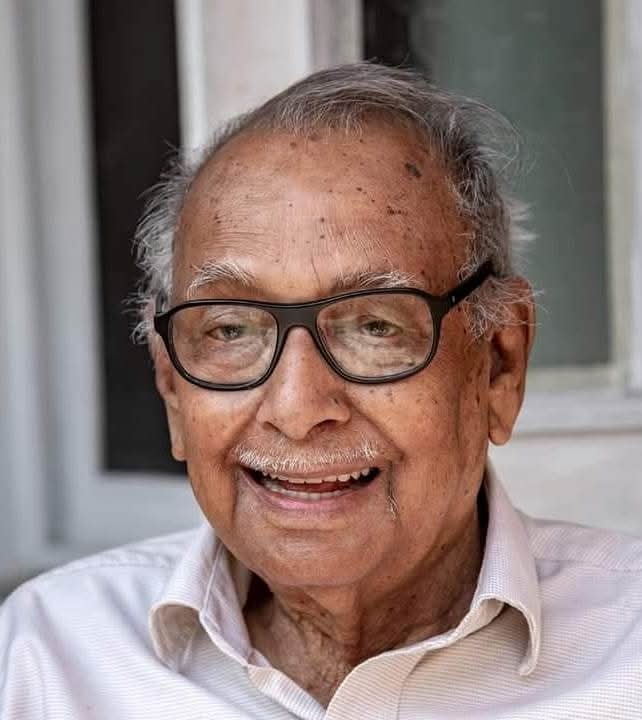
Shreekant Mishra
Chandrasekhar Bose, who passed away on 16TH January at the age of 104, was a doyen of the insurance employees’ movement, founding member of the All India Insurance Employees’ Association (AIIEA), and a beloved leader of generations of insurance employees. At the time of his death, he was the oldest living member of the CPI(M). It is to be noted that Bose attended and addressed the Platinum Jubilee Year and 27TH General Conference of AIIEA in Bhubaneswar from 28TH December 2025 to 1ST January 2026. As he slowly ascended the five-foot-high stage, aided by a group of young volunteers, the entire hall erupted in joyous applause, celebrating not just his arrival but a century of dedication, commitment, resolve, and conviction.
Born on 14TH December 1922 in Jessore district (now in Bangladesh) of undivided India, Bose joined Hindustan Co-operative Insurance Company in January 1944. Coming from a well-educated middle-class family, he had many choices including a very rewarding career in the insurance industry, but he chose to work to ameliorate the gruelling working conditions in the private insurance industry. It was not easy to take the initiative for organising the employees under private management in the pre-independence days. Countless hurdles and dangers had to be confronted on the way. Bose, however, could do it because of his irrepressible courage, self-confidence, unfathomable love for his fellow workers and above all because of his firm political beliefs and commitment to the ideology of the working class.
Bose was drawn into the national liberation movement at a very young age. It was during this period that he came in contact with the stalwarts of the freedom movement and firmed up his political beliefs. He was clear right from his formative years that injustice anywhere is injustice everywhere. The trial of the imprisoned soldiers of the Indian National Army and the Naval Mutiny in Bombay (now Mumbai) rekindled a new revolutionary zeal in the young Chandrasekhar Bose. He, like many of his contemporaries, had hoped that freedom from British colonial rule would usher in freedom for the working class, peasantry and other toiling sections of society and ensure a decent life for all of them. But his hopes were dashed when that did not happen. This further motivated him to carry on the struggle for the true emancipation of the working class.
Bose was drawn to the emancipatory ideology of Marxism at an early age. He founded a unit of the All India Students’ Federation in Khulna in 1936 when he was in the tenth grade. He would often reminisce with justifiable pride as to how they used the surplus money of 12 annas (75 paise in today’s currency) from their school Saraswati Puja to get a flag of the All India Students’ Federation with freedom, peace and progress printed on it. He obtained the membership of the undivided Communist Party in 1944 in a unit at the state centre in Kolkata. He worked in close coordination with eminent leaders like Comrade Bagla Guha, Comrade Nepal Nag and Comrade Nivedita Nag. He has never looked back since then.
Hindustan Cooperative Insurance, where Bose was working, was the second biggest life insurance company in India then. Owned by a Congress leader and minister, the company was a den of exploitation. The monthly salary of the employees was a pittance - only Rs 40! The efforts that began in uniting the employees against the exploitative working conditions in the private insurance companies finally culminated in the formation of the All India Insurance Employees’ Association (AIIEA) in 1951. The formation of the AIIEA was the turning point in the life and struggle of insurance employees. Bose was elected as the general secretary of AIIEA in its second conference in 1955 and continued in that post till 1959. In 1973, he was elected as the president of AIIEA and continued in that post up to 1994. In the intermediary period, he was the vice-president of AIIEA. He played a stellar role in bringing together employees from all over the country under the banner of the AIIEA. Ever since he has not only been associated with all movements of the AIIEA, he has imparted leadership and vision to all the struggles of AIIEA. Be it the struggle for nationalisation of life insurance, struggle for standardisation of wages after nationalisation, struggle to secure bonus for LIC employees defeating the government’s decision of “no bonus in nationalised industry”, struggle to secure DA based on price index, struggle to introduce LTC, the glorious struggle against automation in the sixties, struggle for nationalisation of general insurance, the long and arduous struggle to defeat the lockout, struggle against the ill-conceived move to split the LIC into five independent corporations, the struggle to secure pension for the insurance employees, epic struggle against the privatisation of public sector insurance industry, struggles for wage negotiations and efforts to bring about improvements in the material life of insurance employees -- all these bear the unmistakable imprint of Bose’s skillful negotiations, careful strategising, masterclass planning for agitation, and flawless execution.
Bose was something more than a mere trade unionist. A gentleman to the core, his cool and amiable temperament coupled with his persuasive manner could convert even a sworn enemy into a lifelong friend. He was an inexhaustible reservoir of patience. He was not only a leader, but a leaders’ leader. He identified, nurtured and groomed generations of leaders and activists for the organisation. Almost all the leaders of the AIIEA – both past and present -- have grown under his tutelage. It would be a truism to say that the biggest strength of Bose was the strength of his character. AIIEA veteran Sunil Moitra used to say about him: “Even in the realm of thought, Chandrasekhar cannot be false. In my long and close association of 35-36 years with him I have not heard him speak untruth even once. By today’s standards, many may consider him outdated.” Another AIIEA veteran, N M Sundaram, was a bit philosophical when he remarked: “Perhaps it would not be proper from the point of view of ideological purity to identify an organisation with an individual. But there are times, when exceptions are compelled to be made by the sheer personality of the individual and the enormity of his contribution to the organisation. If such an exception could be made, it could be in the case of Bose. His personality has indeed become synonymous with the organisation, AIIEA.” AIIEA doyen Saroj Chaudhury was perhaps echoing the sentiments of thousands of members of AIIEA across the country when he said, “Comrade Bose has shown extraordinary skill in guiding towards the path ahead, and most of it has taken place away from the public gaze, where no cheap back-patting was there, no roar of clapping out of enthralled wonder.”
The demise of Bose is an irreparable loss to insurance employees’ movement. Insurance employees’ movement has lost its tallest guiding light; but his legacy will continue to inspire us, guide our struggles, and strengthen our resolve to carry forward the ideals he stood for.


