Scrapping MGNREGA is an Assault on Constitution
Brinda Karat
THE Central Government has used its majority in Parliament to scrap the Mahatma Gandhi Rural Employment Guarantee Act (MGNREGA). The new law that replaces it is a law for outright “adhikar chori” (rights theft). It has changed the very nature of MGNREGA. While it is a direct assault on the rights of the rural working poor, it should be seen in the framework of an attack on the Constitution of India.
Article 41 of India’s Constitution states: “The State shall, within the limits of its economic capacity and development, make effective provision for securing the right to work”. In the Constituent Assembly there was a strong difference of opinion between those influenced by socialist ideals who wanted the right to work included as a fundamental right and the strong capitalist lobby who opposed it. Ultimately, it was included in the Directive Principles (DP) of the Constitution. Ambedkar had described this as a “novel feature” asserting that though these DPs were not justiciable they were to be considered as “instruments of instruction” for lawmakers and as being “essential for economic democracy”. Pro- socialist member K.T Shah had then described this as “pious wishes”. Shah’s words resonate through these years of capitalist “development” in the lived experience of the unemployed and the denial of work opportunities.
It took five and a half decades of the struggles of working people and dramatic political developments to ensure a policy shift somewhat closer to the DPs, and more specifically, the right to work. In the 2004 Lok Sabha elections, the BJP was defeated by the Congress led UPA but without a majority, leading to a situation where, for the first time, the Central government was dependent on the support of Left parties. Importantly, the Left parties led by the CPI(M) had fought the elections independently on their own programme and strength. The Mahatma Gandhi National Rural Employment Guarantee Act was possible because of this political configuration. The Left parties played a critical role in the shaping of the final law adopted unanimously by Parliament in 2005.
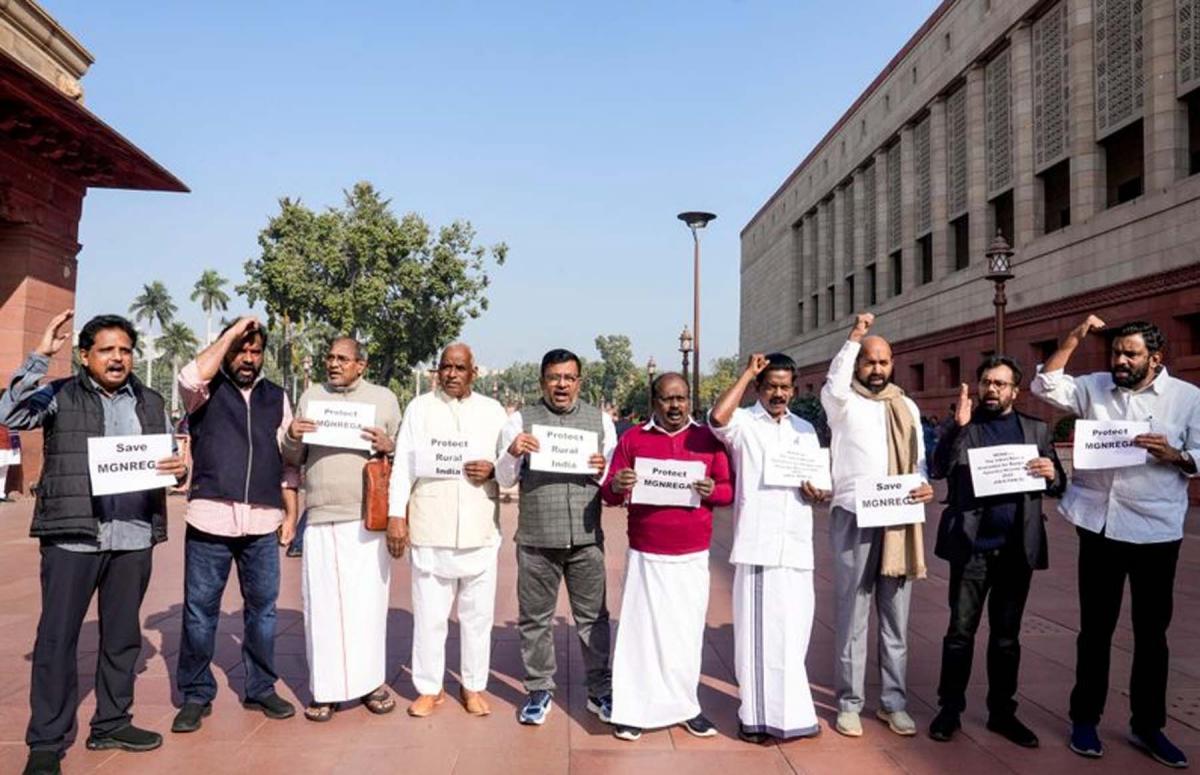
MGNREGA WAS LIFELINE
The law is a partial recognition of the right to work and the acceptance of the responsibility of the State to ensure an increased share of national resources for the provision of work at a minimum wage. The law guarantees a minimum of 100 days of work throughout the year to a rural household and is universal, open to all adults, men and women who volunteer for manual labour. Most importantly the law is based on fulfilling the demand for work, which is not static and can increase or decrease according to the requirement of rural households. There is deep democratic content in this. If a household has better choices for employment, it has the right to exercise that choice while retaining the fallback provided by MNREGA. The law guarantees equal wages for men and women with the entire wage bill to be paid by the Central government. The state governments under the law bear some financial responsibility of around 10 per cent and have a say in the design of schemes and their implementation in tune with the needs of the state. Panchayats have both a right and a responsibility to identify and design projects required in the areas under their jurisdiction. This demand-driven, universally applicable law was probably the first of its kind in the capitalist world.
ASSAULT ON FEDERAL CHARACTER
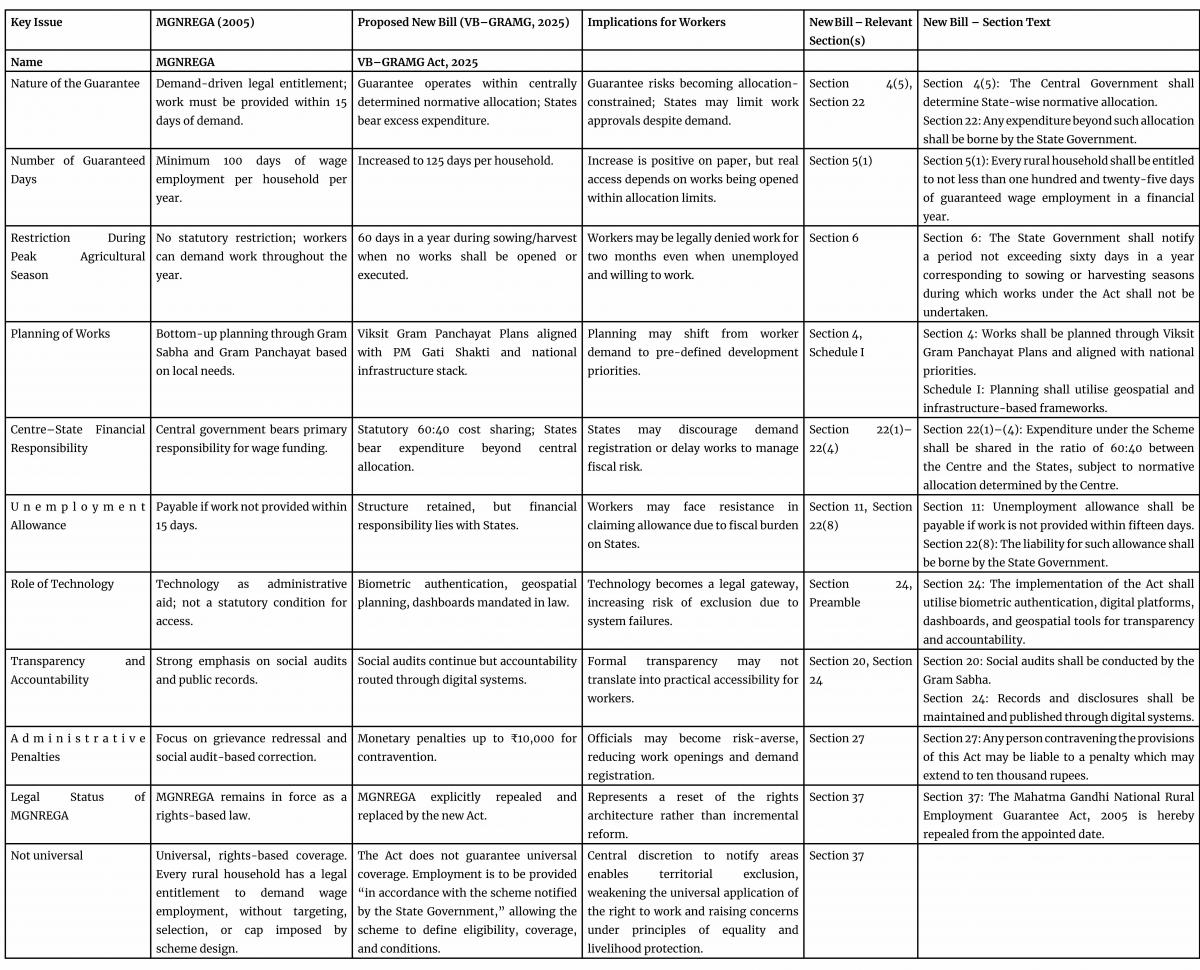
The Modi government with its partners, the TDP and the JD-U as drum beaters, has scrapped all these fundamental features in their law. It will no longer be demand-driven but determined by “normative financial allocations” decided by the central government. The centre will legally now have no obligation if expenditure exceeds this allocation. The states, already in financial crisis because of the unjust denial of their share in central tax revenues, are being saddled with 40 per cent of the cost. In such a context increasing the workdays to 125 days is farcical. The new law is highly centralised and everything from the design of projects to digitised audits will be controlled by the central government. These features are a direct assault on the federal character of the Constitution.
FAVOURS RURAL RICH
The class bias in favour of the rural rich is blatantly displayed in the provision in the new law which prohibits any work under the proposed law during the peak agricultural season. With increased mechanisation in agriculture, workdays have drastically reduced. The work pattern of MGNREGA shows that it is only when agricultural work is not available and when wages paid are below MGNREGA standards, that workers opt for MGNREGA work in the peak season. The prohibition will reduce the bargaining capacity of rural workers who, in the absence of MNREGA, will be forced to accept terms and conditions set by big landowners. This will particularly affect women who get lower wages than men in agriculture. The law legalises Aadhar linkage and online digitally recorded attendance as a condition for eligibility and wage payment. This is despite ample evidence that such conditions and poor connectivity have victimised workers.
Using the acronym of G Ram G as the name of the law is a low level maneuvre to appeal to believers. But when crores of people will shout G-Ram-G murdabad, against the law it may hurt sentiments and backfire on the government.
UNDER-PRIVILEGED WILL SUFFER
Those of us who have worked closely with MGNREGA workers know the difficult conditions in which people work. In some cases, women have to lift up to 3000 kgs of mud a day to fulfil the productivity norm and yet if they make up well over 50 per cent of MGNREGA workers in most states, it is surely a reflection of deep agrarian distress and the lack of a better alternative. Adivasis constitute around 8.6 per cent of the population. But among MGNREGA workers, according to last year’s figures, their proportion is as high as 18 per cent and the Scheduled Castes make up 19 per cent. Therefore, over two-thirds of workers belong to social categories protected by the Constitution. Any reversal of their rights is an attack on the Constitution. But even their representation in the redressal/ advisory councils has been eliminated in the new law.
Since 2014, the Modi government has diluted and starved MGNREGA of funds even as it has greatly increased tax concessions and write offs to corporates. While the number of workers increased from around two crores in the early days to over 7.7 crore workers now, the expenditures have stagnated or declined, never over 0.2 per cent of the GDP. In 2024-25, 8.9 crore workers demanded work but only 7.9 crore workers got work — 99 lakh workers were turned away. Wage arrears have mounted — sometimes up to Rs.8000 crore. On an average, households have got less than 50 days of work instead of 100 days. The farce of promising 125 days in the new law adds salt to the injury. But if people keep coming to MGNREGA sites it is because they have no alternative — such is the desperation and instability in the lives of India’s rural poor.
That lifeline, instead of being strengthened, has now being cut. The Directive Principles of the constitution are being bulldozed. Shame on this government.
Comparison of MGNREGA (2005) and VB–GRAMG Act, 2025