Isfaqur Rahman
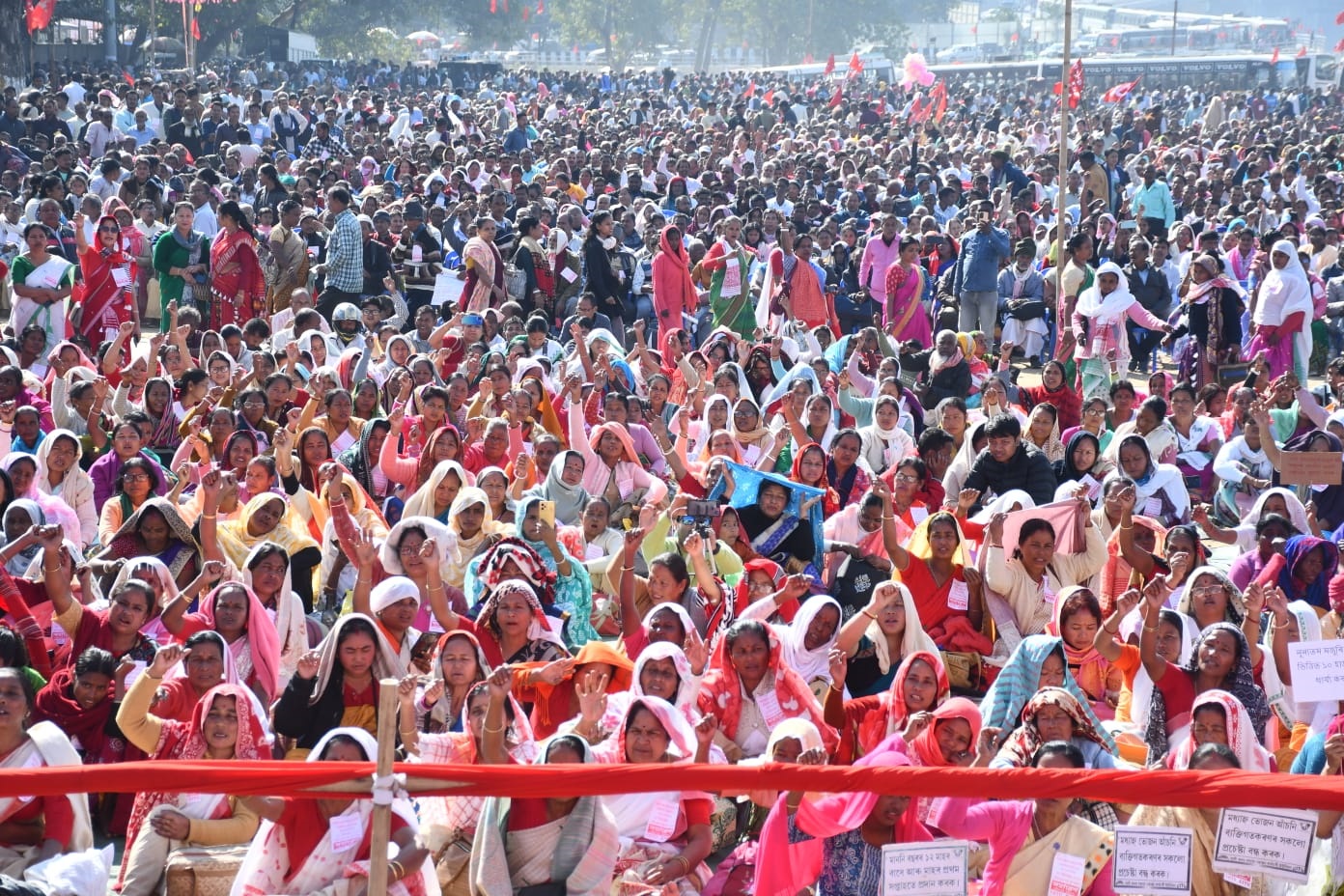
THUNDEROUS slogans reverberated as thousands of workers, peasants, agricultural labourers, tea garden workers and scheme workers assembled at Lachit Ghat in Guwahati, on the bank of the mighty Brahmaputra, on December 14. The rally was jointly organised by the Assam state units of the Centre of Indian Trade Unions (CITU), All India Kisan Sabha (AIKS) and the Agricultural Workers Union.
Participants came from every nook and cranny of the state, representing all castes and communities, cutting across religious, ethnic and linguistic diversities. The bank of the Brahmaputra and the streets leading to the rally venue were awash with red flags, making the entire area a sea of red. Processions from different parts of the state continued to flow into the venue till the conclusion of the rally. The message was clear and unambiguous: unity and struggle, not division and inaction. The public meeting was conducted by a Presidium comprising of Dinesh Nayak (CITU), Tiken Das and Hasim Ali (AIKS), Ajit Das (Agri-Workers Union) and Nani Likson Phukan (Coordination Committee of Working Women).
PEOPLE IN DISTRESS
Addressing the gathering, CPI(M) State Secretary Suprakash Talukdar said the present crisis facing the people of Assam is rooted in an economic and political order that serves a corporate–communal nexus, while systematically attacking the lives and livelihoods of the common people and weakening labour, agriculture and social welfare. Talukdar accused the Himanta Biswa Sarma-led Assam Government of acting as a willing executor of the Modi Government’s disastrous policies, resulting in rising unemployment, price rise, erosion of public services and growing insecurity among the working people. The CPI(M) leader strongly criticised inhuman eviction drives carried out in the name of development, stating that thousands of poor families—particularly from marginalised sections and minority communities—have been rendered homeless without proper rehabilitation. He warned that divisive politics is being consciously promoted to divert attention from governance failures and widening inequality. Referring to scheme workers, Talukdar said lakhs of ASHA, Anganwadi and mid-day meal workers in Assam continue to be treated as volunteers and paid honorarium instead of wages or salaries, despite performing essential public services. He pointed out that extremely low paid scheme workers are not even entitled to beneficiary schemes of the State Government, exposing deep injustice towards women workers and the informal workforce.
REAL ‘ACHINAKI’
Criticising the Chief Minister’s repeated use of the term “unknown” (Achinaki in Assamese), Talukdar said it is a deliberately crafted political narrative in Assam aimed at targeting Muslims of East Bengal origin. Communities earlier branded as suspected nationals, illegal migrants or Bangladeshis are now being stigmatised through coded language as part of a communal hate campaign to fragment the unity of the working people. For the people of Assam, corporate giants like Adani and Ambani are the real “unknowns” and are thoroughly unwelcome, not the poor workers and marginalised sections of society. Yet, the Sarma Government has flung its doors wide open to such “unknowns”—Adani, Ambani, Ramdev and others—allowing the loot and plunder of Assam’s land and resources, the CPI(M) leader asserted. On the issue of Scheduled Tribe status for six backward communities of Assam, Talukdar said that due to the callous attitude and incompetence of the Assam Government, the report of the Group of Ministers could not be submitted to the Centre in time. It was announced that the report would be submitted within six months. But even after nearly seven years of so-called “extensive studies” and deliberations, the State Government failed to determine or recommend two crucial issues raised by the Central Government—the quantum of reservation for the six communities after the grant of ST status and the quantum for OBCs thereafter—thereby providing the Centre further scope to delay the process or once again betray the backward communities.
Raising the central demand of the rally, CITU State Secretary Tapan Sarma said the four Labour Codes must be withdrawn immediately, as they have dismantled decades of hard-won workers’ rights. In Assam, he said, these laws would lead to further contractualisation, retrenchment, wage suppression and denial of job security, with the State Government actively facilitating their implementation.
AGRARIAN CRISIS
Highlighting the agrarian crisis, AIKS leaders Tiken Das and Gajen Barman said farming in Assam has become increasingly unviable. Farmers are deprived of remunerative prices for their produce, denied Minimum Support Price, irrigation facilities remain inadequate, and rising input costs have deepened indebtedness. Instead of addressing these issues, the Assam Government is promoting corporate control over agriculture and land.
Speaking for agricultural workers, Nayan Bhuyan of the Agricultural Workers Union said MGNREGA has been systematically weakened, workdays curtailed and wages delayed, pushing landless workers into extreme insecurity. CITU affiliated Coordination Committee of Working Women's leader Indira Newar further highlighted the exploitation faced by women workers performing essential services without job security or social protection.
OUST BJP
CPI(M) MLA Manoranjan Talukdar warned that democratic rights in Assam are under serious threat, with dissent being criminalised and mass organisations being harassed. Importantly, speakers asserted that policies harming workers, peasants and common people cannot be reversed without a change of political power in the state. The rally issued a clarion call to oust the BJP and its allies from power in the upcoming Assam Assembly elections and appealed for the electoral unity of all secular opposition parties to defeat the BJP.
Revolutionary songs performed by noted mass singer Ghana Deka and his associates inspired the gathering. Veteran leaders, including former MP Uddhab Barman and trade union leader Deben Bhattacharya, were present on the dais and were felicitated. Leaders of mass organisations such as SFI, DYFI, AIDWA and JCTU were also felicitated for their role in the mobilisation and success of the rally.
The meeting concluded with a presidential address by Dinesh Nayak, leader of the Akhil Bharatiya Chah Mazdoor Sangha (ABCMS), who called upon tea garden workers, peasants and all sections of the working people to strengthen unity and intensify struggles against the anti-people policies of the State and Central governments.
Standing on the bank of the Brahmaputra, the rally reaffirmed a collective resolve to defend livelihood, dignity and democratic rights through organised struggle and political unity.


