Sanjoy Mukhopadhyay
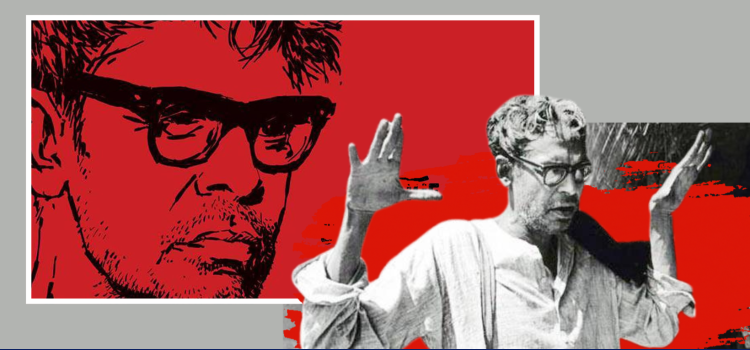
How to locate Ritwik Ghatak (1925-76) in his centenary year in the annals of Indian Cinema?
A Marxist and a rebel, a passionately committed artist as also a loner devoted to suffering rather than action, a victmised and haunted genius walking through the corridors of an industry known for its unparalleled profit motive. Cinema, for him was not a health-resort comedy. On the other hand, he proposed a set of alternative agenda which might surmount the trappings of the Culture Industry, a methodology of looking which goes beyond the parameters of entertainment.
Long after his death in 1976, Ritwik Kumar Ghatak continues to be a mystery, an enigma, in the rich tapestry of Indian cinema. Over eight feature films, and a handful of short films and documentaries, he had become a cult figure even in his lifetime. This is because all his films bear the mark of an artist trying to elevate individual situations within the larger framework of Indian history.
I am not referring only to the awareness which TS Eliot discussed in his seminal essay on poetic theory, 'Tradition and the Individual Talent'. Also, I am inclined to locate Ghatak within the national framework of cinema. Before Ghatak-and after too-there has been a kind of commercial cinema in India that is loosely attached to Hollywood sensibilities; we have a kind of art cinema directly attached to European traditions, inclusive of French surrealism, German expressionism and Soviet montage. But nobody thought of or dared to inject, through Indian philosophical attitudes, something beyond the immediate in cinema, and venture into a kind of unknown territory full of existential interrogation.
A contemporary of Satyajit Ray's, Ghatak had a totally different agenda for the language of cinema. While Ray and other followers of art cinema believed in the representation of authentic details and a close liaison between life and image, Ghatak explored the symbolic and the metaphoric in his images, both aurally and visually. The question of the aural was, to him, of utmost importance. Before him, nobody had considered sound as a primary element in cinema construction.
Although Ghatak was committed to depicting the tragedy of the partition of Bengal, a regional holocaust, he chose not to do so through classic realistic text-an effort that was misinterpreted as anarchic and incoherent in his time. It is a measure of Ghatak's genius that he turned an essentially local experience into an expression that had universal validity. By treating cinema, above all, as an exercise in celebration, Ghatak negated any established genre distinction between the 'artistic' and the 'popular'. He was not loyal to continuity; he saw history as interactive. Naturally, therefore, he thought that unless history was punctuated with myth and legend, it would not resonate with the audience, facilitating a sensitive understanding of the human condition.
His experiences suggested a multicultural and intertextual order for history and folklore, which were then interrogated under the intense supervision of philosophical questioning. The idea of a national culture encouraged him to synthesise, almost absurdly, Nietzschean anarchic possibilities and the collective unconscious under the general umbrella of Marxian thought.
To achieve this, he would need to become a vertical invader.2 And Ghatak was up to the task.
He liberated Indian cinema from the tyranny of visuals and lead storylines. It is through his work that, in my opinion, cinema truly became a vehicle of thought in our country. He introduced a number of issues- on the face of it, beyond the cinematic-when dealing with a particular subject. You may call it a discursive practice essential to understanding culture and modernity, but one thing is certain: in the Western world, there is Ingmar Bergman, and in the non-Western world, there is Ritwik Ghatak. Neither can be defined through their art alone. They were basically philosophers and seem to, I believe, enact a philosophical performance of truth-seeking.
Take Ajantrik, for instance. As Ray quite rightly pointed out, Ghatak's brilliant sense of editing, his compositions, his storytelling all demand comment and appreciation. But the intriguing question is on how tribal life is woven into that narrative. Why? One cannot be certain, but conflict and struggle seem to be at the heart of his thought process. Long before the study of subaltern history became mainstream, Ghatak thought of the deep structure of Indian culture, from which arose the possibility of a so-called primitive culture intermingling with the contemporary. The life of the Oraon people and the story of the vehicle come together and clash, you can easily understand the debate.
What does Ajantrik mean? To Ray, it was anthropomorphism. To Jerzy Toeplitz, the celebrated principal of the Polish State Film School in Lodz, it was the madness in the character of the driver Bimal, which was a manifestation of the transformational crisis of civilisation from a feudal one to a bourgeois one. It was a kind of dialectical revelation-how machines are placed in the context of the emergence of modernity in post- Independence India. It's a significant question. Because our best thinkers, from Gandhi to Tagore, were largely opposed to machines. They considered machines as basically anti-humanistic. In the plays Mukta Dhara, written in 1922, and Rakta Karabi, written in 1924, Tagore fought vividly with the mechanised order of life.
Ghatak wanted to locate machines and modernity in the culture of 1915 (when the film is set). He proved that a machine could act as a beloved. It is an achievement unheard of and unseen in our cinema. Before Ghatak, Indian cinema was not treated as an intellectual tool. Bimal is a born poet, who, in all his absurdities and anarchy, finds a place in the larger trajectory of Indian history, which includes the tribals and the local babus.
It is interesting to note that the first of Ghatak's films-Ajantrik-to be released was shot outside Bengal, despite his reputation as a Bengali through and through. The dialogue track included the tribal Kurukh, and besides Bengalis, the Oraons played a prominent part, as did a Muslim boy from the Chotanagpur Plateau, where the film was set. This is India-and its ethos is not against mechanical impositions in certain areas. Artistically and organically, these can become part of nature and our everyday lives.
The camerawork in Ajantrik is unparalleled. Ghatak captured the car not in close-up but in mid- and long shots, with a bit of foreground and a bit of background. It encapsulates my thesis here: the whole landscape defines the car as a newcomer.
To Ghatak, in direct contrast to Western sensibilities, nature was not part of a mise en scène, but a part of human existence.
In this, he took his cue from Tagore, who, while discussing Kalidasa, said, 'In our oriental sensibilities, we consider nature as not a part of the narrative, but as an integral part of character formation.' He compared Shakuntala in Kalidasa's Abhijnana Shakuntalam to Miranda in Shakespeare's The Tempest, where nature plays a supporting role as a prop for her loneliness and solitude. Ghatak asserted time and again that, in India, the landscape has a role to play. If we go from frame to frame, we'll see how, in his camerawork and in his compositions, he designs the frame and sound altogether in a different mode to what was prevalent in Indian cinema at the time. As a result, like the Japanese film-maker Kenji Mizoguchi, he could go deeper into the very roots of Indian civilisation. Seen in this light, Ghatak was a discoverer as well as an inventor.
We could compare and contrast Ghatak's films with Western modernism, such as the inclusion of the Oraon ballad with that of Picasso's Les Demoiselles d'Avignon, which included the African mask-like faces. Or we could go back to Paul Gauguin and his Tahiti canvases. It may be argued that this association of the ancient with the modern is a kind of artistic maneuvering to locate the true essence of the contemporary.
But in the case of Ghatak, you see that he is not a modernist in the conventional sense of the term. He goes beyond modernism. He is, like Mizoguchi in Japan, soaked in the inner soul of India. And that is why, in his films, landscapes take on unfamiliar shapes.
In Meghe Dhaka Tara, his most commercially successful film, take a look at the first sequence. He is introducing Nita's character. His first shot is completely non-essential. You can see 75 to 80 per cent of the space occupied by a huge tree. Nita is not a part of the narrative. It's only in the second shot that we observe her. Similarly, in the penultimate sequence, when she is screaming 'Dada, I wanted to live', Ghatak moves away from her and pans violently over the landscape, tilts the camera upwards. He wanted to establish Nita as a part of the landscape. As if the whole of nature is screaming. It is his ideal of organic linkage with the mother earth. And that is why the Partition disturbed him so much. In his reading, like in Tagore's, Bengal cannot be partitioned culturally. Indivisibility is the keyword to understanding Bengali sensibilities.
In the shot where the elder brother Shankar sees Nita at the sanatorium, the entire frame is filled with nature. Nita occupies very little space. That was Ghatak's basic argument, one that courses through everything from Komal Gandhar to Subarnarekha to Jukti, Tokko aar Goppo. His movies are a unique coming together of history and culture.
In the sound pattern of Meghe Dhaka Tara, it's astonishing to note how noise can take centre stage. Instead of removing at the editing table every incidental sound, every kind of disturbance, Ghatak included them in the sound design, mingling the incidental noise and the effect noise. It is sheer brilliance. From the sound of rice boiling to that of a falling leaf, plus folk music and Tagore songs, everything became a part of the mise en scène. It is not a narrative only of human beings, but a grand narrative that encompasses a sense of the totality, the Brahma in Indian philosophy.
In Subarnarekha, for instance, Ghatak redesigned, or refashioned, the epic Ramayana. And while doing so, he cast Kaushalya, the mother of the dynasty, as a subaltern bagdi bou, the wife of a fisherman, and Ram, the king in the epic, as a bagdi boy. In the platform sequence, he deliberately avoided showing the death of the bagdi bou, and a cacophony of sounds speak for themselves. Ghatak was like an invader.
In Jukti. Tokko aar Goppo, he used Hindu mythology to a different effect. What does Durga, the mother, represent in his eyes? It is not the elitist, Brahminical form of Durga. Look at the sound design in Titas Ekti Nodir Naam, where he did not show the proximity of human bodies in a lovemaking scene, but just layers of sound to indicate the intimacy. This method was extended to Jukti, Tokko aar Goppo, where he tried to couple at violent historical argument with the deepest moments of human intimacy.
When he used Hindu mythological references, Ghatak was accused of offending Hindu sensibilities. But think of the scene in La Dolce Vita, where the character of Steiner delivers the final speech where the Bible is used very deliberately and effectively. When Ghatak used 'Hey Ram' in the first sequence of Subarnarekha in a historically placed reference to the assassination of Gandhi, and then 'Hey Ram' in the end to a mythically placed reference to the agnipariksha of Sita, we see how he overcomes the limitations of time and creates a kind of hallucinatory moment of absolute truth.
That's why it's demeaning to limit Ghatak to being a teller of Partition stories alone. His characters are always displaced-from Nagarik to Ajantrik, everyone is out of place, in an alien land. Ghatak's relevance has only increased internationally as people across the world lose their homes and travel to far-off places to find a space for themselves. His films describe the true agony and the failures of his times as protest, as Luis Buñuel did in Nazarin. And in Jukti, Tokko aar Goppo, when he inserts, to our utter astonishment, the fifth symphony (or the fate symphony) of Beethoven, we understand that victory is Ghatak's fate; he will be victorious in the end.
In Subarnarekha, the Great Mother appears as a bohurupee/polymorph in the abandoned airstrip, and momentarily, we are frightened. What is this? Portents of a disaster of some sort? No. He wants to console us. He wants to say that it's just a moment of untruth. Whenever Ghatak named his characters, he largely drew on the Hindu tradition, since he considered history as part of today's story. This is unmatched in our culture.
Ghatak was interested in more than innovative adventure. His use of wide-angle lens and telephoto lens, his extreme close-ups, his location of the principal protagonists at the extreme ends of the frames, leaving wide open spaces, forces us to compare him with the great Japanese film-maker Yasujiro Ozu, who also discovered the nuances of empty space. It was the spatial whisperings of nature that Ghatak most paid tribute to: Nita's placement in the penultimate sequence in Meghe Dhaka Tara, and in Komal Gandhar, Anasuya's placement in the river valley or the khowai. This, too, is unique as much storytelling as it is historical commentary. Compare this proclivity with Diego Velázquez's Las Meninas (The Ladies in Waiting). Michel Foucault argued that, though Velázquez was a master of classical painting, in this work, he subtly investigated how structures of knowledge and representation work, giving us a new grammar for newer ways of thinking. This is also what Ghatak does when he uses extreme close-ups of Sita in the brothel scene in Subarnarekha or when he uses sound images to describe the political scenario in West Bengal in Jukti, Tokko aar Goppo. He actually made a drastic metamorphosis of the cinematic mode of realistic representation there.
By questioning established structures with the unusual frames he composed, Ghatak introduced reflexivity in cinema. And he was, it is plain to see, the first self-consciously destructive film-maker when it came to prevalent modes of representation.
There's another important piece of painting, Rembrandt's Nightwatch, that I think of in the context of Ghatak's cinema. People often wonder why Rembrandt, the greatest of portrait painters in medieval Europe, left the path of faithful representation and inserted apparently undesirable elegance to the frame, and why he played so passionately with gloomy, low lights. The same question may arise when we look at the 'Je raate mor duwarguli' song sequence in Meghe Dhaka Tara, where Ghatak deliberately away with normal lighting arrangements, creating extreme darkness, and along with it unimaginably extreme illumination, to prove that heaven can indeed descend on earth.
These kinds of unheard-of and unique manipulations of photographic images and aural moments are Ghatak's unique contribution to Indian cinema. He was an innovator. Ray began the practice of a believable, realistic mode of representation in cinema with Pather Panchali, but Indian cinema reached adulthood and a self-consciously contemporary avatar only with the release of Ajantrik. With the arrival of Ray, we became aware of the possibilities of cinematic reality. With Ghatak, we came to know the true limitations of the cinematic medium. He forced us to learn how art also has a right to criticise itself.
Time will tell what Ghatak contributed to the development of international cinema, but we can conclude with some certitude that he was truly in consonance with Leninist thoughts-national in content but international in form. Rarely has there been an artist like him, capable of functioning in a space of such apocalyptic ambiguity, incapable of denying reality and yet eternally questioning that reality was a fixed thing.
Sanjay Mukhopadhyay is a film historian and author.


