THE pursuit of neo-liberal policies necessarily means bending to the caprices of international finance capital, so that it does not take offence and leave the country’s shores. This in turn necessarily means an attenuation of democracy, for democracy means that policies should be made in accordance with the wishes of the people and not those of international finance capital.
THE 16th meeting of the National Integration Council (NIC) was held in the aftermath of the horrendous communal disturbances in Muzaffarnagar and in the backdrop of the continuing tensions in western Uttar Pradesh. The Resolution adopted unanimously, amongst others, resolved “To condemn violence in any form committed to disturb communal harmony and to deal with all those indulging in such violence in a prompt and resolute manner under the law.
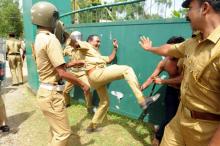
In a most brutal and shocking incident unheard in the history of Kerala, a police team headed by a sub inspector unleashed violent attack on an LDF worker who participated in a peaceful protest against Chief Minister Oommen Chandy. Sub Inspector Vijayadas brutally attacked Jayaprasad, a DYFI activist from Thiruvananthapuram. He purposefully kicked the genitals of Jayaprasad, while other cops held him tight. He collapsed on the spot after the repeated kicking by the police on the groin. He was hospitalised later and his condition is still critical.
ECONOMIST Paul Krugman has recently written a column in The New York Times on the depreciating Indian rupee. He comes to the conclusion that India’s present currency crisis is fundamentally different from the East Asian currency crisis of 1997-8, since India’s debt, denominated in foreign currency, is small compared to what it was for the East Asian economies then. Hence he argues that there is no cause for India to panic; the rupee will depreciate for a while and then settle down, which would mean an upsurge in inflation for a while before prices too settle down.