It is about a year back that the second-generation GST reforms were introduced in September 2025, and the most important selling point was that a simplified and reduced indirect tax would reduce consumer prices. The media was mobilised to speak in defence of the government as usual, and this was projected as one of the game changers, particularly for industries supposed to be facing sluggish demand. The argument was simple.
THE 18th BRICS Summit in New Delhi, held on September 12-13, 2026, produced a 140-point Declaration that is at once an assertion of Global South aspirations and a mirror to the contradictions of the grouping itself. For the Left, the task is neither to applaud nor to dismiss, but to read the document critically, recognising where it advances the struggle against US-led unipolarity, where it falls short, and where the Indian government's own conduct betrays the Declaration’s spirit.
The 18th BRICS Summit, held in New Delhi on September 12–13, occurred amid an exceptional intensification of international contradictions. Wars in West Asia, unilateral sanctions, tariff barriers, and the weaponisation of finance and technology have exposed the fundamentally unequal character of the imperialist-dominated international order.
THE BJP’s façade of patriotism is repeatedly shattered, and the party stands exposed time and again; yet, it persists in singing the same tune. As the English writer Samuel Johnson famously said, “Patriotism is the last refuge of the scoundrel.” The BJP’s conduct consistently proves this adage true.
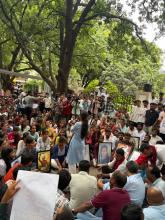
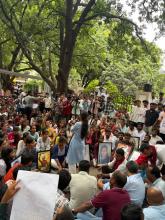
FOLLOWING the vigorous and victorious July student struggle at Jantar Mantar in Delhi, the movement by Adivasi students in Maharashtra in August 2026 once again brought issues of education and employment, especially of the socially oppressed, to the forefront. Given the intensity of the 17-day long agitation, the state government was forced to bow down.
The crisis faced by left-wing movements in India during the neoliberal era has already been reflected at several levels. Communal forces were able to divert the difficulties people faced under this economic framework into a politics of anger against others and reap rich dividends in this regard. The collapse experienced in West Bengal and Tripura after long periods of continuous rule also happened under such circumstances. Continuing this trend, the CPI(M) suffered a major setback in the recent assembly elections in Kerala.
MODI’s narrative about him administering homeopathic medicine is largely a self-inflicted assault. Far from being a successful strategy it is proving to be a self-goal – a case of unmitigated frustration. To brand all those who have views contrary to the regime and Hindutva as “dimagi naxals” leads to only one inescapable conclusion: that all those who support Modi and his ideas are “gair-dimagi andh bhakts”.
THE passage of the West Bengal Universities and Colleges (Administration and Regulation) (Amendment) Bill, 2026, in the state Assembly on September 10, marks a critical turning point in the governance of higher education in West Bengal.