THE passage of the West Bengal Universities and Colleges (Administration and Regulation) (Amendment) Bill, 2026, in the state Assembly on September 10, marks a critical turning point in the governance of higher education in West Bengal.
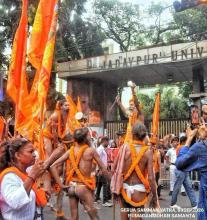
The ‘Gerua Samman Yatra’ from Golpark to Jadavpur’s 8B bus stand on September 9, brought the politics of communal mobilisation directly to the perimeter of Jadavpur University. Led by Chief Minister Suvendu Adhikari, the procession featured large contingents of BJP cadres, saffron-clad sadhus and Naga sanyasis. While nominally organised under the banner of defending the “dignity” of saffron, the rally marched with saffron banners, provocative posturing and slogans of ‘Jai Shri Ram’.
VERY recently the eloquent reticence of the Chief Election Commissioner of India, Gyanesh Kumar, has given way to an extremely brief observation. He has opined that notwithstanding the ‘little inconvenience’ of some citizens, the Special Intensive Revision (SIR) carried out across the country was necessary to clean up the Electoral Rolls for conducting a ‘fair election’. This could be regarded as the greatest understatement of the century.
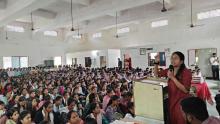
All India Democratic Women's Association (AIDWA) National General Secretary Kaninika Ghosh called upon women to organise struggles to protect their rights and freedoms, stressing that the fight for women's rights must transcend caste and religious divisions.
UTTAR PRADESH is once again in the headlines and has become a serious subject of debate among politicians, intellectuals, journalists and YouTubers. The discussion, however, is not about development, the runaway rise in prices, the growing number of unemployed people, the rising crime rate, increasing violence against women, or the need to control crimes against Dalits because none of this seems to be happening. On the contrary, something or the other happens here every day that leaves people distressed and alarmed.
THE Gen-Z movement, which reverberated across the country and forced the Modi government to bow down, drew the attention not only of the entire nation but also of the world. The agitation at Jantar Mantar, which continued for one and a half months, reached every corner of the country. In cities like Mumbai, Pune, Nagpur, and across the country, thousands of students and youth took to the streets in anger against the Modi-Shah regime.
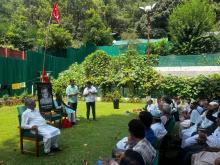
The Jammu and Kashmir state committee of the CPI(M) organised a function in Srinagar on August 30 to commemorate the second death anniversary of Sitaram Yechury. More than two hundred party activists and sympathisers participated in the programme and paid rich tributes to the memory of the great revolutionary, Marxist thinker and mass leader. The Party had given the call to commemorate the death anniversary of Yechury during the period from August 12, his birth anniversary, to September 12, his death anniversary.
Penguin Random House is one of the largest publishers in the world. An imprint of PRH is publishing Sonia Gandhi’s memoir in the United States, with an initial print run of 100,000 copies. Penguin India, however, has refused to publish the memoir in India.
JUSTICE Deepak Gupta, a former judge of the Supreme Court, marked the eightieth anniversary of Independence by asking in print what few in his position have dared to ask; how free are we, the citizens of India? His answer in The Tribune was unsparing. The constitutional courts “have not shown the requisite sensitivity or strength”; the right to liberty “is violated with impunity, and the courts in many cases have become mute spectators”; and “the collegium system has failed.