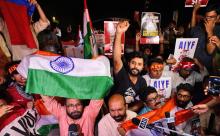
DEAFENING music, high-tempo beats, inflammatory lyrics, and crowds swaying to the rhythm are common sights at processions organised by Hindutva groups across the country. People, intoxicated by the arrogance of Hindu supremacy, frequently shout provocative slogans. As the tempo of the music rises, so does the fervor of the crowd; it appears as though the music has completely taken them over. The lyrics accompanying the music begin to dominate both heart and mind.
WHENEVER in crisis, capital's oldest trick has been to manufacture a shock and let the working class absorb its impact. The fuel prices did what they always do whenever Washington decides to bomb someone – they went up. On February 28, 2026, the United States' unprovoked attack on Iran dragged the Gulf into a war where the rest of the world is having to pay the price.
THERE are moments in history when time scampers. Many Indians who were in a dilemma over the lack of collective rage would now be relieved. With developments over the manner in which the executive, the legislature and eventually even the judiciary appeared to converge, it was almost a replay of the British colonial rule. The freedom struggle, the sacrifices and the democratic secular Constitution, all appeared to be under major strain.
On July 20, 2026, a shocking news of the unnatural death of Mr. Anurag Dhankar (IPS), Director General of Police, Tripura, in his office, stunned the people of state. Reportedly, as usual, he reached office that day before 10 a.m. and conducted some official work. Not finding him in his chair for a considerable time, on searching, he was traced hanging with a scarf inside the washroom attached to his office. Immediately, he was brought down and rushed to G.B. Pant Hospital, where the doctors declared him ‘brought dead’. He was in official uniform.
The Chinese Embassy in New Delhi hosted a seminar to mark the 105th anniversary of the founding of the Communist Party of China (CPC). The seminar was attended by leaders of Left parties, diplomats, academics and other distinguished guests. CPI(M) General Secretary M A Baby, Polit Bureau member and Head of the International Department R Arun Kumar and Central Secretariat member V Muralidharan represented the Party at the event.
Thousands of Adivasis from across the Integrated Tribal Development Agency region converged on Paderu, the headquarters of Alluri Sitarama Raju district, on July 17 to demand the restoration of tribal reservations, protection of constitutional safeguards, and fulfillment of election promises made to tribal communities.
ON 9 July 2026, researchers from US universities published a paper in the top-rated journal Science describing a powerful new AI tool for biomedical research. A year earlier, they had made the initial manuscript available as open access to all by publishing it on bioRxiv, an online repository, and making the software available on GitHub, an online platform for researchers to share code.
DISENFRANCHISING citizens is a mode of control by which the state categorises and hierarchises individuals in the scale of distribution of rights and justice. It has two specific dimensions; one is control by the economy of security and fear and the other is not only excluding the surplus from the realm of production but also invisiblising them from the sphere of entitlements and rights. Defining and redefining citizens is one of the instruments of power by which the economy of security operates.
WHEN US president Donald Trump announced that the ceasefire with Iran was over and ordered a new round of attacks, he attempted to present the resumption of violence as the inevitable consequence of Iranian misconduct. The reality was more complicated. The ceasefire had not been a peace agreement between two reconciled powers, but an armed truce between a United States determined to constrain Iran and an Iranian state determined to preserve its sovereignty, its nuclear energy rights, its missile capability, and its regional influence.
THREE bills moved together through Parliament in August 2025, and taken separately, each look almost technical. The Constitution (One Hundred and Thirtieth Amendment) Bill, 2025 deals with what happens to a chief minister or prime minister who is arrested. The Jammu and Kashmir Reorganisation (Amendment) Bill, 2025 and the Government of Union Territories (Amendment) Bill, 2025 extend a similar logic to other Union Territories.