TWO months ago, two articles were published here on the Ebola outbreak unfolding in the eastern Democratic Republic of Congo (DRC) about the forgotten frontline and global consequences. Back then, the tally was brutal enough: 896 confirmed cases, 232 dead. As of 17 August 2026, we are staring at 4,945 cases and 2,325 deaths. It is already past the 2,299 who died in the 2018–2020 outbreak. The virus is not remaining confined. It has now spread to 54 health zones in six provinces, well beyond the original three hotspots.
The so-called golden period of almost two and half decades of BJP-JD(U) rule has left the state bankrupt. The failure of the government to pay salaries to government employees and teachers on time and fulfill its social security responsibilities is being raised in different forums. Even the meagre amount of 1000 rupees for senior citizens is not being paid on time.
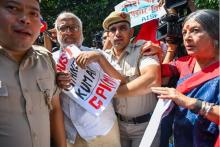
The Modi government’s move to impose charges on UPI (Unified Payments Interface) transactions is an attack on ordinary people. On August 6, the government passed the bill in the Lok Sabha to allow charges on payments made through UPI apps.
This bill was passed without hearing the views of the opposition and without any debate. It was pushed through by voice vote in an authoritarian manner. Through this amendment, the government is punishing ordinary people by collecting charges from them and handing over the benefits to corporates.
In August, right-wing billionaire Abelardo de la Espriella took office as Colombia’s president and vowed to move an agenda of the far right even though he won by less than a percentage point over the left-wing candidate Iván Cepeda. It is characteristic of the far right of a special type to adopt any mandate and pretend that they have the authority to transform their society into a toxic swamp.
On July 26, a general body meeting was held in Erode, Tamil Nadu, to hand over subscriptions collected for Theekkathir, the daily organ of the Communist Party of India (Marxist). Polit Bureau member Com U Vasuki received the subscriptions.
The agreement reached between the Jharkhand government and the students protesting over the recruitments done by Jharkhand Public Service Commission (JPSC) and Jharkhand Staff Selection Commission (JSSC) issue is welcome. The cancellation of the JSSC-CGL (Combined Graduate Level) and examinations conducted by the private outsourcing agency TSR Data Processing Private Limited (TDPL), along with the decision to investigate irregularities in recruitments made since 2014, is a significant achievement of the sustained student movement.
PERHAPS the most consequential legislation in post-independence India was passed by Parliament on August 23, 2005 and came into force on February 2, 2006. It was the National Rural Employment Guarantee Act, later to be renamed Mahatma Gandhi National Rural Employment Guarantee Act that was enacted by the UPA-I government under Left pressure (since the government depended on Left support).
AUGUST 13, 2026, was a day when Cleo, muse of history, wept. For one of her greatest devotees, Professor Sumit Sarkar, foremost of the eminent historians of modern India, breathed his last. Eighty-seven years old, Prof. Sarkar lost his long battle with illness on that day. He is survived by his wife, eminent historian Tanika Sarkar, and his son, Aditya Sarkar. The loss of Prof. Sarkar is not merely the loss of a person. It is as if an institution whose constant presence we had taken for granted for so long a time suddenly crumbled.
The Communist Party of India (Marxist) organised a seminar at Baba Sohan Singh Bhakna Bhawan, Sector 29-D, Chandigarh on August 16, 2026 dedicated to the second death anniversary of former CPI(M) General Secretary Comrade Sitaram Yechury.