Prachi Hatiwlekar
IN the last issue of People’s Democracy/Loklahar, we saw how the BJP-led state government, because of its drubbing in the Lok Sabha elections in May 2024, launched the ‘Mukhyamantri Ladki Bahin’ (CM Ladli Behna) Scheme to lure women into voting for it on the eve of the last Vidhan Sabha elections in November 2024—and how, after coming to power, it began winding down the scheme. We had outlined in last week’s report the various AIDWA-organised district and taluka conventions on the Ladli Behna issue, which had mobilised over 19,000 women.
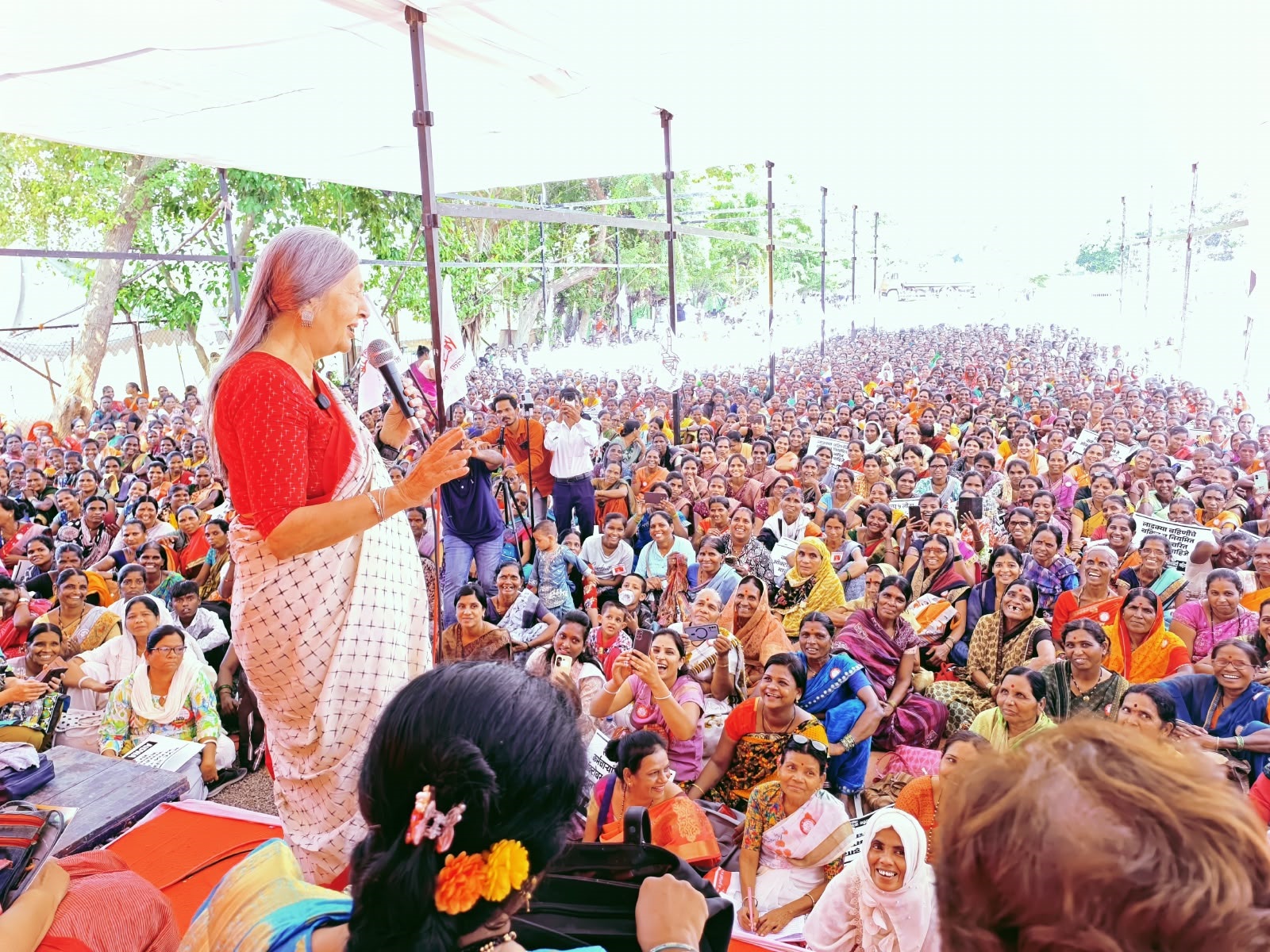
Over the past two years, the monthly allowance of more than 92 lakh women under the Ladli Behna scheme has been gradually stopped and they have been arbitrarily excluded. This was not merely an economic betrayal of women, but also an emotional betrayal of those who had been addressed as “beloved sisters.” Condemning this betrayal and demanding their re-inclusion in the scheme, on November 3, 2026, around 10,000 eligible yet excluded Ladli Behnas from 20 districts across Maharashtra converged at the Azad Maidan in Mumbai.
Travelling at their own expense, carrying simple meals of bhakri and chutney, and without expecting even drinking water, these women undertook long overnight journeys by train, bus and other forms of public transport. From the early hours of November 3, they began gathering at the AIDWA office at Azad Maidan, having travelled through the night to make their voices heard. Even journalists and police officers could not control their emotions, hearing the heart-rending stories of these poor and needy women. Instead of working to make their lives better, the state government is busy organising huge ‘kumbh melas’ spending crores of rupees, cutting thousands of trees, and denying these women what had been promised.
The huge rally of thousands of women had planned to block the main road in front of the Bombay Municipal Corporation until they were granted a meeting with the Chief Minister or the concerned ministers. Initially, the police were under the illusion that hardly a few hundred women would turn up and that they could easily stop them. They had therefore blocked the main gate in front of the office. They also stopped our tribal women from Palghar district, who had arrived literally filling a full local train from Dahanu to Churchgate station, on the way and held them back for nearly an hour. For this, they deployed a force of 500 women police.
However, they did not succeed in holding back such a massive gathering of protesting women for long. As the women, led by AIDWA patron Brinda Karat and National Vice President Mariam Dhawale, began marching out carrying placards and flags and raising slogans against the Fadnavis government, the police hurriedly arranged a meeting with the Ministers for Women and Child Development and Food and Civil Supplies, thereby avoiding further trouble.
In a highly disciplined manner, without taking the law into their own hands, but raising spirited and militant slogans, the women staged a sit-in at Azad Maidan and the public meeting began. AIDWA leaders Brinda Karat and Mariam Dhawale delivered the main speeches. Both leaders strongly criticised the anti-people—and particularly anti-women—policies of this double-engine government, which is in power both in the state and at the Centre. The women responded enthusiastically to their speeches. Several other leaders also addressed the gathering. The meeting was presided over by AIDWA State President, Naseema Shaikh.
The AIDWA delegation led by Mariam Dhawale, Naseema Shaikh, and State General Secretary Prachi Hatiwlekar held discussions for nearly three hours with the two Cabinet Ministers mentioned above, as well as with the Principal Secretaries of the concerned departments dealing with primary education, health and water supply. Some of the issues were taken forward. Concrete assurances were given that the monthly allowance of eligible women who had completed their e-KYC would be restarted immediately. Progress was also made on the implementation of the Jal Jeevan Mission and on several issues related to the public distribution system.
However, several important issues still remain unresolved. The government has currently frozen the Ladli Behna scheme. The demands to restart the scheme, restore the monthly allowance to women who were unable to complete their e-KYC, increase the allowance to Rs. 2,100 as promised, provide 14 essential commodities through the ration system, and distribute the extra ration before Diwali have not yet been met.
The agitation brought into sharp focus the fact that similar schemes—such as the 50 per cent concession for women travelling by State Transport buses and the promise of three free LPG cylinders under the Ujjwala scheme—were intended only to serve the BJP’s electoral purposes.
The lame explanation offered for this was that, due to the serious statewide drought, the state government simply does not have the funds. Therefore, it was decided that the women’s struggle will continue. The AIDWA State Committee decided to take this struggle to the district level and organise large marches on taluka and district government offices in the coming period. Determined to intensify this struggle locally, the women returned to their districts.
Besides the AIDWA state and district leaders, leaders of other CITU-affiliated organisations including Shubha Shamim and Armaity Irani of the Anganwadi Workers’ Union, Anandi Awaghade and Ujjwala Padalwar of the ASHA Workers’ Union, and Meera Shinde of the Mid-Day Meal Workers’ Union were also present to greet and help the AIDWA state rally.


