DDKs - Two Lives, Many worlds
Vivek Monteiro
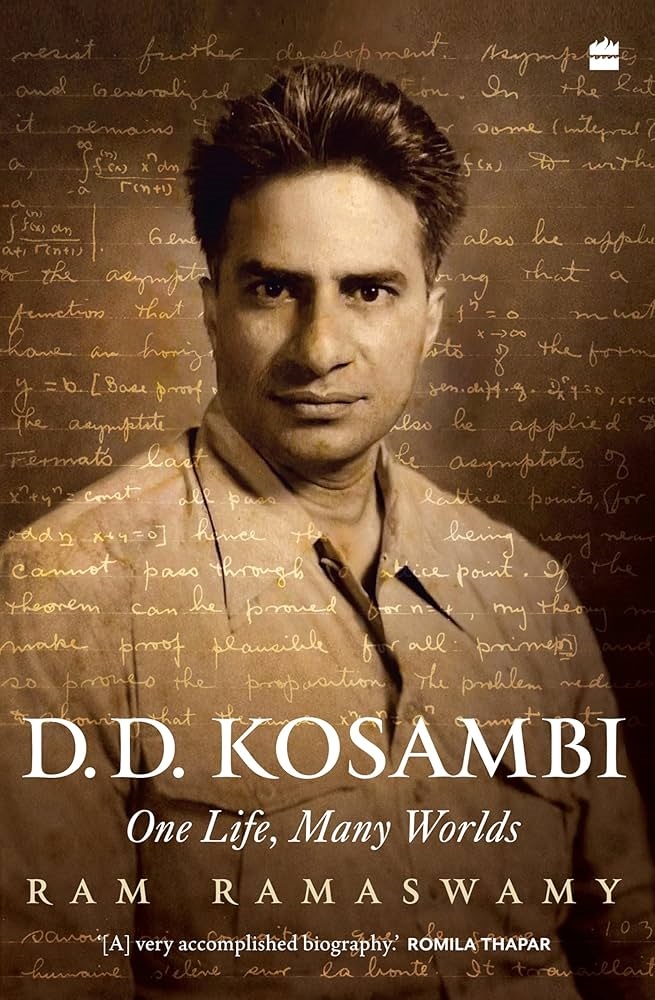
The book launch of Prof R Ramaswamy’s recent biography of D D Kosambi (DDK) was held on July 31, 2026, at Goa, DDK’s birthplace, in a well-attended function organised jointly by the Goa University and the India International Centre, Goa. This writer was a discussant along with Prof. Parag Parobo and scholar Kaustubh Naik. The book, titled ‘DDK – One Life, Many Worlds’ is a masterpiece of research into many of the many worlds of DDK.
The biography is, in fact, two biographies of DDKs. The first of Dharmanand Damodar Kosambi, the father, and the second of his son Damodar Dharmanand Kosambi. Both the DDKs were outstanding intellectuals in their fields of study, and Ramaswamy does a superb job of tracing the career and work of DDK the father, and his influence on his son.
Ramaswamy traces ‘The making of DD Kosambi’ from a young age till his passing at age 59 in 1966, in meticulous and scrupulous detail. He has interviewed many persons close to DDK, colleagues, family members and relatives, in many countries, and visited libraries and archives in all these countries. The bibliography of Kosambi’s writings in this volume is the most comprehensive till date. Perhaps more than any other person, R Ramaswamy has had access to and referred to the Kosambi papers. He has done a great service to readers by drawing attention to and bringing to light interesting and relevant documents many of which were hitherto unknown including excerpts from Kosambi’s diary, and letters written by and received by DDK.
This book is only the latest of his consistent efforts over years to study Kosambi. In 2016 he edited the invaluable full-length volume, ‘DD Kosambi - Selected Works in Mathematics and Statistics’. In January the same year was published ‘Adventures into the Unknown’, edited by RR which contained Kosambi’s notes on 15 lectures on Dialectical Materialism delivered in Pune in 1943, at the time when he took up more serious study of Marxism.
As a comprehensive study of the life of DDK, this biography sets a new standard. Yet even a masterpiece can have shortcomings. Though this is the best biography of DDK till date, it is not an intellectual biography.
KOSAMBI’S MARXIST APPROACH TO HISTORY
Chapter 11 describes DDK’s magnum opus, ‘Introduction to the Study of Indian History’. This book was a game changer for Indian history on a number of counts. Firstly, it asserted that despite the paucity of written records, Indian history could become the subject of scientific study. It showed how a scientific study of Indian history can be conducted with combined methods, archaeological as well as evidence which continue in the present in the form of religious and cultural practices of various communities. Though this chapter is extremely interesting for other reasons, including the role of DDK’s friend and colleague, Mrs. Monica Felton, to whom the book was dedicated, it does not discuss an essential aspect: the central fact of Kosambi’s restructuring of the study of Indian history is his Marxist approach. How DDK became a Marxist, and how he applies the Marxist approach in his different writings is not adequately dealt with in this book.
In his article “The Study of Ancient Indian Tradition’, quoted in DN Jha, ‘The Many Careers of DD Kosambi’, DDK wrote: “The principal aim of history, as hitherto written, has been the presentation of great events in a chronological sequence. However, the relative importance of events rarely appears the same to the people of another time, place, civilization, class bias, so that a mere chronicle does not suffice. The course of social development, the inner causes which ultimately manifest themselves in striking events, the driving forces which underlie great movements, have to be made clear before any work can be dignified by the name of serious history. Yet this type of analysis is not always welcome by some historiographers. They, or the people who really condition their version of history, are unwilling to face the inevitable consequences of the procedure. For the implication is necessarily that all history can be so analysed, hence current events too; but if so, it follows that the course of events can be influenced by deliberate action, that history has hereafter to be consciously made by those that live it, not merely set down after a safe interval of time by the professional historian. This is clearly dangerous to those who would suffer by the change, usually those in power. Thus such historical writing is labelled subversive. History then remains a means of escape, a romantic pastime, a profession, or a means of inducing submissiveness; it cannot become a scientific pursuit.”
The 1981 ‘Statement on Scientific Temper’ stated that the method of science must be applied to a study of history, ethics and economics. DDK showed that this is possible. He brought Indian history into the scope of scientific temper, forever restructuring and resetting discourse on the subject. After Kosambi, Indian history no longer remained a subjective choice between different narratives. There are aspects of Indian history which are beyond narratives which can be identified and arrived at through scientific study. As Kosambi put it: ‘Science is the cognition of necessity.’
KOSAMBI’S MATHEMATICS
The other shortcoming of this masterpiece is that most of Ramaswamy’s commentary on Kosambi’s mathematics is based on others’ evaluations, though some are from eminent mathematicians abroad and some from Kosambi’s own colleagues at TIFR. It is assumed that these evaluations are the last word on Kosambi’s mathematical contributions. There is nothing in the cited evaluations to confirm that any of these were the outcome of intensive close attention by the reviewers. Kosambi’s colleagues at TIFR were themselves dismissive of his work on the Riemann Hypothesis, often described as the most important open problem in Mathematics. There are still reasons to believe that Kosambi’s mathematics has not yet received the close attention that it may deserve.
Ramaswamy writes: “Statistical Methods in Number Theory was reviewed by the Hungarian mathematician A. Renyi, a close colleague of Paul Erdos. Kosambi had been corresponding frequently with them both. Being well aware of the effort that had gone into the work, Renyi saw that the unsuccessful attempt to prove the hypothesis relied on another interesting conjecture on prime numbers, and he wrote the kindest review of any of Kosambi’s papers on the subject:
‘The reviewer thinks that at the present moment one does not have enough knowledge of the fine structure of the distribution of primes to prove or disprove the author’s conjecture. The problem seems to be even more difficult than the problem of the validity of the Riemann hypothesis. As a matter of fact no obvious method exists to prove the author’s hypothesis even under the assumption of the Riemann hypothesis. Nevertheless the conjecture is worthy of study in its own right, and the reviewer proposes to call it ‘the Kosambi hypothesis’ in commemoration of the enthusiastic efforts of the late author’”.
In the epilogue of ‘Adventure into the Unknown’, an autobiographical account of his learnings, Kosambi describes his discovery about prime numbers in lucid language. (For reasons of space, we only give main excerpts here)
“The series of weights formed a sample from a population assumed subject to probability laws. Could something of the sort not be proved for the primes? It was necessary to change the scale…The change gave a fixed average number of primes per interval of any constant length on the changed scale. Still the number varied unpredictably from interval to interval…”
“Let me admit at once that I made every sort of mistake in the first presentation. There is no excuse for this, though there were strong reasons: I had to fight for my results over three long years between waves of agony from chronic arthritis…fever, lack of assistance and steady disparagement. It was much more difficult to discover good mathematicians who were able to see the main point of the proof than it had been to make the original mathematical discovery. How much of this is due to my own disagreeable personality and what part to the spirit of a tight medieval guild that rules mathematical circles in certain countries with an ‘affluent society’ need not be considered here.”
On June 23, 1966, Kosambi wrote to Horst Kruger: “I am completely occupied with a mathematical research project which, I hope, will be the best intellectual achievement of my life. It is nearing completion.”
A week later he mailed the manuscript of prime numbers to his publishers Routledge & Kegan Paul in London. A few days later he suddenly and unexpectedly died.
Ramaswamy tells us, “The manuscript that was sent out on June 26, never reached Colin Franklin and could not be traced subsequently, but a heavily annotated penultimate draft is available”. It is the strong opinion of this writer that this ‘penultimate draft’ deserves close attention.
On the morning of July 31, 2026, a ‘D.D. Kosambi Study Group’ was inaugurated at a well-attended programme organised by the ‘D.D. Kosambi School of Social Sciences and Behavioural Studies” of the Goa University. In his magnum opus referred to earlier, Kosambi devotes 10 pages (pp 301-310 of the first edition, available on Internet Archive) to apply his combined methods to decipher ancient Kadamban history and the peopling of what is today, Goa. Modern methods of genomic analysis will throw much light on this question. Kosambi was an embodiment of multidisciplinary scholarship. With Kosambi as model and mentor, the newly formed D.D. Kosambi Study Group could expand to engage with the Departments of Mathematics, Life Sciences and Linguistics to make Goa University an institute of not just excellence, but something more.


