Samprikta Bose
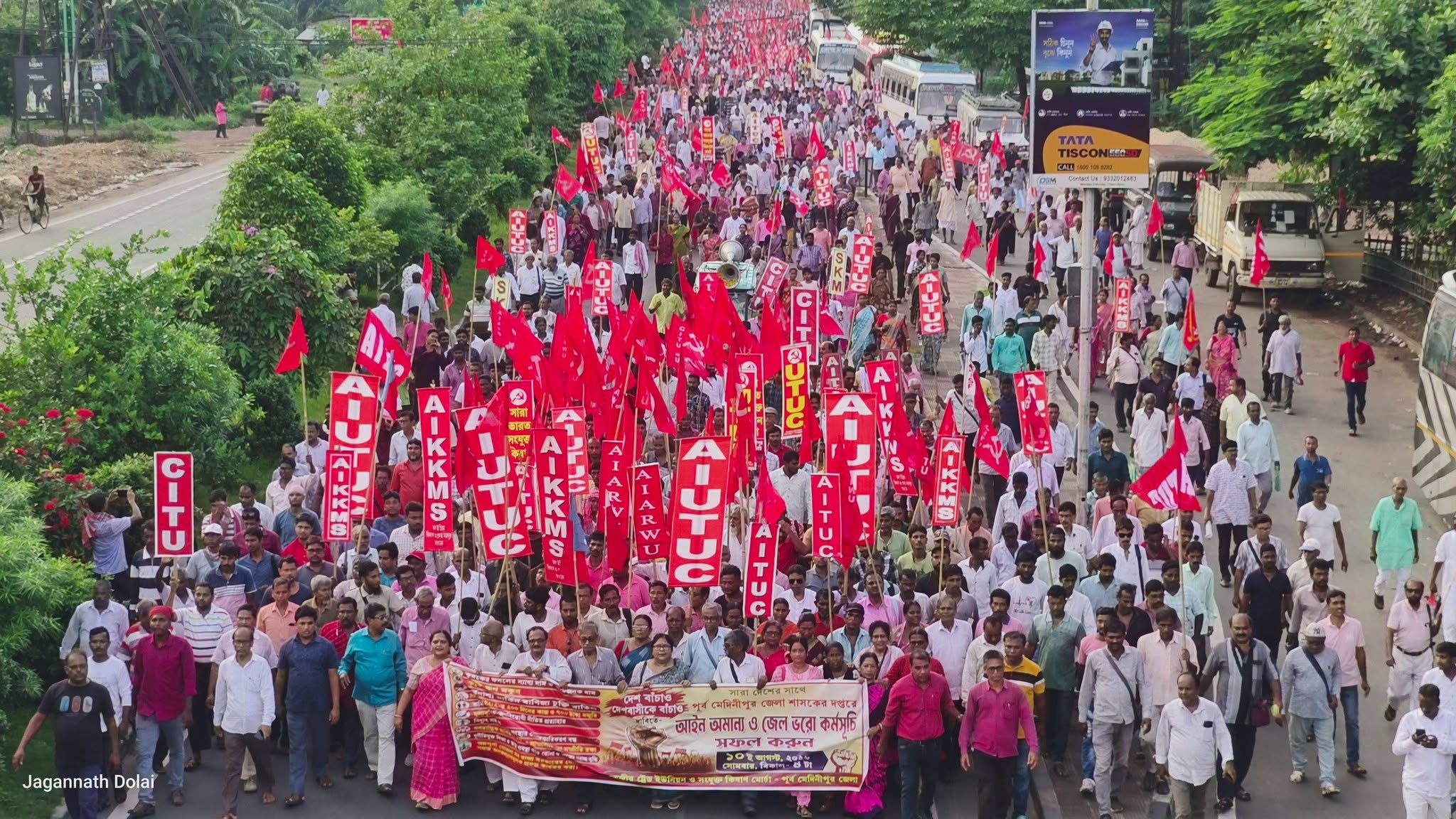
BARELY two weeks after relentless GenZ student protests shook the union government and forced the resignation of Union Education Minister Dharmendra Pradhan, the working class across West Bengal delivered an unequivocal message on Monday, August 10 – democratic resistance in India has entered a decisive counter-offensive phase. Coinciding with the 84th anniversary of the historic Quit India Movement, over one lakh workers, peasants, agricultural labourers, and other sections of the poorest of poor poured onto the streets across 29 designated hubs in 22 districts of the state. Responding to a joint call by the Samyukta Kisan Morcha (SKM), Central Trade Unions, and fraternal mass organisations, the working class transformed the 'Jail Bharo' (Civil Disobedience) program into a massive explosion of accumulated public anger against the anti-worker and anti-farmer policies of the BJP-led Central government. According to organisers, over 61,000 protesters courted arrest across West Bengal, bravely facing police lathi-charges, tear gas, barricades, and violent attacks by ruling-party thugs.
MASS DEFIANCE
In the state capital, thousands of workers, students, youth, women, and unorganised sector labourers assembled at Subodh Mullick Square, holding high the portraits of Netaji Subhas Chandra Bose and Shaheed Bhagat Singh to invoke India’s revolutionary anti-imperialist legacy. Prior to the main rally, a procession of street hawkers marching from Burrabazar’s Canning Street was ambushed by armed thugs who descended from a vehicle in a bid to intimidate the participants. Undeterred by provocative insults and physical assaults—which left five hawkers hospitalised, including Md. Farooq and Md. Shoaib—the movement pressed forward without yielding an inch. Led by CITU All India Vice-President Tapan Sen, CITU State President Anadi Sahu, and State General Secretary Ziaul Alam, alongside leaders like Debasish Roy, Sukhranjan Dey, Kamruzzaman, and Somnath Bhattacharya, the massive mobilisation breached two layers of heavy police barricades past Wellington Square. When halted near S.N. Banerjee Road, thousands courted arrest on the spot in a disciplined show of civil disobedience before being released later in the evening.
STATE-BACKED VIOLENCE
High drama and state-backed repression unfolded across the suburban districts, where administrative machinery clashed directly with mass anger. At Ghari More in Chinsurah, Hooghly district, thousands marching from Akhan Bazar toward the District Magistrate's office broke through two heavy police barriers before being subjected to an unprovoked, brutal police lathi-charge at the third barrier, which injured dozens of workers and women activists. Former CPI(M) MLA Amjad Hossain was forcibly detained alongside several others, while police blocked over 40 activist vehicles at the city entrance to choke the mobilisation. Later in the afternoon, during a peaceful protest meeting at Akhan Bazar condemning the police violence, bike-borne thugs armed with iron rods vandalised the stage, destroyed sound equipment and tore down red flags, injuring CITU Hooghly District Secretary Tirthankar Roy and 12 other activists. Despite police lathi-charges in Polba Amarpur, Arambagh witnessed a massive rally from Netaji More to the SDM office, culminating in a prolonged sit-in that paralysed local administrative functions.
The momentum of civil disobedience resonated with equal severity in North and South 24 Parganas. In North 24 Parganas, thousands marched from Shethpukur Maidan toward the Barasat District Magistrate's office, overcoming administrative intimidation at every turn. Blocked near Barasat Hospital on Jessore Road, a gridlock spanning over a kilometre ensued, leading to the police detention of 32 key leaders, including Palash Das, Gargi Chatterjee, Sayandeep Mitra, and Somnath Bhattacharya, who were subjected to deliberate administrative harassment by being driven across district borders before being released. In South 24 Parganas, Diamond Harbour turned into a massive arena of resistance as two large rallies converged on the Sub-Divisional administrative building, breaking through dual-layered administrative barricades where over 15,000 protesters courted arrest amidst scorching heat under the leadership of Sujan Chakraborty and Samik Lahiri.
INDUSTRIAL BELT
The agitation swept through Nadia, Howrah, and the Midnapore belt with explosive intensity, uniting industrial workers with agrarian communities. In Krishnanagar, over 5,000 protesters led by Sreedip Bhattacharya overthrew barriers to court arrest at the Collectorate. In Howrah, massive rallies from Howrah Maidan to the DM office brought M.G. Road to a complete standstill, while in Uluberia, 5,000 activists courted arrest as Kisan Sabha leader Paresh Paul exposed the corporate takeover of 110 out of 134 FCI godowns amid collapsing farmgate prices for essential crops. In East Midnapore, thousands assembled at Nimtouri More, defying heavy deployments of RAF and police to break through barricades. West Midnapore saw 10,000 people court arrest at the DM office after breaking open the main gates following a rally led by State Kisan Sabha President Meghnad Bhuiya, even as armed thugs attacked participants traveling from Kestopur, injuring five agricultural labourers and vandalising 13 homes in Krishnapur village in a desperate attempt at retaliation. In Jhargram, a sit-in led by Parth Yadav and Pradeep Kumar Sarkar forced the immediate, unconditional release of seven arrested leaders.
NORTH BENGAL
North Bengal similarly witnessed high-voltage confrontations between demonstrators and law enforcement machinery. Dual processions merged at the Jalpaiguri DM office, clashing directly with police and central paramilitary forces after the main administrative gates were locked to prevent entry. The police arrests of prominent local leaders like Pinku Das and Arnab Sarkar prompted enraged crowds to surround police vans, bringing the transport of detainees to a halt before being addressed by Mayukh Biswas and other senior figures. In Siliguri, CPI(ML) Liberation State Secretary Abhijit Mazumdar was arrested while leading civil disobedience on the streets, while in Asansol, CPI(M) leader Comrade Minakshi Mukherjee was detained alongside dozens of activists during widespread blockades that paralyzed the industrial core of the region.
THE 11-POINT CHARTER
The statewide civil disobedience movement was anchored in a comprehensive 11-point charter of core socio-economic survival demands that articulated the deep structural distress of the working people. These demands included the immediate repeal of the four anti-worker Labour Codes, a legal guarantee of Minimum Support Price (MSP) for all agricultural crops based on the Swaminathan C2+50% Formula, the immediate withdrawal of the Electricity Amendment Bill, the repeal of the Seed Bill 2025, a statutory guarantee of 200 days of work annually under MGNREGA at a daily wage of Rs 700, a statutory minimum wage of Rs 26,000 per month for all workers across organised and unorganised sectors, Rs 25 lakh compensation and comprehensive loan waivers for farming families suffering severe crop losses, protection of state financial autonomy by increasing the states' share in the Central Divisible Tax Pool from 31 per cent to 50 per cent, the immediate restoration of all eligible voters excluded during the Special Intensive Revision (SIR) exercise, a total halt to the privatisation of PSUs and public assets, strict price control on essential commodities, and the immediate filling of all vacant government posts.
In a joint press statement issued following the day’s actions, SKM leaders Amal Haldar, Kartik Pal, Meghnad Bhuiya and Paresh Paul declared that the civil disobedience movement has established an unprecedented benchmark for working-class and peasant unity in the state. Issuing a stern ultimatum to the Central and State administration, the leadership warned that if the 11-point charter of demands is not resolved within three months, the working people across the nation will launch an indefinite, full-scale movement starting November 26, 2026, marking a historic escalation in the country's socio-political landscape.


