Partition, Politics and June 20
Samik Lahiri
IN recent years, a concerted political effort has been made to establish June 20 as ‘West Bengal Day’ and to project Syama Prasad Mookerjee as the founder of West Bengal. Political appropriation of history is not new, but any historical event must be understood in its full context. Therefore, examining the validity of the narrative surrounding June 20 is essential.
The politics of dividing Bengal did not begin in 1947. During colonial rule, the British repeatedly attempted to weaken Bengal’s political and cultural strength. The Partition of Bengal in 1905 was a major example. Though presented as an administrative measure, its real objective was to weaken Bengali nationalism and create divisions between Hindus and Muslims. The people of Bengal resisted through the ‘Swadeshi movement’, ‘Rakshabandhan’, cultural protests, and economic boycotts.
One of the principal inspirations behind this movement was Rabindranath Tagore. He emphasised that Bengali identity rested on language, culture, and shared social life rather than religion. At his call, ‘Rakshabandhan’ became a symbol of unity against communal division. Through songs such as ‘Banglar Mati Banglar Jol...’ and ‘Amar Sonar Bangla…’ he reinforced the idea of Bengal’s cultural unity. Ultimately, the British government was compelled to revoke the partition.
Yet the politics of division continued. During the 1930s and 1940s, communal politics grew stronger. The Muslim League’s two-nation theory and the Hindutva conception of politics, both sought to make religion the basis of political identity. As a result, the broader ‘Bengali’ identity rooted in common language and culture came under increasing pressure.
When the British withdrawal from India became imminent, the question of partition assumed central importance. On February 20, 1947, British Prime Minister Clement Attlee announced that power would be transferred to Indian hands. Lord Mountbatten subsequently advanced the timetable and announced his plan on June 3, 1947. That plan effectively determined the partition of both India and Bengal. Therefore, the session of the Bengal Legislative Assembly on June 20 was not the moment when Bengal’s partition was conceived; it was part of the formal implementation of a decision already taken.
This is the central historical fact often obscured in contemporary political campaigns. The decision to partition Bengal had already been made before June 20. The Legislative Assembly merely voted on the framework that had already been established.
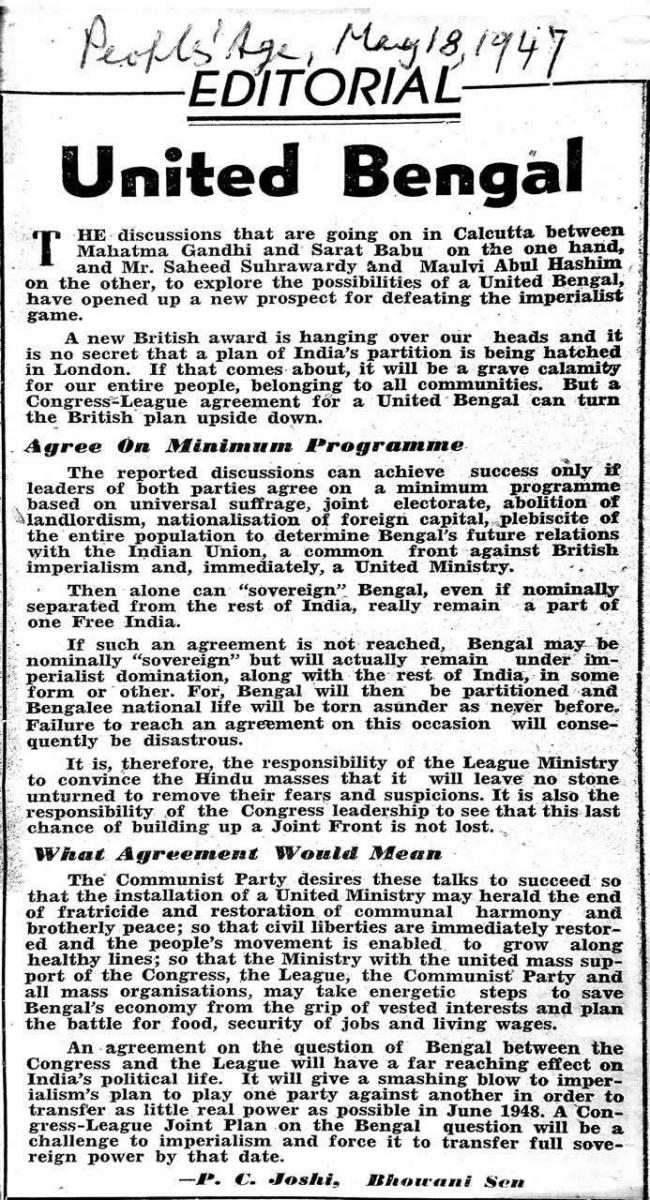
It is also important to remember that many prominent Bengali leaders opposed partition. Sarat Chandra Bose, Abul Hashim and others advocated a united Bengal. They believed that partition on religious lines would weaken Bengal economically, socially and culturally, while undermining the shared identity of its people.
The Communist Party of India also long supported the idea of a united Bengal within a united India. Communist leaders argued that imperialist interests favoured partition because it would weaken Bengal politically. However, by June 1947, political circumstances had deteriorated drastically. The Muslim League wanted the whole of Bengal to become part of Pakistan, while Hindu communal forces actively campaigned for partition. Under these conditions, the Communists argued that no population should be compelled into a state structure against its will. Consequently, Communist legislators voted in favour of partition, while maintaining their opposition to the partition of India as a whole.
The voting of June 20 is often presented today as though it reflected the direct will of the people. In reality, there was no referendum. The future of nearly 5.5 crore inhabitants of undivided Bengal was decided by only 250 legislators elected under a highly restricted franchise system. Ordinary Bengalis were never directly consulted on whether Bengal should be divided. Therefore, the partition of Bengal cannot legitimately be portrayed as a popular democratic mandate. The Communist position was clearly reflected in a joint statement issued on June 19, 1947 by Communist legislators Jyoti Basu, Ratan Lal Brahman and Rupnarayan Roy, which was published in the Communist daily ‘Swadhinata’. The statement argued that the Mountbatten Plan had effectively foreclosed the possibility of a sovereign united Bengal and warned against any course that would further embitter Hindu-Muslim relations. It maintained that the incorporation of the whole of Bengal into Pakistan against the wishes of the non-Muslim majority areas of western Bengal would amount to coercion. Consequently, the Communist legislators announced that they would vote for partition so that no unwilling population would be forced into a political arrangement against its will.
The Communist legislators thus supported partition not as an ideal solution but as a response to an already existing political reality. As Jyoti Basu later observed, the Party opposed the partition of India but lacked the strength necessary to prevent it. This historical context is important when examining contemporary efforts to portray Syama Prasad Mookerjee as the sole architect or founder of West Bengal. Historical evidence does not support such a claim. In the voting on June 20, as many as 58 legislators from the western part of Bengal voted for partition. The overwhelming majority were Congress members. Syama Prasad Mookerjee was only one participant in a much larger political process. Presenting the creation of West Bengal as the achievement of a single individual is therefore historically erroneous.
His political role during British rule also remains a matter of debate. During the Quit India Movement of 1942, Mookerjee was serving as Finance Minister in the Bengal government. In a letter dated July 26, 1942 to then Governor John Herbert, he argued: “Anybody, who during the war, plans to stir up mass feeling, resulting in internal disturbances or insecurity, must be resisted by any Government...” “The question is how to combat this movement in Bengal? The administration of the province should be carried on in such a manner that…this movement will fail to take root in the province.”
These statements are self-explanatory and expose his betrayal role in the freedom movement of India. Netaji Subhas Chandra Bose was also a sharp critic of communal politics. In his diary ‘Leaves from a Diary’, Syama Prasad Mookerjee himself had written: “Subhas once warned me in a friendly spirit, adding significantly, that if we proceeded to create a rival political body in Bengal, he would see to it (by force if need be) that it was broken before it was really born. This I found to be the most unfair and unreasonable attitude to take on.” Whether one agrees with Bose’s language or not, the episode illustrates the depth of his opposition to communal political mobilisation. It is therefore ironic that organisations whose ideological predecessors often maintained a complicated relationship with the anti-colonial movement seek to question the contribution of Communists to India’s freedom struggle. The history of Bengal’s prisons, detention camps and the Cellular Jail in the Andamans bear testimony to the sacrifices made by Communist activists and future Communist leaders.
Muzaffar Ahmad, one of the founders of the Communist movement in India, and Abdul Halim played major roles in organising workers, peasants and students against colonial exploitation. Their efforts in building trade unions, peasant organisations and anti-imperialist movements helped create a powerful democratic current in Bengal. Many revolutionaries who had participated in the freedom struggle later joined the Communist movement. Ganesh Ghosh, Kalpana Datta (Joshi), Subodh Roy, Hare Krishna Konar and Satish Pakrashi, among many others, spent years in British prisons, including the Cellular Jail. During imprisonment many came into contact with Marxist ideas and later became active in Communist politics. Through them, a historical bridge emerged between the revolutionary tradition of the anti-colonial struggle and the worker-peasant movements of the Left.
This tradition contributed significantly to the growth of trade union movements, peasant organisations, campaigns against communalism and the historic Tebhaga movement of 1946–47. These developments remain an important chapter in Bengal’s political history.
Another common claim is that Kolkata remained part of West Bengal solely because of Syama Prasad Mookerjee. Historical records tell a different story. The Congress, the Hindu Mahasabha and several other organisations all regarded Kolkata as indispensable to the viability of West Bengal. As Bengal’s principal port, industrial centre and administrative capital, its inclusion was considered essential by virtually every major political group. Consequently, assigning exclusive credit to a single individual, is nothing but blatant distortions of the historical record.
A further question follows: Can June 20 genuinely be considered the birthday of West Bengal? Historically, the answer is ‘No’. The boundaries of West Bengal on August 15, 1947 were not the same as those of the present state. Cooch Behar joined West Bengal in 1950, Purulia was added in 1956, and further territorial adjustments occurred through the India-Bangladesh enclave exchange in 2015. The modern state evolved through multiple historical processes extending far beyond June 1947.
Most importantly, the partition of Bengal carried an immense human cost. Few crores were displaced and transformed into refugees. Families were separated. Agriculture, industry, trade networks and social relations suffered enormous disruption. Bengal lost much of its natural economic unity, and the consequences of that rupture continue to shape the region even today.
For this reason, the partition of Bengal cannot simply be celebrated as a triumph. It remains a painful and complex historical event. It reminds us that division on religious lines does not resolve social and political problems; it often creates new ones.
The strength of Bengal has never rested on division. It lies in its language, culture, humanism, rationalism and pluralist traditions. The legacies of Rabindranath Tagore, Kazi Nazrul Islam, Jibanananda Das, Sukanta Bhattacharya, Satyajit Ray, Ritwik
Ghatak and Amartya Sen all emerge from that larger cultural inheritance. Even East Bengal ultimately rebelled against Pakistan on the question of language, demonstrating once again that linguistic and cultural bonds are often stronger than religious identities. The Language Movement of 1952 and the Liberation War of 1971 reaffirmed this truth.
Therefore, rather than converting June 20 into an instrument of contemporary political mobilisation, it is more important to understand the history of Bengal’s partition in all its complexity. The purpose of history is not to create myths but to uncover truth. And the truth is that the partition of Bengal was a tragedy whose lessons continue to demand reflection, vigilance and historical honesty.


