Vinod Kumar
The struggle of Haryana’s rural sanitation workers in May 2026 stands out as one of the most significant working-class movements in the state in recent years. Around 10,500 rural sanitation workers have been employed across Haryana since 2007, with one worker serving approximately every thousand residents in rural areas. Most of these workers belong to the Valmiki community, and more than 20 per cent are women. Their labor ensures basic sanitation services in hundreds of villages across the state.
Since 2016, these workers have been organised under the banner of the Centre of Indian Trade Unions (CITU). Through continuous struggles, the Rural Sanitation Workers’ Union has emerged as a militant and respected organization of workers in Haryana. For years, the workers have been demanding regularisation of their jobs, pension benefits, and a dignified wage structure. Despite performing essential public services, they have remained deprived of job security, social protection, and legal safeguards.
BACKGROUND TO THE STRIKE
The BJP government repeatedly ignored the workers’ demands and failed to implement agreements reached through earlier negotiations. This persistent neglect created widespread anger among sanitation workers. The successful strike of urban sanitation workers, organized by the Municipal Employees’ Union from May 1 to May 14, further inspired the rural sanitation workers to intensify their struggle.
Strong bonds of solidarity had already developed between rural and urban sanitation workers through joint campaigns and movements. Rural sanitation workers actively supported the urban workers’ strike, organising solidarity actions across the state. What began on May 15 as a solidarity action soon developed into an independent statewide strike of rural sanitation workers. The movement spread rapidly to 120 out of Haryana’s 143 blocks, drawing support even from organisations not affiliated with CITU.
THE NARWANA MAHAPADAV: A TURNING POINT
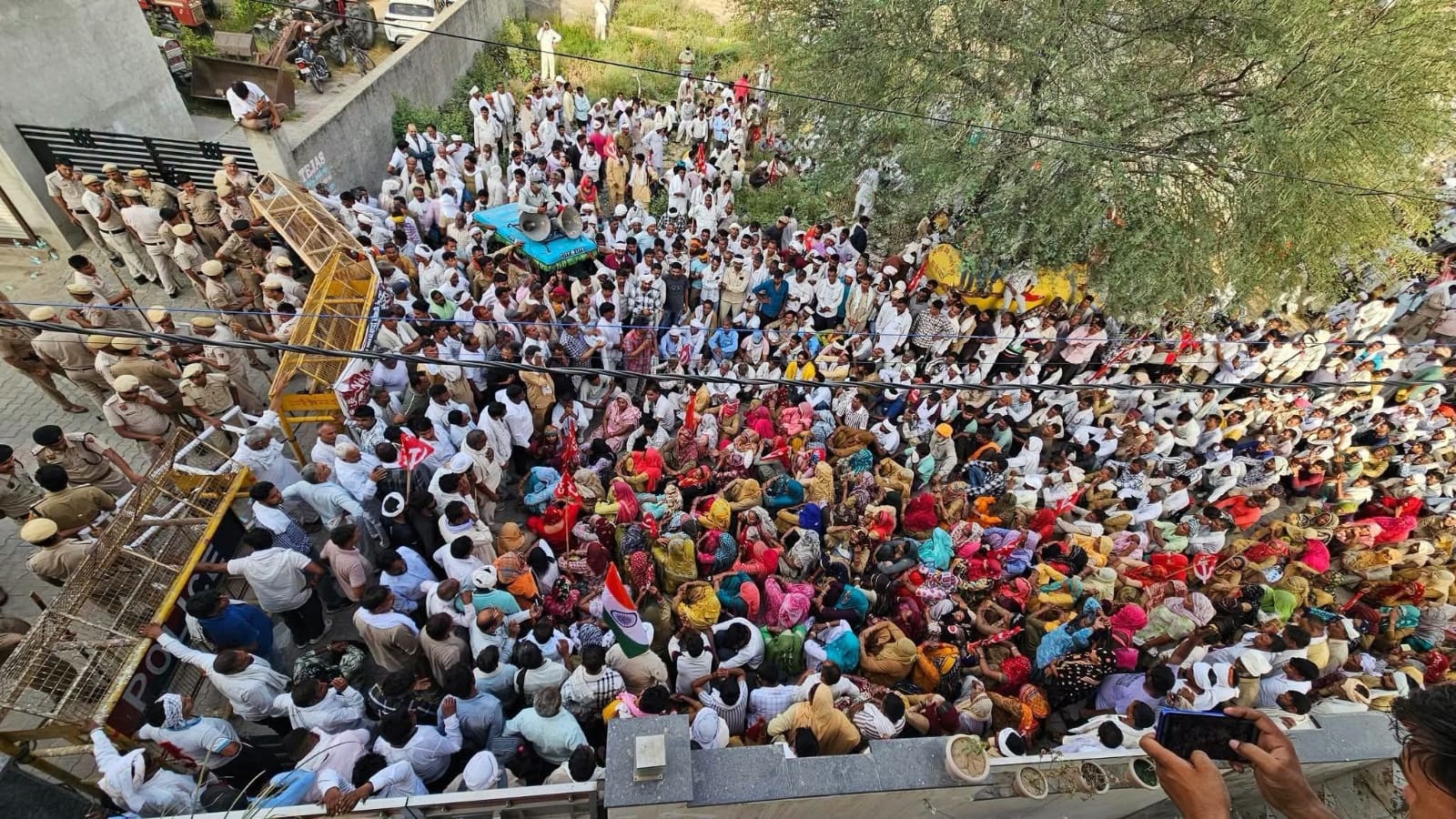
In the midst of the strike, the union organized a two-day Mahapadav (mass sit-in) on May 24–25 in Narwana, the constituency of Social Welfare Minister Krishna Kumar Bedi. Nearly 6,000 workers from all 23 districts of Haryana participated.
Workers were particularly angry with the minister because the BJP had projected him as a leader of the Valmiki community while failing to address the concerns of sanitation workers. Before the 2024 Assembly elections, the BJP had mobilised Dalit voters through campaigns around DSC reservation and promises of welfare measures. These efforts contributed significantly to the party’s electoral success and Bedi’s elevation to the state cabinet.
On November 24, 2024, during a state-sponsored Maharishi Valmiki Jayanti celebration chaired by Bedi, Chief Minister Nayab Singh Saini announced a monthly wage of Rs 27,000 for urban sanitation workers and Rs 26,000 for rural sanitation workers. This was one of the workers’ principal demands. However, six months later, during a Sant Kabir Jayanti function on June 11, 2025, the Chief Minister stated that the Rs 26,000 wage would be implemented gradually by 2029, beginning with an increase of Rs 2,100. Even this increase was never granted, fueling widespread resentment among workers.
Another major issue was the government's refusal to implement a Punjab and Haryana High Court judgment delivered on December 31, 2025. The court ruled that employees who had completed ten years of service should be regularised and paid ten years’ arrears with 6 per cent interest. The order was to be implemented by February 28, 2026, but the government failed to comply.
These developments exposed the gap between the BJP government's claims of supporting Dalits and its actual treatment of sanitation workers.
MASS MOBILISATION AND MINISTER’S GHERAO
Despite extreme heat and inadequate facilities, the Mahapadav witnessed remarkable participation and determination. The gathering was chaired by Union President Basau Ram and addressed by several union and CITU leaders, including Union General Secretary Vinod Kumar and CITU Haryana General Secretary Jaibhagwan.
When no meeting with the Chief Minister was arranged, thousands of workers marched to the minister’s residence and staged a gherao. Faced with mounting pressure, the minister requested 72 hours to facilitate negotiations. The workers responded by announcing a march to Kurukshetra, the Chief Minister’s home district, while continuing their strike.
The All India Kisan Sabha (AIKS), Jind district, demonstrated class solidarity by providing tea and refreshments to the participants throughout the Mahapadav.
THE 50-KILOMETRE MARCH
On May 26, sixty-two activists began a padyatra (march) from Narwana after paying tribute to Dr. B.R. Ambedkar. Temperatures reached 48°C, yet the marchers remained determined.
Because the decision to launch the march was made suddenly, logistical preparations were limited. Workers often marched without adequate food and water, relying on support from sanitation workers and villagers along the route. Despite hardships, the march continued with enthusiasm.
In Kaithal, workers affiliated with CITU and the Sarv Karamchari Sangh welcomed the marchers, showered flowers upon them, and arranged meals and accommodation.
As the march advanced, participation grew steadily. By May 28, around 300 workers, including 35 women, had joined. Workers from distant districts brought food and supplies, strengthening the movement further.
GOVERNMENT ATTEMPTS TO DISCREDIT MOVEMENT
Alarmed by the growing momentum of the struggle, the government and its supporters launched a campaign of misinformation. False claims were spread on social media alleging that Union General Secretary Vinod Kumar was neither a sanitation worker nor a member of the Valmiki community.
Cartoons portraying Vinod Kumar and Municipal Employees’ Union leader Naresh Kumar as puppets of the Congress Party and former Chief Minister Bhupinder Singh Hooda were circulated. Even a Facebook page named “Safai Karmiyon Ki Awaaz” was reportedly manipulated to spread confusion. However, workers effectively countered these attacks and remained united.
HISTORIC NEGOTIATIONS AND SETTLEMENT
As workers’ anger and participation continued to grow, the Haryana government was compelled to negotiate. On May 29, a delegation of union leaders met Panchayati Raj Minister Krishna Lal Panwar, Social Welfare Minister Krishna Kumar Bedi, Principal Secretary to the Chief Minister Yashpal Singh, Additional Chief Secretary Vijayendra Singh, and Director General Anish Yadav.
The negotiations lasted more than three and a half hours. Out of 18 demands submitted by the union, agreements were reached on 17. The major gains included:
· Action toward regularisation in accordance with the High Court judgment.
· Commitment to implement the Rs 26,000 monthly wage.
· Annual wage increments.
· Uniform allowance of Rs 6,000 and washing allowance of Rs 1,500.
· Increase in tool allowance.
· Advance assistance of Rs 24,000 for food grain purchases.
· Employment for a family member in case of death due to accident or illness under ex gratia provisions.
· Group insurance coverage.
· Payment of wages deducted during the 51-day strike of 2023 and the 15-day strike of May 2026.
· Retirement benefits.
· New recruitment of sanitation workers.
· Promotion of sanitation workers as supervisors.
· TA/DA payments for election-related duties.
SIGNIFICANCE OF THE STRUGGLE
The victory of Haryana’s rural sanitation workers is not merely a settlement of economic demands. It is a powerful example of how collective organisation, class solidarity and militant struggle can compel governments to respond.
Workers endured extreme weather, administrative obstruction, and organised misinformation campaigns, yet remained united and determined. Their struggle forced the government to negotiate and concede to most of their demands.
On May 30, during a statewide workers’ assembly held on the occasion of CITU Foundation Day in Rohtak, participants warned that if the agreement was not implemented within a month, they would return to the streets with renewed strength.
This movement stands as an inspiring example of the power of organized workers and the importance of sustained collective struggle in defending the rights and dignity of labor.


