Badal Saroj
Ironies don’t always have to be in absurdities, they can also manifest in contrasts, mirror images. The images are of Pakistan and India. Pakistan, the country about which no one has any illusion of being a secular country or an inclusive democracy, was restoring the names of different places. In Lahore, orders were being issued to rename Sunnat Nagar as Sant Nagar, Islam Nagar as Krishna Nagar, Babri Masjid Chowk as Jain Mandir Chowk, Rahman Gali as Ram Gali, Mustafabad as Dharampura and Maulana Zafar Ali Khan Chowk as Laxmi Chowk. And here, in India, the declared secular, democratic union of states, a court was giving a ruling to convert the 700-year-old Kamal Maula Mosque into a temple forever. The order of the Indore Bench of the High Court in the Kamal Maula Masjid-Bhojshala case of Dhar district of Madhya Pradesh is as if the conclusion was reached earlier and the “arguments” in favour of this conclusion were gathered or interpreted later.
On May 15, Justice Vijay Kumar Shukla and Justice Alok Awasthi of the Madhya Pradesh High Court delivered the verdict on six different writ petitions keeping the petition of the Hindu Front for Justice at the centre and accepted most of the arguments of this main petitioner. Through this verdict the court declared the archaeological monument in question as Saraswati temple. At the same time, the continuously re-issued orders since last 90 years of allowing to offer prayers on Tuesday and namaz on Friday were revoked. The court also gave several instructions to the government and the Archaeological Survey of India (ASI) for the conservation of this building, management, Sanskrit teachings and to make efforts to bring back the idol of Saraswati kept in the British Museum. On the lines of the Ayodhya case of the Supreme Court, the verdict also states that “in order to do full justice to both the parties and to secure the religious rights of Muslims, they must be given land in Dhar by the district administration for the construction of a mosque if they raise demand for it.”
This 243-page verdict of the Indore High Court can neither be called a judgment nor justice: it neither properly addresses nor resolves the issue under consideration. Its base is neither the evidences which lead to the truth without any doubt and nor the rules and regulations laid down by law. At the same time, since this verdict can become a precedent which can be used in the future, it is a cause for concern.
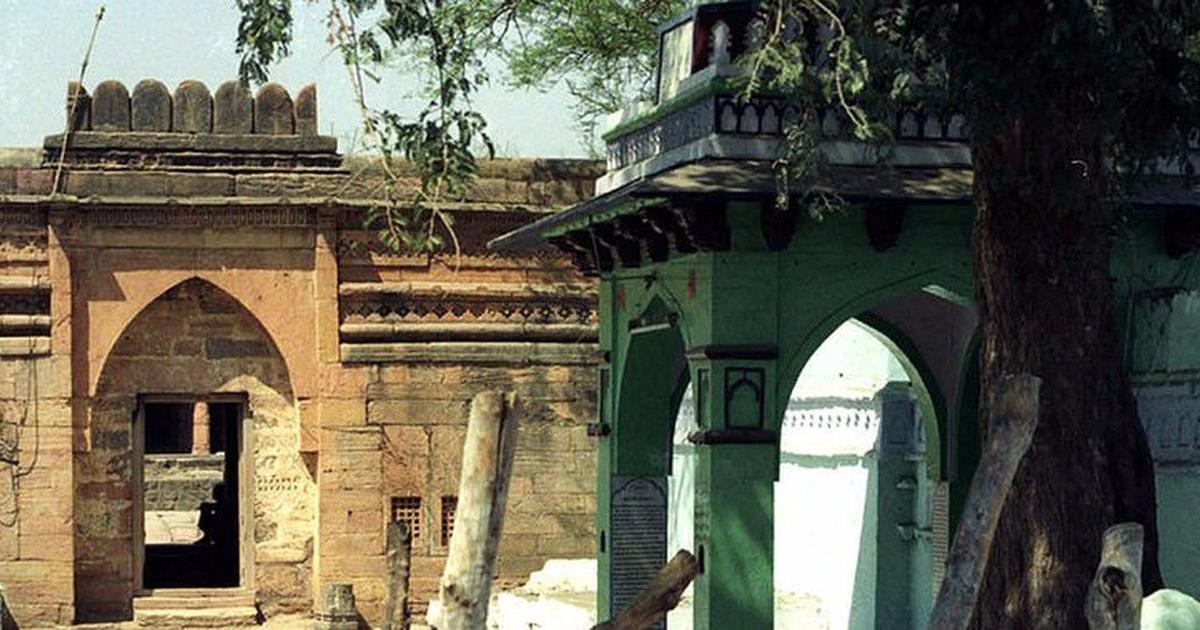
The history of Kamal Maula Mosque is not of today. It has been in existence for centuries in the name of Sufi saint Kamaluddin Maula Malvi, a disciple of Baba Farid. It was built in 1331. It is recorded in the inscription on this building that it was repaired in 1392-93 by the Subedar of Malwa – Governor Dilawar Khan Gauri. This means, it existed before him. Akbar during his reign passed from here in1598, Jahangir in 1617 and Aurangzeb in 1684-85. Whenever it was mentioned in the historical documents including the records of their visits, it was in the form of Kamal Maula Mosque. The architecture of this building and style of construction does not have any reflection of temple. Temple does not have mihrabs or minarets, they are not as high as theirs.
In the history of these 700 years, before the year 1903, no one has ever said that there was a Saraswati or any other temple here. This first started in 1903 when then ASI Director K N Dixit saw a statue in the British Museum and described it as Saraswati. However, there were also references which say that the statue had Jain goddess Ambika written on it and was made by Jain sculptor Vararuchi. Similarly, the story of the address of the banquet hall being associated with this building is also not old. It was first mentioned in a British Gazetteer in 1906 as the ‘Hall of Bhoj’: The word ‘Bhojshala’ also means 'place' or place rather than 'school'.
This shows that instead of accepting the written and documented history of 700 years, the appearance of this monument has been changed on the basis of assumptions of some people expressed just 120 years ago. These assumptions are also being interpreted partly and incomplete, in some cases arbitrarily. For example, a description of this idol as Saraswati made by some C P Lele in 1903 was taken into consideration as evidence but that description has one more important mention about finding this idol in old city. This part was not accepted. Whereas, in the old Dhar city, there are both palaces and schools. There are many such examples of this flawed verdict, it is enough to take stock of only a few of them.
For example take the material used in the construction of the building. The High Court has blindly believed the petitioners’ claim to accept them as evidence, even though the use of the ruins of old buildings is a common practice. But still, this reusable material has nothing to do with Saraswati or her worship. Whatever writing is found in Sanskrit or Prakrit language on the stones has as much to do with Jainism which has no history of being here. The inscriptions carved on the stones, which are claimed to be complex formulas of Sanskrit grammar, belong to the Jain tradition and are excerpts from a Jain drama prevalent in that period. This has also been reported by those who read and translated it from time to time.
Avoiding these facts the path which was chosen by the High Court through this verdict is even more worrying. The High Court says that Jain is not a separate religion, it is a branch of Hinduism. By coming to this remarkable conclusion, the learned judge of the High Court does not stop at declaring Masjid Kamal Maula as a temple, but also the oldest atheistic religion born and developed on this part of the earth. Jainism is also declared as a Hindu religion. Taking this theory forward, the court interprets the inscription 'Jain Vidyadevi' written on the statue of Ambika kept in the British Museum and says that the goddess of knowledge is Saraswati, so it is Saraswati. Whereas there is no Saraswati among the goddesses of Jainism. The presence of seekers and Tirthankaras seated under the statue in padmasana is considered normal on these grounds as the theory has already been formulated that Jainism and Hinduism are the same.
It seems that in this verdict, the petitioner has treated the Hindu Front as evidence of very interesting information and pseudoscience covered in superstition without any commentary or criticism. There are two or three paragraphs on the scientific nature of the consecration of idols, linking it to quantum science, and interestingly, it also uses a quote from Einstein.
The court said that in this case, they have come to a conclusion on the basis of archaeological and historical facts and principles established by the Supreme Court in the Ayodhya case. These 10 principles were put forward by the Advocate General of Madhya Pradesh during the hearing. The Ayodhya case was a dispute over the ownership of property, in which the Supreme Court had considered both the place of hidden idols in the mosque premises and the demolition of the Babri Masjid on December 6 as wrong and criminal acts. Even after this, what was the legal basis of the decision, DY Chandrachud, who later became CJI, told the people of his native village in Pune that "In the Ram Janmabhoomi-Babri Masjid dispute case, I sat in front of God and prayed to Him that some solution will have to be found.”
The Ayodhya case cannot be a basis because it itself is an exception. In 1991 only the Parliament of India has already passed the Places of Worship (Special Provisions) Act, 1991and the law of this part of the earth still remains the same. It provides in very clear terms that (except in the Babri Masjid-Ram Mandir dispute) "the religious character of any place of worship existing on August 15, 1947, shall remain the same as it was on that day." Also " if any lawsuit, appeal or other proceeding is pending before any court, tribunal or other authority about the place of worship existing on 15th August 1947, with the commencement of this act automatically be terminated. The appeal or other proceedings will not be accepted by any court, tribunal or other authority after commencement of this law. “
When the law says so, how did Justice Dharmadhikari order the survey again in2024? How was the writ petition of the Hindu Front for Justice regarding Masjid Kamal Maula-Bhojshala approved for hearing in 2022 and how was the verdict pronounced on it on May 15, 2026? Two things are worth noting: one, the role of the Chief Justice of the Supreme Court, he should have stayed the High Court's 2024 order to re-survey to determine its 'true form', but he allowed it in January 2026 with some safeguards. For this, a loophole contained in Section 4(3) of the Ancient Monuments and Archaeological Sites and Remains Act , 1958 was used. Which is nothing but procedural deception. One of the implications of the CJI's statement is that the Places of Worship Act prohibits civil litigation, not public interest litigations!! Such an interpretation is to render the 1991 Status Quo Act hollow and useless without removing it. In a time when the role of the courts is highly polarised and increasingly polarised, the role of the courts should not be reflected in the impact of political polarization, but unfortunately it does not appear to be happening.
In fact, it is part of a purely political project. All the petitioners, except the Muslim side, were either directly affiliated with the BJP or part of organisations affiliated to the Rashtriya Swayamsevak Sangh or RSS. This information has been recorded by the High Court itself while introducing the petitioners. In the introduction of one of them, the High Court has described him as "engaged in the task of preventing inter-faith marriages”: To assume that the act of obstructing such marriages is unconstitutional and criminal is not known to the Hon'ble High Court would be contempt of the court. Thus, the petitioners were BJP flag-bearers and so had a specific agenda. Now they will use the baton of this verdict delivered in the Kamal Maula Masjid-Bhojshala case and in the fog of such imagined history bring the possibilities of illumination of the future to apprehension.
This is the concern due to which appeals are being made to the central and state governments to challenge the Verdict in the Supreme Court. The courts are being urged to thwart any attempt to undermine the secularism which the Supreme Court has described as an immutable and fundamental part of the Constitution of India.
PS:
If it is called a coincidence, then it is indeed a very rare coincidence that just a day before the May 15 High Court order, the son of Justice Vijay Kumar Shukla, who wrote this order, was also issued to appoint him as a public prosecutor in the Indore bench of the Madhya Pradesh High Court. This has brought back memories of the coincidence of the appointment of the then Chief Justice to the Rajya Sabha in 2019 after the Ayodhya episode and the appointment of the only Muslim member of the five-member bench as the Governor.
Now what is to be done with coincidences, they are coincidences. But in matters of justice, it is repeatedly said that it should not be, it must be seen, and there is also a more than two thousand old saying that Caesar's wife should be above doubt.
Translated By Sandhya Shaily


