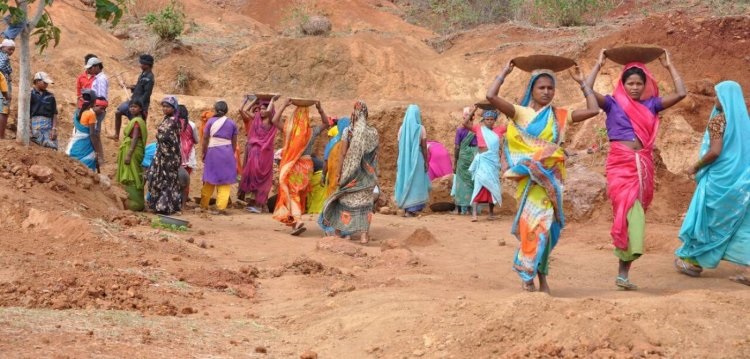
The Ministry of Rural Development has notified the implementation date for Viksit Bharat – Guarantee for Rozgar and Ajeevika Mission (Gramin) (VB-G RAM G). The notification is titled ‘Historic Commencement of VB-G RAM G.’ It is indeed historic in the way this act has been forcibly pushed through parliament and it is historic because it puts an end to the only nationwide demand drive scheme of guaranteed employment – the MGNREGA Act.
The notification is full of false promises just like the whole Act. It is an attempt to throw back the concerns raised by MGNREGA workers and unions into the trash bin by saying none of the concerns are true and that VB-GRAM G is an improvement on MGNREGA. The criticism of the Act and the propaganda peddled in this notification is already known to workers and activists. The 125 day promise is meaningless in substance as the BJP government is not even able to guarantee 55 days of work on an average. Use of technology like facial recognition and direct bank transfers has led to more deletion of job cards and legible workers instead of fixing the problems of corruption. There is a huge backlog of payments that has not been cleared and in some places for even more than a year. The notification is mute on the criticism of halting of work for two months as there cannot be any justification other than the fact that it is meant to reduce the bargaining power of agricultural workers.
An important thing to note is that the centre is making clear for the first time the division of allocations between the centre and the states. The notification reads, “Including the likely contribution of the States, the total programme outlay is estimated to exceed ₹1.51 lakh crore.” The centre, without consulting with the states, made an allocation in the central budget and now expects the states to fund 40% in proportion to the central allocation. This is against the principles of federalism and a complete centralisation of power. The centre has completely ignored the fact that there are many states without the financial capacity to fulfill this proportion. The states are already burdened due to the economic policies of the centre. While the central government goes on to make corporate friendly economic policies and allocations, it is burdening the states to provide for the social security schemes even when they are under severe economic pressures.
It is clear that the BJP government wants to shift the onus of a deteriorating employment guarantee scheme onto the state governments. This will severely affect how workdays are generated. As there is a weak central backing now, the states will hesitate in properly providing work to those who demand it. This is already visible in Andhra Pradesh and Telangana. According to the latest MGNREGA tracker released by the Delhi-based LibTech India for Andhra Pradesh, the total person-days of work declined by 23.2% year-on-year, falling from 2,422.84 lakh to 1,859.77 lakh. The contraction was broad-based: the number of registered households dropped by 6.1%, households that received work declined by 8.6%, the total number of workers fell by 10.1%, and the average number of workdays per household decreased by 16%. Most strikingly, the number of households completing the full 100 days of employment saw a steep decline of 57.6%, falling from 5.1 lakh to 2.16 lakh. Consequently, the proportion of such households nearly halved, dropping from 10.9% to just 5%.
While it is easy to see the shortcomings in the implementation of the employment guarantee, there are some more concerning figures that point towards a severely deteriorating situation of agricultural and rural workers. According to the latest National Crime Records Bureau (NCRB) report released in May 2026, 10,546 individuals in the farming sector, comprising 4,633 farmers/cultivators and 5,913 agricultural labourers, died by suicide in 2024. This shows the grim reality of agricultural and rural workers and small peasants and repealing MGNREGA will lead to a worsening in these figures.
The AIAWU has condemned this notification of the VB-G RAM G and restated its demands that agricultural and rural workers and their unions and associations are going to raise in the upcoming strike on 15 May 2026:
1. Roll back of VB-G RAM G and reinstating a strengthened form of MGNREGA.
2. This strengthened form must provide at least 200 days of work with a minimum wage of Rs 700 which should yearly adjust as per market inflation.
3. Roll back of the exclusionary technology for payments and attendance systems (recent addition being facial recognition for attendance leading to mass scale exclusions)
4. Empowering the Gram Sabhas to be a major stakeholder in MGNREGA works and its implementation throughout the villages.
The AIAWU has appealed to the agricultural and rural workers and unions, organisations and NGOs organising MGNREGA workers to join this strike/action of MGNREGA workers on May 15, 2026 and show this government that they see through the false promises and will not move an inch back until all demands are met.


