Azhar Moideen
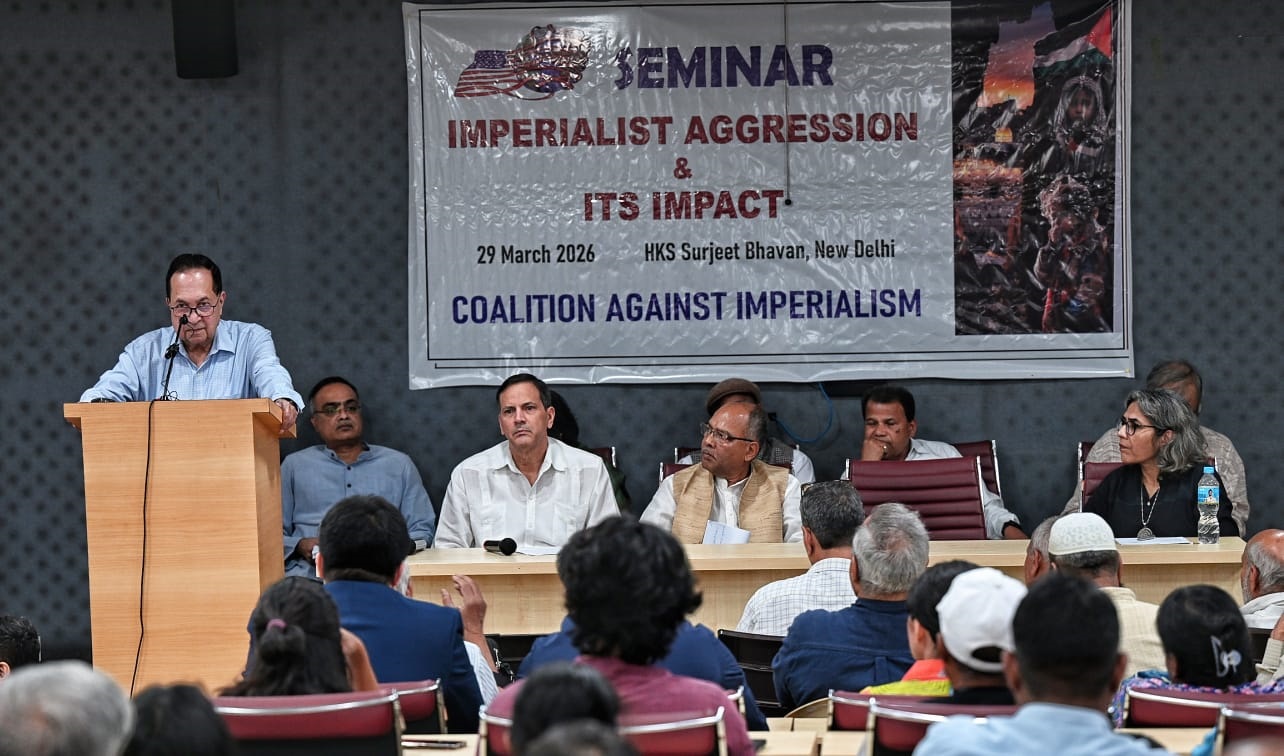
In a packed hall in Harkisan Singh Surjeet Bhawan, New Delhi, on 29 March, activists from Left parties and mass organizations, journalists, academics, diplomats, and a substantial number of students and youth had turned up to discuss and deliberate on “Imperialist Aggression & Its Impact.” The seminar, which was held by the Coalition Against Imperialism, was a timely reminder of the danger posed to humanity by imperialism and the perils of staying silent. The horror, shock, and numbness as a result of a quick succession of events over the last few months that have led to the loss of thousands of lives and untold misery in various parts of the world, the concern over shortages of gas cylinders and price rise, and the determined resolve to stand up and fight were all evident in the milieu.
After the mandatory fidgeting during the start of the seminar, the audience turned quiet soon after the speakers were introduced. Two of the most distinguished journalists of our times were present, the Cuban Ambassador was in attendance, the Palestinian Ambassador had sent a message to be read out, and there were representatives of many of the Left parties. Over the next couple of hours, imperialist aggression, rising resistance, and possible futures were discussed and deliberated.
CPI(M) Polit Bureau member presiding over the seminar, opened the discussion by recollecting the saying “We live in interesting times,” which is attributed to a Chinese proverb. “But these are not hopeful times,” he was quick to point out. These are times marked by wars, aggression, and instability across regions. The genocidal attack on Palestine carried out by Israel with the active support of the United States of America is not yet over. A ceasefire exists, but only in namesake, while attacks continue in Gaza and occupation intensifies in the West Bank.
After issuing threats and enforcing a naval blockade, in a blatant violation of sovereignty, the President of Venezuela and the First Lady were abducted. They remain incarcerated in the US on trumped-up charges based on lies, much like the lies that were used when George Bush and Tony Blair invaded Iraq. The war against Iran started with the ghastly attack on a school in Minab and the assassination of the Head of State. And now, the United States President says he’s ready to take over Cuba.
THE SHIFT IN FOREIGN POLICY
Senior journalist N Ram condemned the “brutal, unprovoked, fascistic war imposed on Iran, the violation of sovereignty, all tenets of international law, the United Nations Charter, and the horrific massacre of schoolgirls.” He noted that the very same president who came to power with the promise to end the endless wars had now bombed seven countries. However, much to everyone’s surprise, Iran had hit back and was now waging a war of attrition, striking military bases, assets, and data centres across West Asia and de facto closing the Straits of Hormuz, except for “friendly countries,” under their own terms.
However, despite the US effectively extending the war into India’s neighbourhood by attacking an Iranian frigate that was returning from India, India had chosen to stay silent. The foreign policy shift that began with Vajpayee, and most noticeably under Manmohan Singh after 2005, had now completely transformed. And the transformation was most visible in the deepening strategic partnership with Israel and the weakening of anti-colonial solidarity with Iran and Palestine. The nexus between domestic economic policies and foreign interests can explain this phenomenon. India has stayed mum even as the US has dictated where oil must be purchased from. India is now a subordinate ally of the United States.
OIL IS THE NEW OIL
Echoing Eric Hobsbawm’s Age of Extremes, Seema Chishti, the Editor of The Wire, referred to the current age as the “Age of Stupid Evil,” a time when “incredible absurdities are twinned with most incredible horrors.” She noted that crude resource extraction, naked aggression and belligerence, and rapacious 19th-century rhetoric of annexation brought out the centrality of material truths behind the ongoing wars: oil, food, fertilizers, lithium, and so on.
The battle of “isms,” the structured logic of the Cold War, and the “clash of civilizations” were no longer in play as a result of the “smarter” role played by China and the complexity in West Asia as a result of the role of the GCC countries. It was not the global majority vs the global minority either. In fact, the biggest betrayer was India under Modi, which had gone rogue on the question of Global South solidarity, with the attempt to become “the third wheel to the scooter that is US-Israel.” India had squandered the legacy of Bandung.
The role of tech platforms owned by the richest billionaires, who had now become both information enablers and enablers of war, has now brought more clarity to the nature of resistance that must arise globally: necessarily one against the “billionaire raj.” The political economy of the war was more visible now even among all the absurdities. And the lesson from Iran is that asymmetry, not playing by the rules, is the path to seek to strengthen solidarity and end the war.
THE ONTOLOGICAL NEED FOR HOPE
Prof. Sonya Gupta, former Director of the Centre for Spanish and Latin American Studies in Jamia Millia Islamia, talked at length on the rupture brought about by the Cuban and Venezuelan Revolutions in Latin America. She recalled the prophetic words of Simón Bolívar, who had remarked in 1829 that the United States appeared destined by providence to plague Latin America in the name of independence.
With the establishment of the Organization of American States, the US was in control of America, until the Cuban Revolution in 1959. The second such moment was the Bolivarian Revolution in the 90s. However, the people of both countries have now mobilized on the streets. Their resilience in the face of every trial brings out what Paulo Freire had talked about in Pedagogy of Hope: that hope is an ontological need. Hope, intertwined with political praxis, is needed to build solidarities.
CUBA WILL PREVAIL; SO, WILL PALESTINE
The Ambassadors of Cuba and Palestine let the audience know that their people had not let go of hope. “Every day, the Cubans now wake up to war and human suffering,” said Juan Carlos Marsan Aguilera, “but they have been preparing for more than 65 years for this very moment, in order to save and defend their sacred land.” “Trump has said he will take Cuba, but Cuba is not a piece of cake and cannot be taken,” he declared emphatically. Pointing out that more than 600 people had visited Cuba just last week, carrying solar panels, medicines, and essential supplies with them, he said that Cuba is not alone, that millions of committed people all over the world stand with them. He passionately proclaimed that Cuba will prevail.
In a written note, Palestinian Ambassador Abdullah Abu Shawesh recounted the history of his people and that of their struggle, right from the infamous Balfour Declaration. Pointing out that imperialism operates not just through military force, but through narrative, through the distortion of history, and through the manipulation of language, he exposed the complicit role of the media, “as dangerous as weapons themselves.” He warned that the consequences of the war are not confined to Palestine, or Cuba, or Venezuela, but that the current wars are potentially the beginning of a wider and more dangerous phase for humanity as a whole.
The leaders of Left parties, including the Communist Party of India (Marxist), Communist Party of India (Marxist-Leninist) Liberation, All India Forward Bloc, and Revolutionary Socialist Party, extended solidarity to the people of Palestine, Venezuela, Iran, and Cuba on behalf of the people of India. The leaders of Left parties, including Nilotpal Basu, Polit Bureau member of the Communist Party of India (Marxist), Raja Ram Singh, Lok Sabha MP and Polit Bureau member of the Communist Party of India (Marxist-Leninist) Liberation, Dharmendra Verma, Secretary of the All India Forward Bloc, and RS Dagar, Central Secretariat member of the Revolutionary Socialist Party, extended solidarity to the people of Palestine, Venezuela, Iran, and Cuba on behalf of the people of India. Declaring that the people of India have not bowed, even though their government might have done so, the gathering resolved that “the fight is both yours and ours; we will fight with you.”


