Samprikta Bose
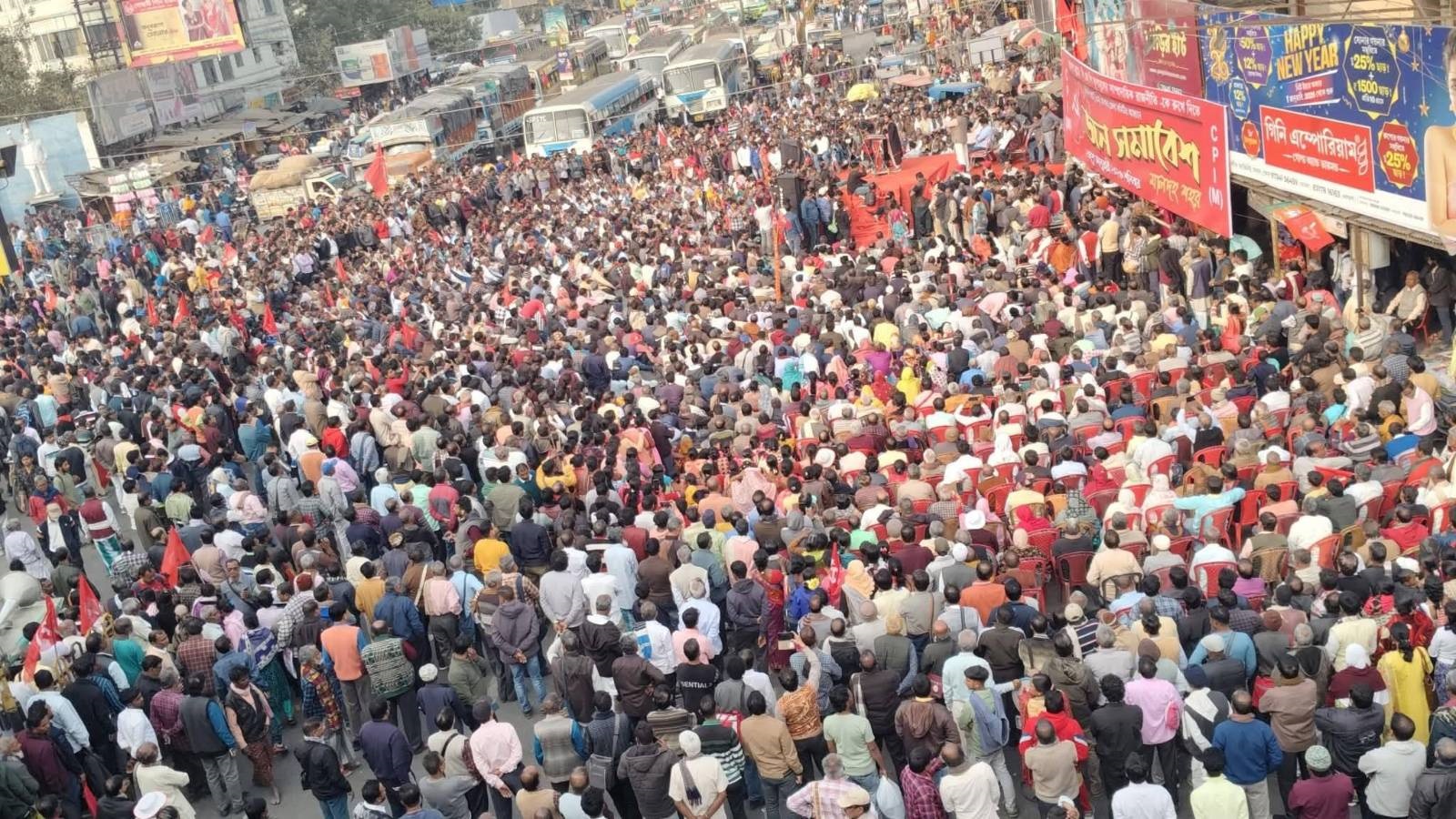
The political focus in West Bengal has shifted dramatically during the final week of January 2026. What began as a desperate administrative attempt to disrupt the CPI(M) rally in Malda escalated into a widespread, multi-district display of defiance. From the congested Malda flyovers to the 'martyr's soil' of Lalgarh, the Left Front's actions signal more than just a protest; they represent a solemn declaration of a struggle for democratic space in the lead-up to the forthcoming Assembly elections.
Sea of People
The Malda administration's refusal to permit a rally at the Brindabani Ground last Saturday backfired dramatically. Denied a conventional venue, an immense crowd effectively paralysed the town, with a sea of people overflowing onto and submerging the National Highway and urban flyovers, bringing the region to a complete standstill. Addressing the massive turnout, party state secretariat member Minakshi Mukherjee and state secretary Md. Salim delivered a powerful warning to the state administration. They declared that if the administration acts as a broker for the ruling party by denying a fair playing field, the Left will respond by mobilising directly on the streets. Meenakshi Mukherjee launched a stinging attack on the administration, accusing officials of acting as political "henchmen" and "brokers" for the TMC and BJP, rather than serving the public impartially. Her critique connected administrative obstruction to pressing public concerns, specifically citing the crippling microfinance debt borne by women and the halt of the 100-day work projects. Mukherjee charged that the administration was actively collaborating with the TMC to stifle public dissent, particularly by interfering with CPI(M)'s efforts to mobilise people against the heavy microfinance debt. Furthermore, she held the administration accountable for the stalled 100-day work projects, claiming it was operating as a pawn for both the TMC and the BJP. Mukherjee also directed her criticism toward the BJP, demanding an explanation for the targeting of migrant workers from Malda and Murshidabad in BJP-ruled states merely for speaking Bengali. Furthermore, she accused the BJP of exploiting the Election Commission to manipulate voter lists, thereby causing distress to ordinary citizens. She concluded her remarks by demanding an immediate halt to the "brokerage" activities being conducted by government officials.
SIR - War Against People
Md. Salim echoed this defiance, mocking the ruling party’s "Khela Hobe" slogan. "In this state, they talk about 'playing the game' when elections arrive, but they won't give us a field to stand on. Listen well—if you don't give us a field, the game will be played on the streets," Salim said to thunderous applause. He blamed the road blockade squarely on the administration and the "thieves sitting on the 14th floor" of Nabanna, the state secretariat.
The spirit of defiance seen elsewhere extended south into Birbhum on Sunday. At the Rampurhat College Ground, the focus shifted to what the Left is calling a "war against the people": the controversial Special Intensive Revision (SIR) of voter lists. Md. Salim launched a severe criticism of the Election Commission, alleging that the SIR process, which he termed an "RSS playbook" manoeuvre, was designed to disenfranchise the poor and minorities. This condemnation came amidst reports that nearly four lakh people in Birbhum alone were facing potential disenfranchisement due to issues such as "logical discrepancies" and "no-mapping." The rally highlighted the growing anger over the SIR process, with leaders questioning why the state government has failed to implement protective legislation, similar to measures passed in Tamil Nadu and Kerala.
‘Setting’ between TMC/BJP
The focus of the recent rally on January 28, was the historic Sajib Sangha Ground in Lalgarh, Jhargram. The event, held in a solemn yet defiant atmosphere, served as a tribute to 267 victims of past political violence. A significant moment underscoring the Left's efforts to reconnect with tribal communities was the presence of Chitamani Soren, mother of the late Comrade Salku Soren.
Reports from the Junglemahal region paint a grim picture of the government's policies, highlighting their severe impact. Key concerns include the exodus of 33,000 migrant workers from seven blocks in Jhargram, the forced closure of 72 tribal hostels, and the deterioration of vital infrastructure, such as the irrigation system of the Tarafeni reservoir.
Against this backdrop of decay, party leader Salim launched a strong critique, alleging a secret "setting" or hidden agreement between the TMC and BJP. As evidence of this clandestine partnership—which he claims is designed to shield high-profile individuals from prosecution—he pointed to the recent Padma Award given to the CBI officer who was in charge of the failed investigation into the brutal rape and murder of a young trainee doctor at R G Kar Hospital.
The escalating attendance and enthusiasm at meetings clearly signal the rising tide of public discontent. The "Red Flag"-led movement is strategically building a new coalition of the marginalized by linking the bureaucratic frustration of voter verification with the severe hardships faced by migrant labourers and women burdened by debt. As the renewed political tension charges the winter atmosphere in Bengal, the message echoing from the streets is unequivocal: not an inch of land will be surrendered without a fight.


