________________________________________________________________________________________________________
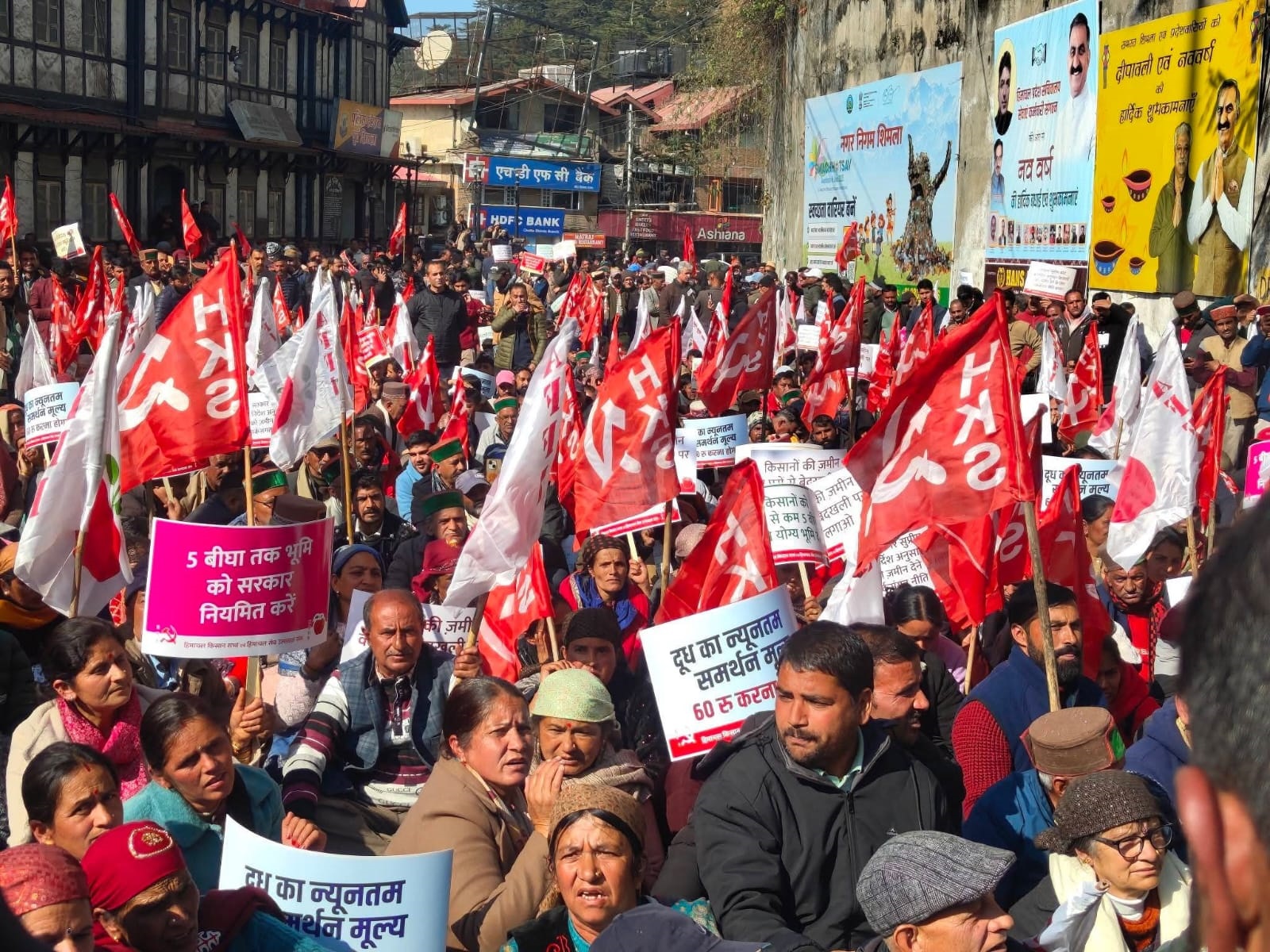
Thousands of apple growers in Himachal Pradesh gheraoed the state Secretariat, demanding the retention of high import duties, protection of land and forest rights, and safeguards for local livelihoods. They warned that proposed tariff cuts under trade agreements with New Zealand and the U.S. would give foreign producers an unfair advantage, threaten smallholder farmers, and destabilize the Himalayan apple economy that supports hundreds of thousands of families.
___________________________________________________________________________________________________________________________________________
On 19 January, thousands of farmers joined by apple growers from Himachal Pradesh, joined by other growers, gheraoed the state Secretariat to raise demands like stopping land evictions, implementing Supreme Court directives to formulate a policy for allocating land to farmers, enforcing the Forest Rights Act (FRA), restoring MGNREGA, and to oppose the central government’s proposed reduction of tariffs on apples and other fruits under ongoing free trade and bilateral agreements with countries such as New Zealand and the United States. The farmers demanded that import duties be retained at 100 per cent.
According to farmer leader Sanjay Chauhan, the Modi government has finalised negotiations with New Zealand on a Free Trade Agreement (FTA), under which the import duty on apples could fall from 50 per cent to 25 per cent. Tariffs on pears are set to drop to 16.5 per cent, while kiwis may attract zero duty. Simultaneously, talks with the United States on a Bilateral Trade Agreement (BTA) are reportedly in their final stages, with discussions underway to reduce apple tariffs to 25 per cent or even zero.
Rakesh Singha, President Himachal Kisan Sabha said that the government’s move to lower import duties on foreign apples threatens local farmers, who already face climate challenges and rising costs. “Instead of opening the market to foreign produce, the government should focus on strengthening domestic growers through targeted support, better infrastructure, and measures to enhance productivity,” he said. “Our farmers are the backbone of the Himalayan apple economy, and protecting their livelihoods must be a priority before allowing cheaper imports to flood the market.”
Sanjay Chauhan warned that if the government does not reconsider, they will mobilise growers in Jammu and Kashmir and Uttarakhand for a joint protest, including a march to Delhi. Over the next two to three months, apple farmers plan a decisive march to the capital to press the central government to scrap these trade agreements and exclude apples and all agricultural and horticultural produce from them.
What This Means for Apple Growers
The Centre’s decision to lower import duties on New Zealand apples from 50 per cent to 25 per cent for the April–August period, under the recently concluded India–New Zealand Free Trade Agreement threatens to destabilise India’s already fragile apple economy, particularly in the hill states where the fruit is not just a crop, but a way of life.
Unlike industrial goods, agricultural produce is governed by seasons. Indian apples are harvested between July and November, after which growers depend on cold storage and controlled-atmosphere facilities to sustain sales through the lean months. New Zealand’s harvest cycle, running from January to May, allows it to export fresh apples precisely when Indian farmers are forced to market stored produce. By halving import duties during this critical window, the Centre has effectively handed overseas producers a structural advantage.
The imbalance is not limited to timing alone. India is still in the early stages of adopting international apple varieties such as Gala, while New Zealand has spent over five decades perfecting these cultivars. With eight to nine times higher productivity and significantly lower production costs, New Zealand’s apple industry operates on a scale and efficiency that Indian growers-many of them smallholders in mountainous terrain-cannot hope to match in the short term. These countries produce apples using advanced machinery, receive significant state support, and incur costs that are about 50 per cent lower, leaving Indian growers at a clear disadvantage. Add to this the fact that the average Indian apple farmer cultivates just 0.40 hectares, compared with 50-plus hectare farms in New Zealand, the U.S., and the EU, backed by heavy subsidies. The result is competition that is far from fair-Indian growers are being asked to compete on an uneven playing field.
Global apple growing countries such as the United States, Chile and Italy, which together command over 40 per cent of world apple exports, are likely to seek comparative benefits. For apple-producing regions like Himachal Pradesh and Jammu and Kashmir, where livelihoods are deeply dependent on a single crop, the consequences would be severe and irreversible.
The Backbone of Himalayan Livelihoods
Trade agreements are necessary in a globalised economy, but they cannot be blind to domestic realities. Apples are not an interchangeable commodity for India’s hill states; they are the economic spine of rural communities with few alternative income sources.
India’s apple economy is far more than an agricultural statistic-it is the backbone of rural life in the Himalayan states. Of the country’s 28 lakh metric tonnes of annual apple production, nearly 70 per cent comes from Jammu and Kashmir, with Himachal Pradesh contributing another 5-6 lakh tonnes. Production in other states remains marginal, meaning that any adverse policy or market decision lands squarely on these two regions.
The human cost of disruption is enormous. In Kashmir alone, around 12 lakh families depend on apple cultivation and trade, an industry that generates nearly ₹30,000 crore each year. In Himachal Pradesh, apples sustain about 3 lakh families and add ₹5,000–6,000 crore annually to the state’s economy. These figures underscore a simple truth: when the apple sector is stressed, entire regional economies and livelihoods are put at risk.
Apples are the lifeline of Himachal Pradesh and Jammu & Kashmir, but growers face mounting challenges from erratic weather, reduced snowfall, dry spells, floods, landslides, and crop diseases like alternaria, scab, blight, and powdery mildew. After the 2023 floods, Himachal’s output fell 28% to 4.84 LMT, and although production rebounded in 2025, nearly 1 LMT of apples remained unsellable due to quality losses. Infrastructure disruptions, including blocked highways, further stranded trucks and hindered market access during peak harvest.
A tough struggle lies ahead for Himachal’s apple farmers. Falling import duties threaten to flood the market with cheaper, high-yield foreign apples, putting local incomes, livelihoods, and entire rural economies at risk. Without strong protections, decades of traditional knowledge and regional stability could be lost, leaving the Himalayan apple sector-and the families it sustains-vulnerable to forces far beyond their control.


