Sania Hashmi
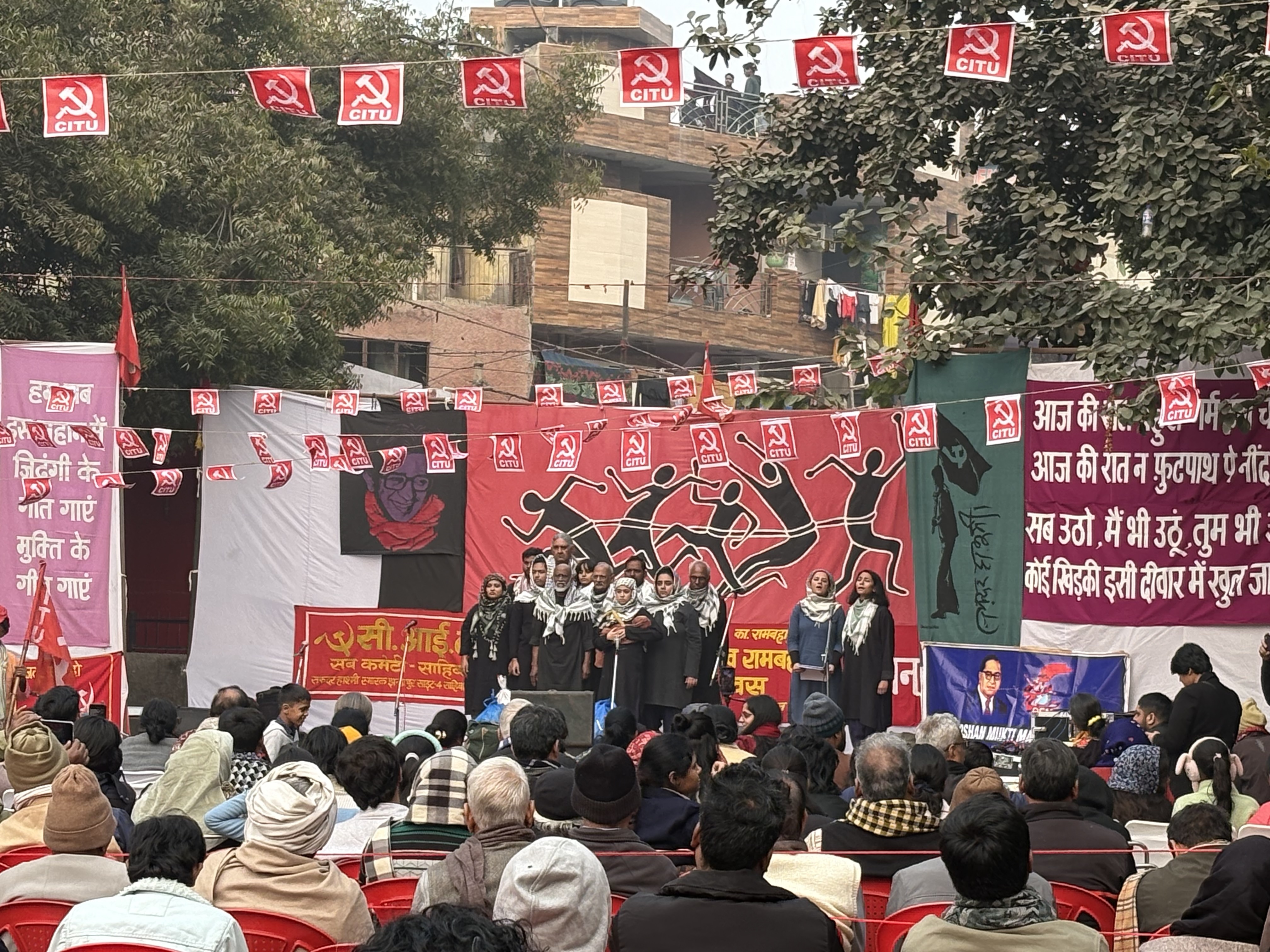
In the biting cold of January 1 this year, hundreds of local residents — women, men, and children alike — came together at Ambedkar Park in Jhandapur to honour the memory of Safdar Hashmi on the 37th anniversary of his martyrdom. Braving the harsh weather, they gathered not just to remember a man, but to reaffirm the values he lived and died for. Over the years, Safdar Hashmi has emerged as a powerful symbol of resistance and courage, inspiring generations beyond the cultural and artistic movements, and giving voice to all who continue to dream of an egalitarian, democratic, and oppression-free society.
For over three decades, Jhandapur has stood as a symbol of the shared struggle of workers and artists. That bond was violently tested on January 1, 1989, when Jana Natya Manch (JANAM) was performing Halla Bol in the Site IV Industrial Area of Ghaziabad, on the outskirts of Delhi. The performance was attacked by local hoodlums backed by the then ruling Congress party. Safdar Hashmi — JANAM’s founding member and convener — was brutally beaten, and Ram Bahadur, a migrant worker in the audience, was shot dead on the spot. Safdar died of his injuries the next day, January 2. He was 34.
Grief soon turned into collective resolve. On January 3, more than 15,000 people — artists, workers, students, professionals, political leaders, and ordinary citizens — filled the streets of central Delhi to join Safdar’s funeral procession.
In a remarkable act of defiance, Jana Natya Manch returned to the site on January 4 to complete the interrupted play. Since then, January 1 has been observed by JANAM and the Centre of Indian Trade Unions (CITU) as Safdar Hashmi Shahadat Divas. Safdar Hashmi’s killing became a turning point in the people’s cultural movement, where violence was met with resistance — and silence with song.
As always the programme started with farmer-artist Ratan Gambhir singing songs against capitalist and communal forces. The programme officially started with Ditsa from JANAM speaking about the history and significance of the occasion. Her introduction was followed by revolutionary songs by JANAM members and singer-composer Kajal Ghosh as an homage to Safdar Hashmi.
The songs were followed by a performance of Kacchi Chhat by the Bargad cohort. The play explores the idea of ‘home’ through memory, movement and reflection. The performance traces questions of where and what home feels like, beyond just a physical address. The play was thoroughly enjoyed by the audience at Jhandapur.
This year CPI(M) Polit Bureau member Mohammad Salim addressed the public meeting as the keynote speaker. The public meeting was presided over by the president of CITU Ghaziabad district committee Rajbir Singh. Apart from the keynote speaker, CITU leaders Siddheshwar Shukla, BS Chauhan and GS Tiwari also spoke briefly on the current situation in the country.
While recalling the attack on JANAM and paying homage to Safdar Hashmi and Ram Bahadur, Salim emphasized that the sacrifices of Safdar Hashmi in the struggle to liberate the working class from exploitation will never be forgotten, and that his ideas will continue to inspire generations of activists. He said that the past few years have marked one of the darkest periods in post-Independence Indian history. Inflation and unemployment have sharply increased, pushing millions into hunger and deep insecurity. Society, he noted, is being deliberately divided along religious lines, minorities are being targeted, and hatred is being systematically spread for political gain.
Salim pointed out that during the pandemic, the central government introduced four labour codes aimed at weakening workers’ rights. Sustained resistance by workers and the electoral setback suffered by the BJP in the last Lok Sabha elections delayed their implementation. However, following its recent controversial victory in the Bihar Assembly elections, the Modi government issued a notification on November 21, 2025 to implement all four labour codes. He said workers’ organisations across the country are preparing for a major struggle and stressed the urgent need for unity.
Recalling the historic farmers’ movement, he noted that farmers fought for 13 months against three anti-farmer laws, sacrificing over 700 lives before forcing their repeal. In the same spirit, workers continue to resist the labour codes designed to erode their hard-won rights. With the Constitution, democratic institutions, and the electoral process under serious threat, he called upon workers, farmers, youth, students, and women to unite to defend democracy and defeat communal and anti-people forces in power.
The meeting was followed by JANAM’s short presentation on Palestine, Filisteen ke Liye. The piece was created by JANAM in solidarity with the people of Palestine. It’s a choreographed piece which has poetry by Faiz Ahmad Faiz and Taufiq Riaz with music woven around stories of dispossession, destruction, struggle and resistance.
The programme ended with JANAM’s play, Bulldozer Raj. The play lays bare the violence behind the language of development. Set against the demolition of Delhi’s slums, it captures the everyday fear of eviction, displacement and resistance by the urban poor. The bulldozer becomes a symbol -- not just of force but of a state that wants to build a neo-liberal “smart city” by pushing its poor out. Ratan Gambhir’s songs brought the programme to a close.
Every year, on January 2, JANAM has a smaller, intimate meeting in which, along with a couple of JANAM members, some invited friends and comrades also recall their interactions with Safdar. This year Safdar ki Yaad Mein meeting had former Polit Bureau member Brinda Karat as the main speaker. She spoke about her association with Safdar, about his constant engagement with the workers. She also spoke about how there was a clarity of thought when it came to his politics and there was no wavering on the fact that he was a communist. Safdar was very fond of poetry, and JANAM organises a poetry reading session every year on January 3. This year, the theme was Poetry of Love, selection of poetry was done by Brijesh and Ditsa. The evening was full of poetry, music and was attended by friends of JANAM.


