Eshan Sharma
FOR a large community of artists, activists, students, workers and citizens in Delhi, January 1 has come to mean something very specific over the last thirty-six years. It is the day when people gather to remember Safdar Hashmi and to renew a collective commitment to the ideals he stood for. The Safdar Hashmi Memorial, organised every year since 1990 by the Safdar Hashmi Memorial Trust (SAHMAT), has become a significant event in the cultural and political calendar of the city. In the aftermath of Safdar’s death, artists and intellectuals from across disciplines came together to form SAHMAT. What began as a response to a brutal political killing soon evolved into one of the most sustained cultural collectives in the country, consistently defending secularism, democracy and freedom of expression. Over the decades, SAHMAT has intervened through performances, publications, lectures and, importantly, exhibitions that have responded sharply and creatively to the political moment.
The 37th Safdar Hashmi Memorial was part of this long tradition. Though there was no officially announced theme, the intent was unmistakable. At a time marked by aggressive communalisation and shrinking space for dissent, the programme reaffirmed SAHMAT’s unwavering position against communal politics and in defence of India’s secular and plural traditions. This has been central to SAHMAT’s work since its inception. SAHMAT’s exhibitions over the years have played a crucial role in shaping this cultural resistance. These exhibitions are never ornamental. They are interventions, responding to their times with urgency and clarity. In keeping with this legacy, the 37th memorial opened with a one-day exhibition titled Parcha: the Political Voice. The exhibition focused on the pamphlet as a political form, a medium historically used to document events, circulate ideas and counter dominant narratives. Curated by three young artists and scholars, Aban Raza, Shatam Ray and Vijender Vij, Parcha emerged from an open call that deliberately avoided social media. Instead, it travelled through conversations, emails and word of mouth, echoing older modes of political networking. The works on display addressed communal violence, state repression, labour struggles and disinformation. In an age saturated with digital content, the exhibition underlined the continued relevance of the printed word as a form of mobilisation and resistance.
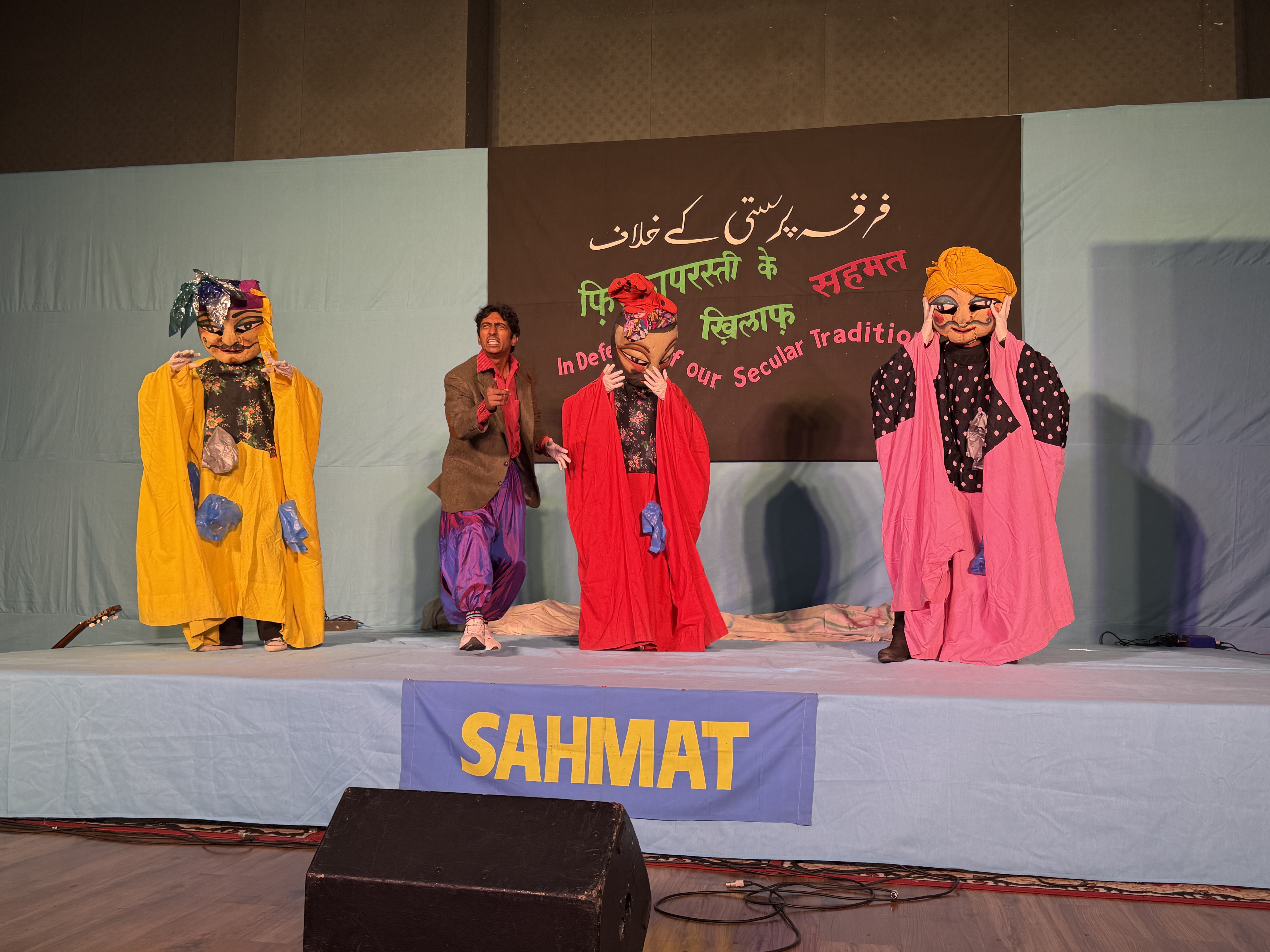
The day’s proceedings were anchored by Sohail Hashmi. As always, the memorial was not confined to remembrance alone. It was equally a celebration of Safdar’s life through music, theatre and dance. The day began as usual with a street play performance by Haryana-based Jatan Natya Manch. This was followed by Apurva Gauri, a young singer-songwriter, singing western pop songs from the 1960s and 1970s along with poems by Gauhar Raza. This was followed by a theatre presentation by noted puppeteer Dadi Padamjee’s Play Factory, titled ‘Dreams in the Dump’, a satirical play told through puppets that become the voices of sanitation workers. Ashish Ghosh and his group then presented Bangla Shakta Sangeet, tracing its origins to Ramprasad Sen in the eighteenth century, a period marked by social upheaval and transition. He was accompanied by Deepankar Das and Asim Banerjee. Ashish’s thunderous voice filled the audience with a renewed energy to speak up against injustice.
Poet Ashok Vajpeyi released SAHMAT’s annual calendar, designed by photographer Ram Rahman, dedicated this year to litterateurs and cultural personalities whose centenaries are being observed including writers like Mohan Rakesh, Shrilal Shukla, Harishankar Parsai among others. Vajpeyi also released a book designed by Rajinder Arora documenting 37 years of January 1 commemorations. The publication stands as an archive of SAHMAT’s sustained cultural work in Safdar’s memory. A revised edition of Rashtriya Andolan: Vichaardhara aur Itihas by historian Irfan Habib and a new edition of Balraj & Bhisham Sahni: Brothers in Political Theatre were also released.
Himanshu Joshi followed with a powerful unaccompanied vocal performance of Sufi poetry, including verses by Bulleh Shah. Deepak Castellino, a veteran guitarist and banjo player, then performed solo before joining Madan Gopal Singh and his group Chaar Yaar. Madan Gopal Singh reminded the audience that his group brings together people from different religious and social backgrounds. Their music embodied the secular ethos they spoke of, offering songs of resistance, solidarity and shared belonging. A striking dance performance by Priyakshi followed. Trained across classical, semi classical and contemporary forms, Priyakshi’s performance titled Nanga Kapda addressed violence against women and patriarchal oppression with intensity and clarity.
One of the significant aspects of this year’s memorial was the visible and deliberate foregrounding of young artists, many of whom are disciples of senior performers who have been part of SAHMAT’s journey for decades. It reflected an active process of passing on the legacy. Neil Khopkar, trained in the khayal tradition, sang Main Har Maa Ka Beta by Ghanshyam Soni, Aami Bhoy Korbo Na by Rabindranath Tagore, Sadho Dekho Jag Baurana by Kabir composed by Vidushi Neela Bhagwat, Chal Hansa by Kabir composed by Neela ji, and Bol by Faiz Ahmed Faiz composed by Neela ji. His performance carried forward a musical and political lineage shaped by his gurus, many of whom have been long associated with SAHMAT. He was followed by Shivangini Yeashu Yuvraj, a disciple of Shubha Mudgal, who sang compositions rooted in classical and folk traditions and rendered Punjabi poetry by Faiz Ahmed Faiz. Rutuja Lad, a disciple of Ashwini Deshpande, joined Shivangini for a joint rendition of a Faiz nazm and later concluded the evening with a vibrant Holi composition. Ending the programme with young voices was symbolic, underlining that SAHMAT is not only a space of memory but also of renewal.
Equally striking this year was the presence of a large number of young people in the audience. Students, first-time attendees and young cultural workers filled the auditorium, many standing through long stretches of the programme. For several of them, this was their first Safdar Hashmi Memorial. Their presence signalled that the ideas Safdar stood for continue to find resonance, and that the memorial is not a closed circle but an expanding one.
Over the years, the memorial has moved from Mandi House to the Constitution Club and now to HKS Surjeet Bhawan, but its spirit has remained unchanged. The camaraderie, the friendships, old and new, the shared food, books and posters, and the conversations that spill beyond the formal programme continue to define the day. Many in the audience spoke of attending the January 1 memorial since childhood, marking their own lives through it.
The Surjeet Bhawan complex that day carried a distinct energy. Banners designed by SAHMAT over the years, carrying sharp and urgent questions, adorned the space. Volunteers moved tirelessly to keep the programme running smoothly. Journalists, historians, poets, activists, artists and students mingled freely. In a city that often feels alienating, the Safdar Hashmi Memorial remains one of those rare occasions where people feel a sense of collective belonging.
As the evening drew to a close, people lingered. Thirty-seven years on, the Safdar Hashmi Memorial continues to affirm that culture can still speak truth to power, and that Safdar Hashmi’s legacy lives on. (END)


