Utkarsh Bhardwaj
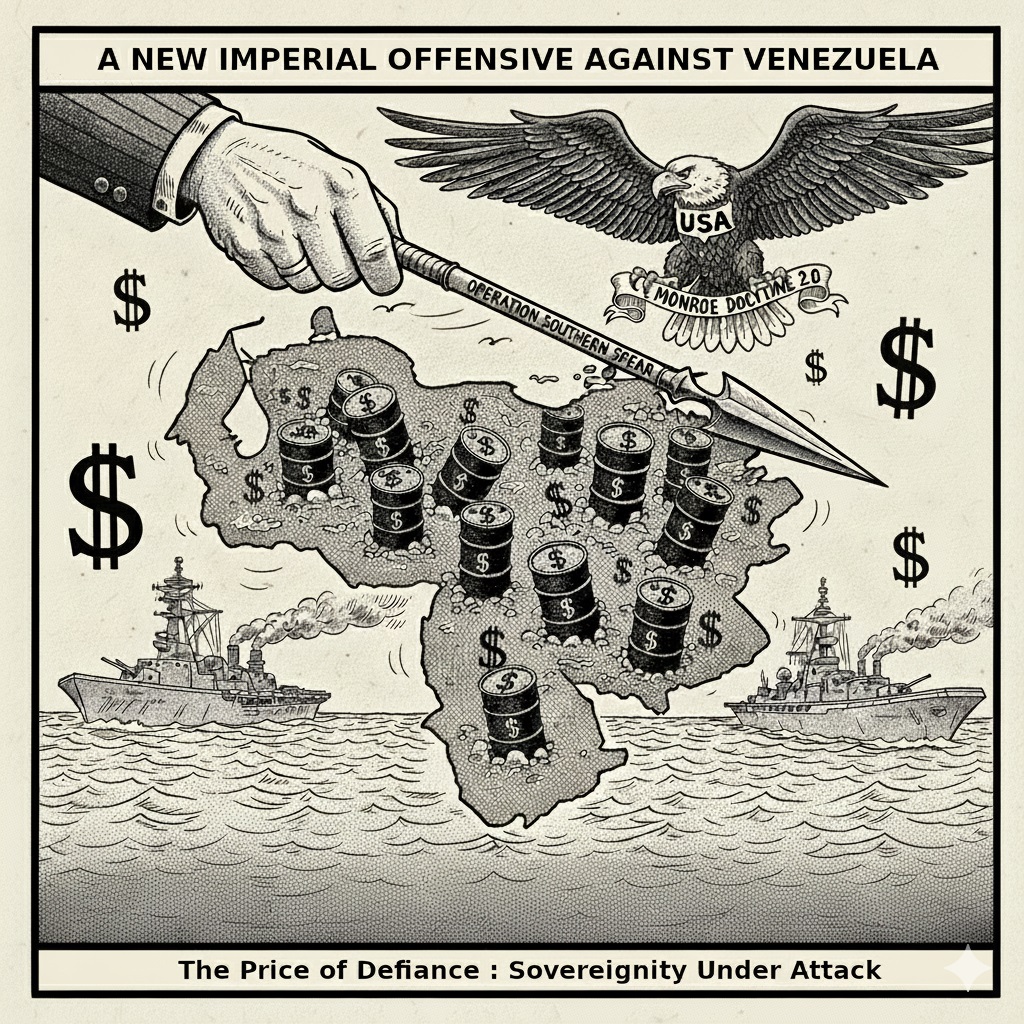
THE United States has opened yet another dangerous chapter in its long history of interventions in Latin America. Under the name “Operation Southern Spear,” Washington has launched a series of lethal strikes in the Caribbean and the eastern Pacific, backed by the largest US naval deployment in the region in decades. More than 80 people have already died in these attacks, most of them on small boats that the US claims were connected to drug trafficking. Needless to say, the claims were made without any evidence. We are seeing the revival of a familiar and deeply destructive imperial playbook and it would be a mistake to read it as another isolated act of military adventurism.
For Venezuela, this is not a new experience. Ever since Hugo Chávez initiated the Bolivarian Revolution more than two decades ago, the country has been subjected to sanctions, sabotage, coup attempts and economic strangulation. The US has pursued regime change with an obsession that cannot be explained by any of its stated reasons. Venezuela’s only “crime” has been to use its vast oil wealth to fund social programmes and challenge US dominance in its own hemisphere.
What has changed now is the level of open military pressure. And this escalation should be understood in the broader geopolitical context. The US ruling class sees its international position weakening. The deepening crisis of neoliberal capitalism, the wars in Ukraine and West Asia, and the rise of China and other developing countries have all shaken the foundations of US hegemony. In such moments, imperial powers have historically always turned to aggression to reassert their authority. Today is no different.
Washington’s actions in Venezuela follow a clear pattern: tighten sanctions, delegitimise the elected government, support hardline opposition figures promising wholesale privatisation, and use an invented pretext to justify military action. In this case, the pretext is the “drug war”, and it is not new. The drug narrative has been deployed across the world; from Plan Colombia to Duterte’s Philippines, this narrative has allowed states to carry out extrajudicial killings in the name of “security”. In Venezuela’s case, the claim collapses immediately under scrutiny. There is no significant flow of narcotics from Venezuela to the US. Even US authorities, when pressed for evidence, have failed to provide any credible link. The Drug Enforcement Administration or DEA is a US federal agency tasked with fighting illicit drug trafficking and distribution. It regularly releases a document called the National Drug Threat Assessment (NDTA). NDTA 2024 is a 57-page document which doesn’t have even a single mention of Venezuela. And in less than a year, Venezuela is suddenly such a grave threat that it requires the largest US military buildup that the region has seen in decades!
The USA has made numerous unsuccessful attempts against Venezuela employing almost all methods of regime change available in its playbook. Trump recently released a National Security Strategy 2025, that talks about ‘Predisposition to Non-Interventionism’, where a ‘high bar’ is required for a ‘justified intervention’. In this context, labelling of an elected leader of a sovereign country as a narco-terrorist should only be understood as an attempt to justify the ‘intervention’ that the US wishes to make in the region. Nothing can be more ironical when all this is happening at the same time when Trump has issued a pardon for Juan Orlando Hernandez, former Honduran President (and a strong ally of US imperialism in the region) who was serving a 45-year jail term for shipping over 400 tonnes of cocaine to the US.
Why then the sudden urgency? Part of the answer lies in what Venezuela possesses. It has the world’s largest proven oil reserves. Its public sector controls strategic industries that US corporations have long coveted. Leaked documents, public statements by opposition leaders, and the detailed investigative work of independent journalists show a striking consistency - the US-backed opposition has promised to sell off nearly every major public asset. One proposal by the Opposition leader and ‘Nobel Laureate’(!) María Corina Machado outlined the privatisation of more than $1.7 trillion worth of national wealth. The scale of this planned loot reveals the true agenda behind the current intervention.
But the story does not end with oil. Chávez’s and now Maduro’s governments represent something more threatening to Washington than resource nationalism alone. They symbolise a political project that rejects neoliberalism, redistributes wealth, strengthens public services, and encourages popular organisation. For Washington, the fear is not that Venezuela will invade a neighbour; the fear is that its experiment in sovereign development will inspire others. This fear has motivated US policy from Guatemala in 1954 to Chile in 1973, from Nicaragua in the 1980s to Bolivia more recently. Venezuela is part of that long line of countries punished for choosing their own path.
The timing of Operation Southern Spear is also revealing. As Russia, a key ally of Venezuela, is absorbed in the protracted conflict in Ukraine, the US sees an opportunity to reassert dominance in regions it once treated as its exclusive sphere of influence. It speaks volumes about how the stretching of the Ukraine war is serving US imperial interests, precisely because it diverts Russia’s attention and resources away from its allies. This has already been visible in events in West Asia, where Washington and its allies have attempted to revive regime-change projects. The case of Syria and the attack on Iran are two examples of the same project. Venezuela is the most recent target in this revived Monroe Doctrine for hemispheric control.
From the standpoint of international law, the US actions cannot be defended. The illegal strikes carried out under Operation Southern Spear fall under the category of extrajudicial executions as they killed individuals who were neither engaged in any hostilities nor were given any chance to surrender. The US government, like always, has acted entirely unilaterally. It yet again demonstrates that its much-repeated phrase “rules-based order” is nothing more than a convenient fiction.
Venezuela, for its part, has responded with restraint and has called for international solidarity. Despite years of sanctions and economic blockades, the country has shown remarkable resilience, rebuilding its economy through new links with China, Russia, Iran and other Global South partners. This very resilience is what frustrates Washington. The idea that a developing country can survive, and even recover, despite US pressure, is intolerable to an empire that insists on unquestioned obedience. And hence, the empire is trying to tighten its grip through force as developing countries are seeking alternative economic arrangements, exploring dedollarisation, and expanding South-South cooperation. The crisis of US capitalism drives imperialist expansion, and such interventions will only continue as this crisis deepens.
The implications of this intervention extend far beyond Venezuela. What is needed now is a broad, principled stand against this aggression. Imperialist wars ultimately undermine the working people of all countries, whether through rising fuel prices, economic dislocation or the strengthening of reactionary forces. It is essential that Left parties, trade unions, students, and democratic organisations in India add their voices. For countries like India, which have historically maintained a good relationship with Venezuela for over six decades, the destabilisation of the region will contribute to greater global volatility. India has a vital interest in defending Venezuela’s sovereignty and supporting a genuinely multipolar world order. India’s relationship with Venezuela has long rested on a quiet but firm foundation of South-South solidarity. From Hugo Chávez’s landmark visit to New Delhi in 2005 to the regular political consultations that have followed, the relationship has been marked by warmth, respect and the recognition that both countries stand to benefit from cooperation free of hegemonic pressures. The natural complementarity between the two economies gets demonstrated by the active participation of Indian public-sector enterprises like ONGC Videsh in different ventures of the Orinoco Belt. It is noteworthy that even private refiners such as Essar and Reliance have sourced Venezuelan crude oil for years. New Delhi and Caracas have often consistently aligned in defence of sovereignty and against unilateral sanctions, particularly in multilateral forums like the Non-Aligned Movement. For India, respecting Venezuela’s sovereignty is not only a matter of historical ties, but it strongly aligns with its foreign policy and energy security interests, as well as with its broader commitment to a world order built on equality, not coercion.
Venezuela’s struggle is connected to all peoples resisting imperial dominance. The defence of Venezuelan sovereignty is also the defence of a world in which no country, whether large or small, can be targeted for pursuing an independent path. It is our responsibility to stand with the people of Venezuela who have shown remarkable courage in the face of repeated attempts to subdue them. If the US wants to use Operation Southern Spear as a warning, through our solidarity we must ensure that it becomes an example that imperialism will not just be resisted, but defeated.


